Got a Low Performance Rating? What to Do Next
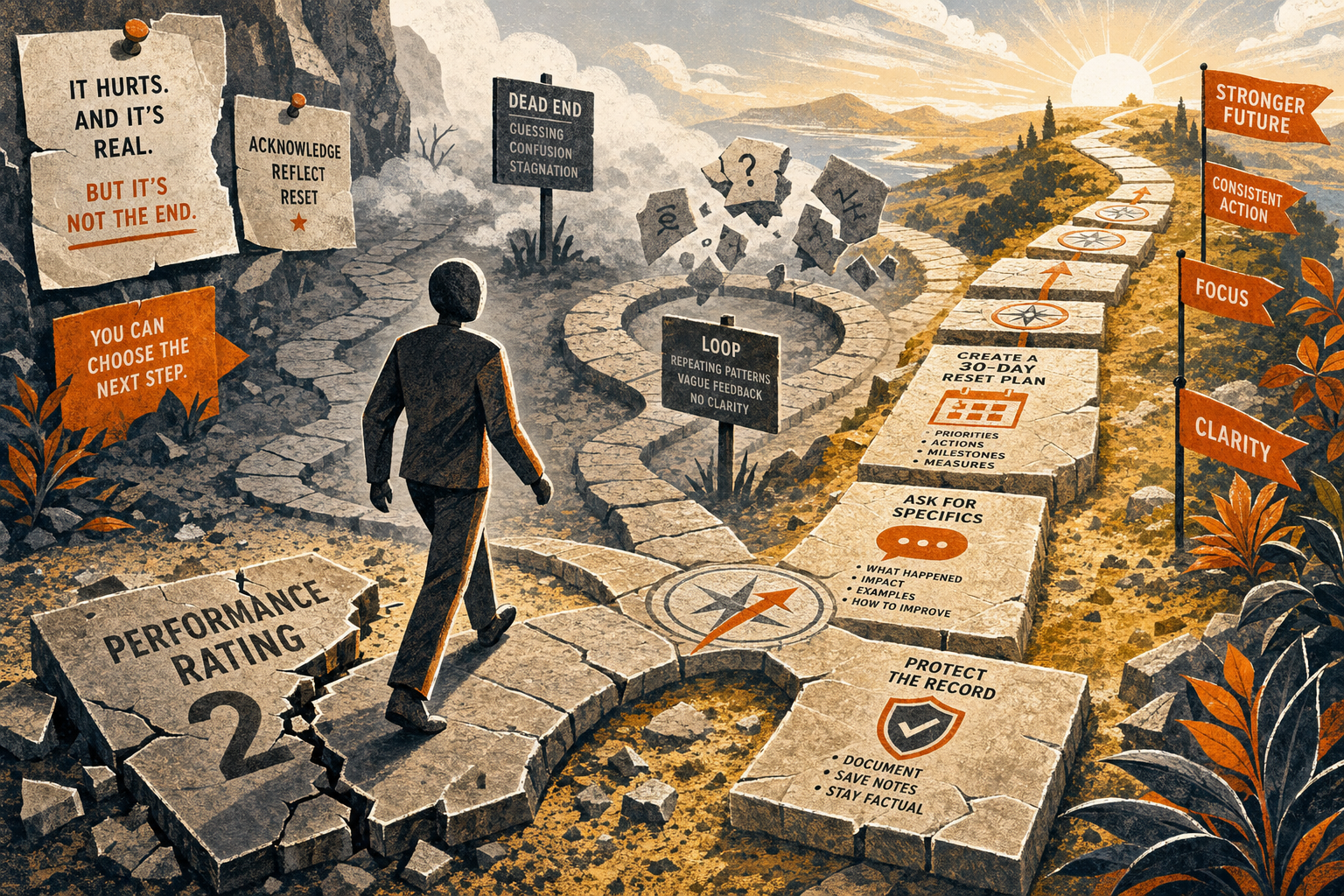
Got a Low Performance Rating? Don’t Waste the Next 30 Days
A low performance rating lands in a weird professional category.
You still have a job, so you feel almost silly for being upset. But you also know something changed. Your stomach drops on Sunday night. Slack pings feel loaded. Every meeting invitation starts to look like a trap. You replay the review in the shower, in transit, at 2 a.m., trying to decode whether this was a manageable setback or the opening paragraph of your exit paperwork.
That confusion is the real problem.
Plenty of people respond in one of two useless ways. They either turn the review meeting into a trial and argue every sentence, or they go quiet, feel ashamed, and avoid the topic while hoping good work will magically erase the impression. Both reactions make emotional sense. Neither gives you much protection.
Here’s the blunt version: a low rating is serious, but vagueness is often more dangerous than the rating itself. A bad review with crisp examples can be repaired. A soft, mushy review full of “needs more presence” and “should be more strategic” can follow you around for months because nobody ever pinned down what was wrong.
So that is the job now. Not to win the emotional case. Not to prove you are secretly excellent. Your job is to force a fuzzy story into plain language before it hardens into office folklore.
TL;DR
- A low rating is not automatically a written warning or a PIP, but it can become the basis for both when expectations stay muddy.
- Do not spend the review meeting trying to reverse the verdict in one dramatic speech.
- Get three things in writing: specific examples, business impact, and what “better” means over the next 30 to 60 days.
- Recovery usually looks boring. Fewer surprises. Cleaner communication. Earlier risk flags. More visible follow-through.
- The biggest signal to watch is not the rating itself. It’s what happens next. If feedback gets clearer, you may be fine. If expectations keep moving, treat that as a threat.
- Documentation matters because memory bends to mood, while written notes hold their shape.
First, stop catastrophizing — but stop minimizing too
A low rating is not the same as a casual piece of criticism in a 1:1. It is also not always a pre-firing ritual. People tend to flatten everything into extremes: either “this is nothing” or “I’m done.” Most of the time, neither is true.
What it usually means is simpler and more annoying: your manager, rightly or wrongly, now has enough concern to put it on the record. That affects how your work gets read from here. The same missed deadline that might once have been brushed off as a hectic week can now get interpreted as part of a pattern. Bonus conversations change. Promotion timing changes. The amount of patience around your mistakes often shrinks.
That does not mean panic. Panic makes people sloppy. It makes them overtalk, overshare, overpromise, and send emotionally charged messages they regret later. But minimizing is just as costly, because it leads to drift. “I’ll just keep my head down and do better” sounds mature; in practice, it often means nothing changes except your anxiety level.
The move this week is to name the situation accurately in your own head: this is a credibility problem, not a character verdict. Credibility can be rebuilt, but only if you treat it like something concrete.
Do not litigate the whole review in the room
The urge to defend yourself is immediate and physical. Your face gets hot. Your brain starts building exhibits. You remember the project that went well, the coworker who dropped the ball first, the fact that expectations were never clear, the months you were carrying too much with too little support. Some of that may be true. It still does not mean the review meeting is the place to fight every inch of it.
Most managers do not change a rating because someone made a passionate closing argument. What they remember instead is whether you stayed composed, whether you could absorb hard feedback without melting down, and whether you asked sharp questions. Fair? Not always. Real? Completely.
A better script is less satisfying in the moment and more useful later:
- “Can you walk me through the main examples that led to this rating?”
- “Which of these issues had the biggest impact on the team or business?”
- “If I were turning this around over the next 30 to 60 days, what would you need to see consistently?”
- “Are there one or two patterns you see as most important to fix first?”
Notice what these questions do. They drag the conversation away from taste, mood, and personality, and back toward events, impact, and expectations. That is where you want it.
If you already had the meeting and froze, spiraled, or got defensive, don’t waste energy being embarrassed about that too. Send a follow-up. Ask the good questions now.
Translate labels into behaviors or you will chase smoke
Most low ratings arrive wrapped in vague executive-sounding phrases.
“Needs more ownership.”
“Needs stronger communication.”
“Not operating strategically enough.”
“Needs more executive presence.”
Some feedback like this points to a real issue. A lot of it is lazy shorthand. Either way, you cannot improve against a slogan. “Be more strategic” is not a plan. It is workplace incense.
Your task is to convert every label into observable behavior.
If they say you lack ownership, ask: - Did I fail to raise blockers early? - Did I miss follow-through after meetings? - Did work sit too long without updates? - Did I leave loose ends for someone else to tie up?
If they say communication is weak, ask: - Were my updates too late? - Too long? - Missing a clear recommendation? - Did stakeholders leave confused about who was doing what by when?
If they say you need to be more strategic, ask: - Am I spending too much time executing without connecting work to priorities? - Am I bringing problems without options? - Am I reacting task by task instead of showing judgment about tradeoffs?
This matters because labels turn sticky fast. Once someone starts seeing you as “unreliable” or “not polished,” they unconsciously sort future moments into that bucket. Facts interrupt that. Facts can be corrected, tracked, and disproven.
Here’s a useful question to sit with tonight: if your manager had to explain your low rating to HR using only specific examples, what examples would they give? If you don’t know, that’s your first problem.
Send the follow-up note while the meeting is still warm
This is one of those small professional habits that saves people enormous pain.
After the review, send a calm recap. Not a manifesto. Not a wounded essay. Not a stealth rebuttal disguised as “just to summarize.” A recap.
It can be as simple as:
Thanks for talking this through today. I want to make sure I understood the main concerns correctly. My notes are that the biggest issues were X, Y, and Z, especially in relation to [project/team goal]. My understanding is that stronger performance over the next 30 to 60 days would look like A, B, and C. I’m going to focus on those areas and would appreciate any correction if I missed something important.
That note does three useful things at once. It shows professionalism when you could easily have gone moody. It gives your manager a chance to correct the record now instead of three weeks from now. And it creates documentation, which matters a lot more than people think when a situation gets worse.
Some readers resist this because it feels formal. Send it anyway. Memory is soft clay. A written summary is a brick.
Your Move: Draft the recap before the end of the day, even if you do not send it until tomorrow morning after a cooler reread.
Recovery is usually boring — that’s good news
When people get scared, they often become theatrically hardworking.
They volunteer for extra projects they cannot carry. They send five updates where one would do. They stay online late so everyone sees the green dot. They speak more in meetings without actually saying anything clearer. It looks like effort, and sometimes it even feels heroic. To a manager, it often reads as instability.
The better recovery plan is narrower and duller.
Pick two or three behaviors that are: 1. visible, 2. measurable, and 3. tied to the criticism you actually got.
Examples: - Hit deadlines you commit to, with no last-minute surprises. - Send a brief post-meeting summary with decisions, owners, and dates. - Raise risks 48 hours earlier than you think you need to. - Bring one recommendation, not just a pile of problems. - Close loops. If you say you will do something, send the confirmation when it is done.
This works because after a low rating, your manager is not looking for a personality transplant. They are looking for a steadier pattern they can trust. You are trying to replace “I’m not sure what I’ll get from this person” with “I know how this person operates now.”
Pick one stakeholder and send the cleaner update today. Not next week, not after you build the perfect system. Today.
Your results do not “speak for themselves” nearly as much as people claim
I dislike this advice because it flatters people while setting them up to fail.
In many jobs, especially early in your career, good work does not automatically produce a good reputation. Work gets filtered through visibility, timing, trust, and whether the people around you understand what they are seeing. You can do solid work and still look shaky if nobody knows the status, the tradeoffs, or the risk until the end.
That means part of recovery is making your work easier to read.
A weekly update can help a lot here if you keep it tight. Think: - top priorities, - current status, - risks or blockers, - what changed since last week, - where you need input.
Not a diary. Not a novella. A dashboard in sentence form.
This is especially powerful if the original criticism involved ownership or communication, because it gives people repeated evidence that you are paying attention, thinking ahead, and not hiding the ball. The emotional payoff matters too. When you are rattled, a simple weekly rhythm can stop you from spending every day wondering whether you are “doing enough.” It gives shape to the week.
Ask yourself: if someone looked only at your written communication from the next month, would they see calm control or frantic overcompensation?
Watch what the company does after the rating
This is where the real diagnosis happens.
A decent manager who wants you to recover usually becomes more specific after a low rating, not less. You should see clearer priorities, more direct feedback, examples that sound like actual work, and a shared picture of what improvement looks like. It may still feel uncomfortable. You may still dread those check-ins. But the path should get more defined.
When the path gets less defined, pay attention.
Bad signs include: - criticism with no examples, - expectations that change after you meet them, - support that disappears while documentation increases, - feedback that arrives only after the fact, never in time to correct course, - personality-heavy language like “not a fit,” “not polished,” or “low leadership energy” with no behavioral detail.
That is not coaching. That is a setup, or at the very least sloppy management with real consequences for you.
You do not need to become paranoid. You do need to become observant. Start keeping a simple private record: key feedback, examples given, goals discussed, and what you delivered. If things improve, great. If they don’t, you will be very glad you wrote things down while they were fresh.
A question worth asking after your next 1:1: are the rules becoming clearer, or am I being asked to hit a target that keeps walking across the field?
If the environment is unstable, run two plans at once
Sometimes the feedback is fair and fixable. Sometimes the workplace is chaotic, political, or managed by people who confuse intimidation with leadership. Those situations feel different in your body. You leave meetings buzzing with adrenaline instead of clarity. You overprepare and still get surprised. You “improve” one thing and somehow the complaint just mutates.
If that is happening, do not bet your whole career on winning over an incoherent system.
Run two plans at once.
Plan one is internal: stay professional, keep improving what is truly in your control, document expectations, and make your work easier to track. Plan two is external: update your resume, reconnect with people who respect your work, quietly scan the market, and prepare for the possibility that this place is not fixable.
This is not defeatist. It is adult. A lot of career damage comes from spending six extra months trying to earn clarity from managers who do not have any to give.
Try this test: if your best friend described your exact work situation to you, would you tell them to keep investing blindly, or would you tell them to stabilize and open options?
The emotional part is real, even if you need to stay strategic
A low rating embarrasses people because work is never just work. It hooks into identity fast. Suddenly you are not only thinking about deadlines and stakeholder management; you are hearing old fears with a corporate accent. Maybe I’m behind. Maybe everyone sees it. Maybe I’m not cut out for this level. Maybe they hired the wrong person.
That spiral is common. It is also a terrible strategist.
You need enough emotional honesty to admit what this stirred up, because otherwise it leaks out sideways in meetings, Slack messages, and late-night overwork. Talk to one grounded person. Write down what you are afraid this rating means. Separate what you know from what you are imagining. “I received a low rating” is a fact. “My career is permanently damaged” is a conclusion, and often a dramatic one.
Be kind to yourself, but not in the vague bath-bomb sense of the phrase. Be kind in the useful sense: sleep, get perspective, stop rereading the review like it contains hidden scripture, and make a plan while your head is clear enough to make one.
The next chapter gets decided by what you track
This is exactly why I built Career Compass.
Not because a tool can magically make a bad manager wise or office politics disappear, but because moments like this are when people most need structure and usually have the least emotional bandwidth to create it. After a low rating, the dangerous thing is drift. You forget what was said. You lose the thread. One rough week turns into four. Your confidence gets replaced by static.
Career Compass helps you turn a messy, emotional work problem into something you can actually manage: a personalized growth plan, weekly check-ins, and clear tracking across the signals that tell the truth about your career, including performance patterns, stress, job satisfaction, work-life balance, and the health of your key work relationships. It gives you a place to record wins, spot recurring friction, and keep moving when your brain wants to either panic or avoid.
That matters because recovery is not one brave conversation. It is a month or two of steadier behavior, cleaner communication, and better evidence. And if the situation turns out not to be recoverable, you will have something just as valuable: a clearer record, a sharper story, and a better sense of what needs to happen next.
A low rating does not get to define your career by itself. The story that sticks comes from what happens after: whether you got specific, whether you made your work legible, whether the people around you responded with clarity, and whether you were honest about the difference between a fixable problem and a bad system.
So don’t waste the next 30 days trying to look unbothered. Get exact. Write things down. Make your progress obvious. And if you want help doing that without losing the thread, Career Compass was built for this exact stretch of road.