When Your 1:1 Gets Canceled, Keep Work Moving
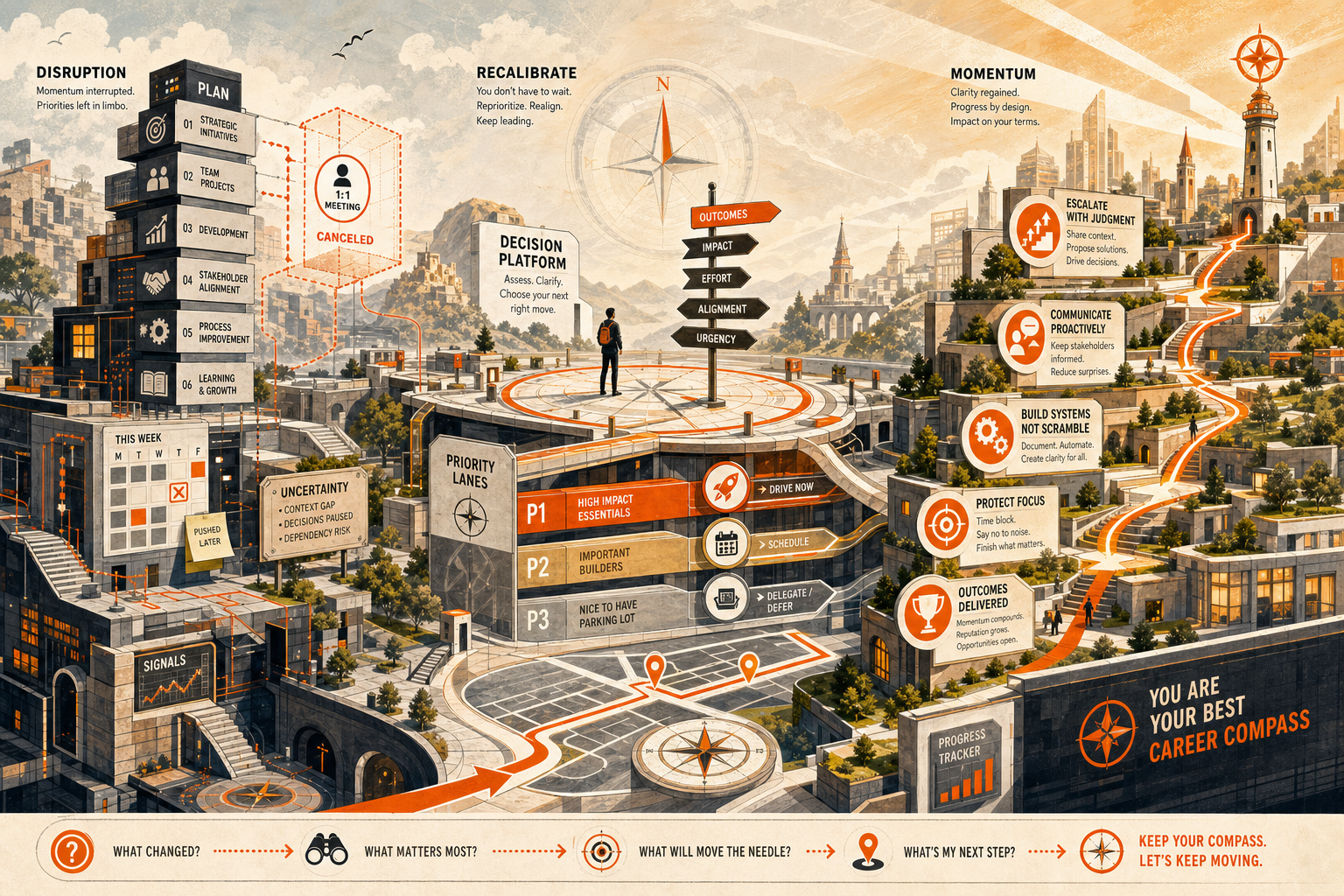
When Your 1:1 Gets Canceled, Don’t Let It Hijack the Week
A canceled 1:1 can wreck far more than 30 minutes.
Not because the meeting itself is holy. A lot of 1:1s are meandering little performances where someone says “circling back” three times and nobody leaves wiser. The real problem is what you had stuffed inside that slot: a decision you didn’t want to guess at, a blocker you were finally going to surface, proof that your work still maps to reality, maybe a tiny hit of reassurance that you are not free-climbing your job without ropes.
When that meeting disappears, the calendar only loses half an hour. You can lose the plot.
That is the part people underestimate. You were expecting a quick yes, a redirect, maybe one sentence from your manager that would save you from spending all afternoon polishing the wrong thing. Instead you get a chirpy “Need to move this” and then silence. Now your tabs all look equally urgent and equally fake. If you’re early in your career, the feeling is especially nasty: not just annoyance, but exposure. Am I supposed to know what to do here? If I move without approval, do I look reckless? If I wait, do I look helpless?
Here’s the more useful framing: your job is not to defend the 1:1 like it’s a museum artifact. Your job is to keep the week from going soft and directionless when the 1:1 vanishes.
That sounds modest. It isn’t. It’s one of the first meaningful shifts from “I complete assigned tasks” to “I can keep work moving when the system gets sloppy.”
TL;DR
- A canceled 1:1 becomes expensive when priorities, blockers, and visibility were all trapped inside that meeting.
- “No worries, let me know when you’re free” is polite and almost useless.
- Replace the meeting with a short written update that includes your recommendation, not just your uncertainty.
- If a call changes scope, deadline, ownership, budget, or another team’s expectations, surface it. If it doesn’t, you can often proceed under a documented assumption.
- Repeated cancellations are not random bad luck. They are management data.
- Mature professionals do not wait prettily in ambiguity. They reduce ambiguity before it starts eating the week.
The real damage is structural, not just emotional
Yes, a canceled 1:1 can sting. It can make you feel brushed off, demoted in importance, weirdly childish for caring. Especially if you were counting on that meeting all morning, there’s a tiny drop in the stomach when the notification hits. A good 1:1 can bring electric relief: Okay, great, I’m not crazy, this is still the priority, keep going. When that relief gets yanked away, the frustration is real.
But the bigger cost is structural.
A decent 1:1 usually does three jobs: it confirms what matters now, exposes what’s stuck, and keeps your work visible enough that your manager isn’t inventing a fantasy version of your week. When the meeting gets canceled, people often fixate on the social meaning of it — Did I get deprioritized? Do they care? — and miss the operational problem underneath: the work just lost its steering wheel.
That shows up in a few predictable ways.
You start doing clean, efficient, beautifully organized work that may have nothing to do with what actually matters this week. Office life is full of decoy productivity. You can reorganize a deck, smooth out a report, answer twelve messages, tweak a dashboard, and still be drifting farther from the real assignment.
Or you sit on a blocker because you had mentally filed it under “I’ll bring this up in the 1:1.” Then the meeting disappears, and the blocker sits there like spoiled groceries in the back of the fridge, quietly making everything worse.
And visibility evaporates fast. Your manager assumes silence means progress. You assume silence means uncertainty. Both stories are wrong, and both can harden into decisions.
Here’s the useful diagnostic: if your 1:1 disappeared for a month, what would break first — prioritization, decision-making, emotional support, or visibility? Your answer tells you exactly where your working system is flimsy. Name that weak spot this week. Don’t just complain about the cancellation; identify what the cancellation exposed.
Stop acting like the reschedule is the fix
Most people respond to a canceled 1:1 with some version of:
No worries — happy to reschedule. Let me know when you have time.
This is socially smooth and operationally useless.
It puts the next move on the busier person, asks for vague future attention, and does nothing to protect your week in the meantime. Managers often don’t ignore this because they’re monsters. They ignore it because the message contains no urgency, no decision, and no easy handle. It is the professional equivalent of placing a sticky note into a wind tunnel.
The better move is to replace the meeting, not mourn it.
Send a short written update with four parts:
- what you’re focused on
- what’s blocked
- what requires a decision
- what you recommend next
That fourth part matters more than people think. Without it, your update can sound like administrative whimpering. With it, you sound like someone who can think under imperfect conditions.
For example:
Since we missed today, I’m treating X and Y as the top priorities this week. Z is blocked pending legal review. My recommendation is to keep moving on X, pause Z until Thursday, and deprioritize A unless you want it pulled forward for stakeholder reasons.
That message is useful because it gives your manager three easy options: approve, adjust, or object. No scavenger hunt. No “can we find time?” mush. No need for them to reverse-engineer your entire week from a phone between meetings.
If you want a simple rule, use this one: never send uncertainty upward without attaching your current best judgment. You are not required to be right all the time. You are required to think before escalating.
Pick one canceled 1:1 from the last month and write the message you wish you had sent instead. Save it somewhere obvious. Future-you should not have to invent professionalism from scratch at 2:17 p.m.
Not every question deserves to be carried upstairs
This is where early-career anxiety loves to dress itself up as diligence.
Some people think professionalism means checking every minor move with a manager. It doesn’t. Sometimes that’s responsibility. Sometimes it’s fear in a sensible outfit.
If you need approval for every small execution choice, you are not being “thorough.” You are outsourcing your discomfort. Over time, that makes you slower, noisier, and harder to trust, because your manager starts experiencing you as a person who turns ordinary ambiguity into their problem.
A cleaner framework:
Safe to make
Routine execution choices, previously aligned priorities, low-risk improvements, standard follow-ups, and next steps that don’t alter anyone else’s expectations.
Safe to pause
Work that matters but gets worse if guessed at. Maybe there are two plausible directions and both create downstream consequences. A pause here is not laziness. It is judgment.
Too consequential to assume
Anything that changes scope, deadline, ownership, budget, or what another team believes is happening.
That last category is where people get into trouble because the choice often feels small in the moment. It doesn’t feel dramatic to promise a delivery date, quietly drop a lower-value request, redefine “done,” or imply someone senior has already blessed the plan.
But those are not personal workflow choices. Those are coordination choices. Coordination choices should be visible.
Ask yourself one brutally clarifying question: If this assumption is wrong, who gets surprised? If the answer is “basically no one,” proceed and document it. If the answer is “another team, a customer, or someone two layers above me,” bring it into the light.
Today, make a list with three columns: proceed, pause, escalate. Put every live work item into one of them. Half the stress will vanish the moment your uncertainty has categories instead of vibes.
Document assumptions like a grown professional, not a tiny corporate lawyer
The phrase “document your assumptions” makes some people produce unbearable prose. Suddenly they sound like they’re preparing evidence for a deposition.
Don’t do that.
You are not building a legal defense. You are making your reasoning visible while it can still be corrected cheaply.
Often one calm sentence is enough:
Unless I hear otherwise by noon tomorrow, I’m prioritizing the onboarding fixes first because they’re tied to the launch date we aligned on last week.
That sentence is doing real work. It states the plan, gives the rationale, and creates a correction window. It doesn’t sound dramatic. It doesn’t sound sulky. It just makes your judgment legible.
This matters because invisible thinking gets misread. I learned that one late. Early in my analytics work, I was doing solid technical stuff and assuming the quality of the output would speak for itself. It did not. From my seat, I was being efficient. From everyone else’s seat, I was opaque. People made assumptions around me, priorities shifted in rooms I wasn’t in, and I would eventually discover that I had solved the wrong problem beautifully.
That is one of the meaner workplace experiences: being hardworking, productive, and completely misaligned at the same time.
The move this week is not to over-document your life like you’re filing taxes in a bunker. It is to write down one live assumption before it turns into a hidden risk. One. Build the reflex, not the bureaucracy.
If this keeps happening, stop calling it “just a busy week”
One cancellation is life.
A pattern is information.
This distinction matters because smart people can waste a shocking amount of time romanticizing dysfunction. They tell themselves their manager is just slammed, this month is unusually chaotic, next quarter will be calmer. Meanwhile, the 1:1s keep slipping, Slack replies arrive six hours late or not at all, priorities wobble around without explanation, and every Sunday night starts to smell faintly like dread before the weekend is even over.
That kind of stress is sneaky because it rarely becomes cinematic. No one is screaming. Nothing explodes. It just hums in the background and makes ordinary work feel harder than it should. You over-prepare for simple updates. You hesitate before making obvious calls. You keep wondering whether you’re behind or just under-led. It’s exhausting in the way a dripping faucet is exhausting: one drop is nothing, but eventually you want to move out.
Managers do get overwhelmed. That’s real. I’ve been on that side too, and I handled parts of early leadership badly enough to burn myself out completely. What I understand better now is that “minor” support failures do not feel minor to the person living under them. Unclear support creates chronic tension. People stop trusting their own judgment. They start trying to read tea leaves instead of doing work.
So if your 1:1s are regularly canceled and your async updates disappear into the void, don’t keep treating it like weather. Redesign the system.
You could propose: - a 15-minute weekly checkpoint instead of a 30-minute 1:1 that never survives the week - a standing written update every Monday with same-day response expectations - a simple urgency rule: Slack for priority conflicts, email for FYIs, 1:1 for development - a shared document where unresolved decisions live until they’re closed
Notice the framing shift. You are not saying, “You keep flaking on me.” You are saying, “Our current operating system is creating ambiguity, and here’s a lighter one.”
That is much harder to dismiss, because it is not about etiquette. It is about execution. Pick one alternative format and suggest it this week in plain English.
Manage up without sounding fragile, fake-calm, or weirdly combative
This is where people tend to overcorrect.
They either go full doormat — “Totally fine, no worries at all!” while privately melting down and reorganizing their desktop in a state of quiet resentment — or they make the scheduling issue itself the fight. Neither move helps.
The better tone is steady, specific, and lightly unsentimental.
Try:
I’m happy to flex when things come up. To keep priorities clear, I’ll send a short update with blockers and recommended next steps whenever we miss the 1:1.
Or:
We’ve had to move a few of these recently, so I want to make sure I’m not guessing on priorities. Would a shorter standing check-in or a written Monday review work better?
That tone does something valuable. It communicates competence without pretending the ambiguity is harmless.
There’s a trap here for ambitious people: they think maturity means absorbing bad process quietly. It doesn’t. Quietly absorbing bad process often just trains the organization to rely on your ability to function without support. Congratulations — you have become “low maintenance,” which is not always the compliment people think it is.
Sit with this question for a minute: what are you normalizing right now that is making your work harder to steer?
Build a missed-1:1 protocol before the next chaotic Tuesday
The smartest version of this problem is preventive.
Do not improvise your response every single time the meeting disappears. Irritation is a terrible systems designer. Build yourself a default protocol so the cancellation does not also become a little identity crisis.
A simple version might look like this:
- wait ten minutes and confirm the meeting is truly off
- send a three-to-six sentence update with priorities, blockers, decisions needed, and your recommendation
- keep moving on low-risk work for a defined block of time
- explicitly flag anything that changes scope, deadline, owner, budget, or outside expectations
- capture unresolved items in one place so they don’t dissolve into chat history
That may sound obvious. Good. Obvious systems are wildly underrated. The point of a protocol is not originality. The point is that you stop burning mental energy deciding how to behave every time someone else’s calendar catches fire.
Try This
Create a note titled “If my 1:1 gets canceled.” Put in: - your default message template - your proceed/pause/escalate rule - the list of projects where assumptions would affect other people
Then the next cancellation becomes annoying, not destabilizing.
The bigger skill here is career durability
A canceled 1:1 is rarely just a canceled 1:1.
It reveals how dependent your working life is on one person, one meeting, one approval channel, or one weekly burst of reassurance. And to be clear, reassurance matters. Especially early in your career, a solid 1:1 can feel like oxygen. You leave with your shoulders lower, your priorities cleaner, your brain quieter. But if your ability to work well collapses every time that oxygen tank gets moved, the issue is no longer the meeting. The issue is that your system is too brittle.
Career durability means building a steadier source of clarity. Not perfection. Not robotic independence. Just enough structure that when support gets flaky, you don’t immediately slide into guesswork, overthinking, or silent resentment. That looks tactical on the surface — better updates, clearer assumptions, sharper escalation rules — but it is also emotional. You get better at noticing the exact moment confusion starts turning into fog. You stop marinating in that “I can’t tell whether I’m behind or just unguided” feeling and replace it with a visible next move.
That shift matters more than it sounds. Entire months disappear inside low-grade ambiguity. People call it burnout, lack of motivation, impostor syndrome, or “just a weird quarter,” when sometimes the simpler truth is that they’ve been trying to work inside a blurry system without naming the blur. Once you start treating repeated confusion as a design problem instead of a personal flaw, your options expand fast. You can document more cleanly. You can propose a new cadence. You can spot whether this is a temporary rough patch or a management pattern that deserves bigger decisions.
That’s where Career Compass fits naturally. Not as some magical script machine, and not as an excuse to dramatize every workplace annoyance, but as a way to track the signals people usually dismiss until they become their whole job: recurring ambiguity, dread before the week starts, invisible work, weak manager communication, and the subtle erosion of confidence that happens when you keep operating without enough clarity. If a canceled 1:1 is part of a larger pattern, Career Compass gives you a place to see that pattern before it hardens into “I guess this is just how work feels.”
So the mindset shift is this: stop treating canceled 1:1s as isolated acts of calendar vandalism. Treat them as stress tests. They reveal whether your week depends on one fragile point of contact or whether you’ve built enough judgment, visibility, and structure to keep moving. Strong professionals are not the people who wait most politely. They are the people who can name what’s unclear, recommend a path, and make ambiguity visible before it becomes drift.
The next time your 1:1 gets bumped, don’t hover in uncertainty like a browser wheel spinning forever. Put the priorities in writing. Name the blocker. State the assumption. Recommend the path. And if the pattern keeps repeating, stop asking yourself how to be more patient and start asking what system would make good work easier to do. That is not damage control. That is professional adulthood.