How to Respond to a Written Warning at Work
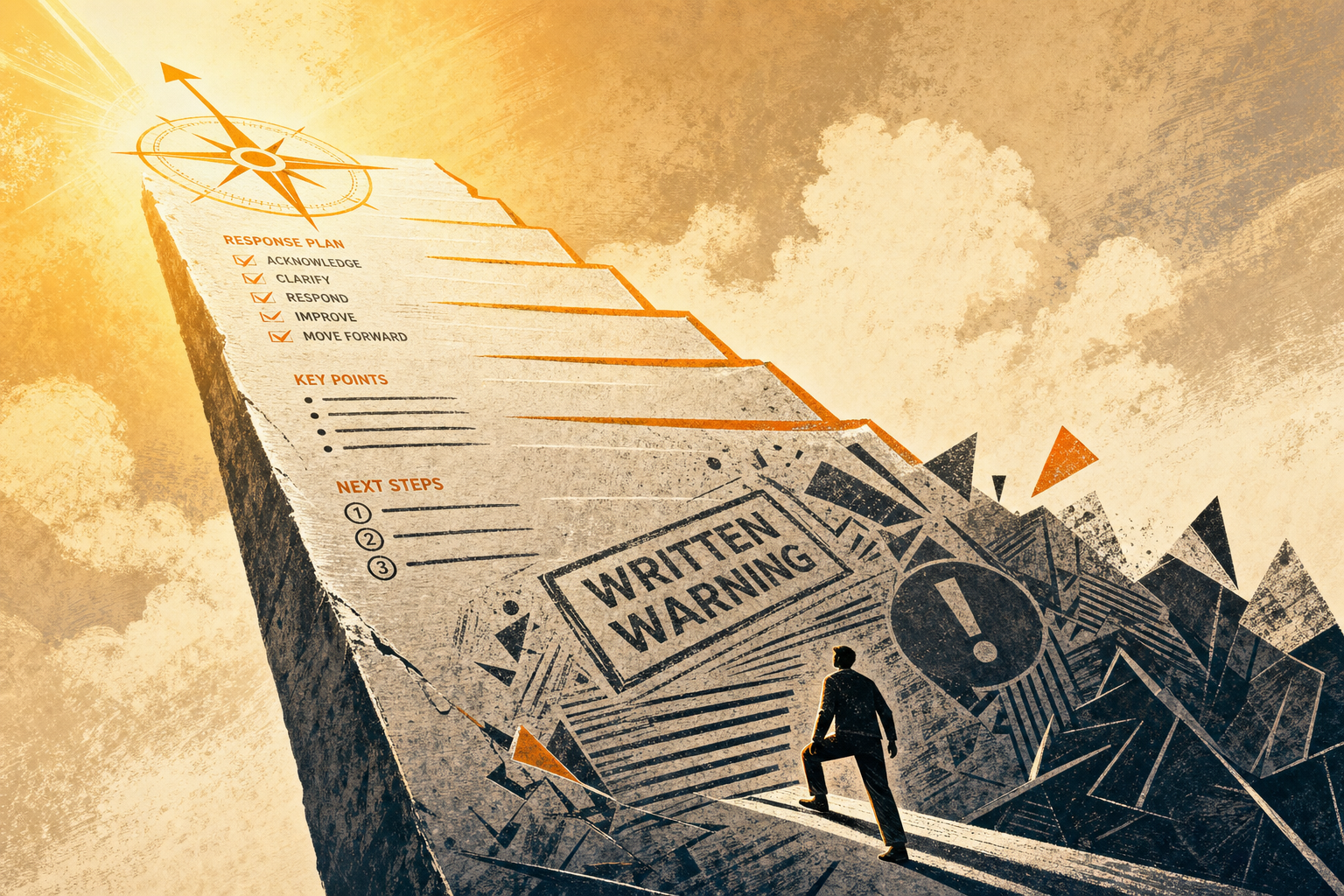
Written Warning at Work? Don’t Reply Until You Read This
A written warning does not end your career.
It does, however, ruin your Tuesday.
Your pulse picks up. Your jaw locks. That Slack notification sound suddenly feels like a smoke alarm. You reread old messages looking for the sentence that doomed you. You start performing “totally normal professional” while internally cycling through panic, rage, shame, and the deeply humiliating hope that maybe this is all one big misunderstanding.
That reaction is human. It is also a terrible person to put in charge.
Most people make one of two bad moves immediately. They either turn into a courtroom lawyer, objecting to every adjective as if the goal is to win on procedure. Or they collapse into a giant foggy apology — “I’m so sorry, I’ll do better” — without forcing anyone to define what “better” actually means.
Both are expensive mistakes.
A written warning is usually not a moral verdict. It is paperwork. It is the company building a record. The second you understand that, your job changes. You are no longer trying to give the perfect emotional response. You are trying to make the record more accurate, more specific, and less dangerous to you later.
That is a much colder game than most people want to play. It is also the game you are actually in.
TL;DR
- A written warning raises the stakes, but it does not automatically mean you’re getting fired next week.
- Your first job is not to “clear your name.” It is to slow the moment down and get specifics.
- Signing may mean receipt, not agreement — but only if the wording says so, or you clarify it.
- Vague warnings are a problem. If the document says “be more proactive,” your mission is to drag that sentence into concrete reality.
- Treat the situation as dual-track: improve visibly inside the role while quietly strengthening your outside options.
- The cleanest record usually beats the strongest speech.
First, understand what just happened
A written warning is formal documentation that your employer believes something is wrong with your performance, conduct, attendance, or behavior.
Dry sentence. Not a dry experience.
What it actually feels like is exposure. Yesterday, you had a weird dynamic, a tense manager, a 1:1 that felt off, maybe a few comments you were trying not to overinterpret. Today, the concern has a date, a title, and a place in your file. That is why this hits so hard. It turns ambient dread into an object.
But “formal” does not mean “final.”
In some companies, a written warning is a genuine correction step. In others, it is the opening paperwork for an exit someone already wants. Annoyingly, you often cannot tell which one it is on day one. So stop trying to read tea leaves from your manager’s facial expression. Start reading the actual document.
Look for the basics: - What exactly are you accused of? - What dates or incidents are listed? - What standard do they say you missed? - What changes are required? - By when? - How will improvement be measured? - Who decides whether you improved?
If the warning can’t answer those questions, then the warning is weak, even if the tone is intimidating.
Sit with this question for five minutes before you respond to anyone: if a neutral outsider read this warning, would they know exactly what I am supposed to do differently next week? If the answer is no, that is the first thing to fix.
Do not let your first reaction become part of the file
The instinct to defend yourself immediately is completely understandable. You hear something one-sided or unfair and your body wants to correct the record right there, in real time, with passion, context, and several examples from Q2.
Usually that goes badly.
Not because you’re wrong. Because the room is not built to reward emotional accuracy. It is built to observe your response. A heated rebuttal often gets translated into phrases like “defensive,” “resistant to feedback,” or “lacked accountability.” Now the record contains two problems instead of one.
Do not hand them that gift.
The smarter move feels almost annoyingly restrained: - “I want to review this carefully.” - “Can you walk me through the specific examples behind each point?” - “What measurable improvement would address this concern?” - “What is the review timeline?” - “Does my signature acknowledge receipt only, or agreement with the contents?” - “Can I submit a written response for the file?”
That is not weakness. That is discipline under fluorescent lighting.
And yes, discipline is harder when your chest is tight and your ears are ringing and you can already feel the Sunday-night dread setting up camp in your nervous system. But your job in that meeting is not to express your whole wounded inner universe. Your job is to leave with clarity, and with as little additional damage as possible.
If you have advance notice of the meeting, write those questions down on paper. Not in your head. On paper. Adrenaline makes fools of memory.
Read before you sign. Then read the sentence above your signature like your rent depends on it.
A lot of people sign written warnings because the social pressure is brutal. The manager slides the form across the table. HR puts on their neutral museum-curator face. The room goes quiet in that very specific corporate way that says, “Please help us complete this ritual.”
Slow it down.
Sometimes the signature means only, “I received this document.” Fine. Sometimes it quietly implies that you agree with the contents, the characterization, or the corrective plan. Very much not fine.
Read the wording. Then ask the obvious question out loud: “To confirm, my signature acknowledges receipt, not agreement?” If that matters to you, ask whether you may write “receipt only” next to your signature. If company policy doesn’t allow that, send an immediate follow-up email memorializing your understanding.
Something like this works:
Thanks for meeting today. I’m confirming that I received the written warning discussed on [date]. I am reviewing the contents carefully. Please confirm the specific expectations, success measures, and review timeline associated with this warning. I would also like to submit a written response for my file.
Notice what this email does not do. It does not rant. It does not confess. It does not write fan fiction about anyone’s motives. It creates a timestamp and forces specificity.
Send it the same day. “I’ll do it when I calm down” is how people accidentally let the slop harden into the official version of events.
If the warning is vague, make vagueness expensive
“Needs better communication.”
“Must demonstrate more ownership.”
“Not operating at expected level.”
These phrases sound important in the way a fog machine looks solid from far away. Up close, they’re mostly theater.
Vague criticism is dangerous because it gives bad managers infinite editing power. If the standard is fuzzy enough, they can always claim you still missed it. You cannot improve against a mood. You need observable behavior.
So ask questions that pin the complaint to the floor: - Which project or meeting are you referring to? - What exactly did I do or fail to do? - When did it happen? - What was the expected behavior instead? - What would success look like over the next 30 days? - How often will we check in? - Who will evaluate whether I’ve met the standard?
Ask plainly. No smirk. No TED Talk. Just one clean question after another until “be better” turns into something a sane adult could actually execute.
Here’s the test: could a stranger watch your work next month and tell whether you improved? If not, the expectation is still mush.
Pick the blurriest sentence in the warning and translate it into a behavior by end of day. If they won’t help you define it, note that in writing too.
Build your own record before memory turns into a chaotic little goblin
After a warning, your memory becomes unreliable fast. It forgets dates, inflates tone, compresses timelines, and starts blending three separate conversations into one giant emotional weather system.
Do not rely on recollection. Build a record.
As soon as possible, write down: - date and time of the meeting - who attended - exact concerns raised - examples they gave - anything you disputed - what improvement is supposed to look like - deadlines and review dates - support or resources promised - anything unclear, inconsistent, or missing
Then keep going.
Start a private weekly log. Track deliverables, feedback, approvals, delays, shifting scope, dependencies, wins, recap emails, and positive comments. Save the “looks great, thanks” messages too. People are weirdly disciplined about preserving criticism and bizarrely casual about losing evidence that they were competent.
I learned this one the hard way. Earlier in my career, I stepped into a bigger leadership role before I had the systems to support it. I was overextended, overthinking everything, and way too emotionally tangled in whether I was secretly failing as a person. The problem felt existential. It was not existential. It was operational. Expectations were moving, communication was messy, and I had not built a clean enough trail of what was actually happening.
That distinction matters. A lot of workplace pain feels like an identity crisis when it is really a documentation crisis.
Open a document today. Put the date at the top. Start your record while the details still have edges.
If the process is fair, make your improvement impossible to miss
Not every warning is a setup. Some are clumsy, overdue attempts to address a real issue.
A fair process usually has tells. The feedback is specific. The examples are recent. The expectations stay stable. Your manager answers questions without acting personally insulted by them. There are actual follow-ups. You are given a chance to improve that is visible, not imaginary.
If that’s your situation, private suffering is not a strategy.
Neither is “working really hard” in a vague, invisible way and hoping people somehow sense your effort through the walls. In a documented performance situation, invisible improvement barely exists. The improvement must be legible.
That may mean: - confirming priorities in writing after meetings - sending a weekly status update - asking for feedback before a deadline, not after the explosion - recapping decisions so there is less room for revisionist history - fixing the exact behavior named, even if another behavior would be easier or more flattering to improve
For example, if the issue is follow-through, do not just become more anxious in silence. Send a concise weekly update: completed, next, blocked, needed. If the issue is communication, stop assuming people know where things stand. Tell them before they wonder.
Try This: Pick the single behavior named most clearly in the warning and create one visible replacement for it this week. Not ten. One.
If the process is bad faith, stop waiting for a dramatic reveal
Some warnings are not correction. They are cover.
The company wants paperwork. The manager wants a trail. The process becomes a theater production where the ending was cast before auditions. This is miserable partly because it scrambles your instincts. You keep hoping the next meeting will finally make the logic click, while your body already knows something is off. You feel crazy, then guilty for feeling crazy, then embarrassed for still wanting reassurance from the same system that is making you sick.
Watch the pattern, not the speeches.
Bad-faith processes often look like this: - the standard shifts after you meet it - old work is suddenly framed as unacceptable after being accepted before - examples stay hazy when you ask for details - check-ins get canceled, then your “lack of progress” is documented - support is promised and never arrives - you’re excluded from information needed to succeed - somehow every path still leads to “not enough”
If you see that pattern, do two things at once: remain professional inside the job and quietly build your exit.
Update your résumé before your confidence gets worse. Reconnect with former coworkers before you are desperate. Save evidence of achievements within company policy. Look at openings now, not after some future meeting finally gives you permission to admit what is happening.
One blunt question matters here: if your manager genuinely wanted you to succeed, would their behavior look like this?
If the answer keeps being no, stop negotiating with obviousness.
Use a dual-track mindset, because false choices are for movies
Career advice loves fake binaries. Fight or surrender. Trust the process or assume the worst. Stay committed or start job hunting. Real work is less cinematic and more irritating than that.
The useful mindset is dual-track.
Improve as if the situation can be salvaged. Prepare as if it may not be.
That means you can take feedback seriously and update your LinkedIn. You can cooperate in meetings and document every inconsistency. You can try to recover the role and send three networking messages this week. These are not contradictions. They are adult strategy.
This is also where a lot of people get stuck emotionally. They think preparing a backup plan means they are being negative, disloyal, or dramatic. No. It means you are refusing to let one manager’s opinion become your only available future.
So here is your move: choose one action for each track today. One action to improve your standing internally. One action to expand your options externally. Then do both before you overthink them into dust.
What to say when you need actual words
When people are stressed, they either say too much or nothing useful. It helps to have language ready.
In the meeting, borrow these: - “I want to make sure I understand each concern specifically.” - “Can you tie that point to a concrete example?” - “What would improvement look like in measurable terms?” - “When will progress be reviewed?” - “I’d like time to read this carefully before responding.”
After the meeting: - “Thanks for meeting today. I’m confirming receipt of the warning.” - “Please confirm the expectations, timeline, and success measures in writing.” - “Here is my understanding of the next steps.” - “I’d like to submit a written response for the file.”
If part of the warning is flatly wrong, keep your correction boring. That is a compliment. Boring wins. Name the specific claim, provide the factual correction, attach documentation if appropriate, and stop. Do not produce a 1,600-word manifesto powered by indignation and cold brew.
Draft the email. Cut it in half. Then cut the sharpest sentence. That version is usually the one to send.
Structure will help you more than reassurance
A written warning can hijack your self-story fast. Suddenly every awkward pause in a 1:1 feels loaded. Every kind comment sounds fake. A decent meeting gives you a weird electric relief for three hours, then one curt message from your manager sends you right back into the pit. It is exhausting.
That is why you need structure more than comfort.
Comfort says, “Maybe it’ll be fine.” Structure says, “Here is what was said, here is what I need clarified, here is what I changed, here is what still doesn’t add up.” Comfort can be lovely. Structure is what protects you.
This is also where Career Compass can actually be useful instead of just inspirational. If you’re dealing with a warning, use it to map the situation in writing: build a 30-day improvement plan, track evidence of progress each week, and log whether the process is becoming clearer or more slippery. In messy work situations, the real advantage is often not confidence. It is pattern recognition.
A written warning feels personal because work is personal. It touches your money, your sleep, your pride, your household mood, the way your stomach drops on Sunday afternoon, the story you tell yourself about whether you are competent and safe. But the next move is still practical. Read carefully. Ask sharp questions. Follow up in writing. Keep your own record. Improve where the process is real. Prepare where it is not.
The paper is real. It is not prophecy.
And that mindset shift matters more than people think. The goal is not to prove that you are a flawless employee or a misunderstood genius. The goal is to respond like someone who understands how workplaces actually work: imperfectly, politically, often unfairly, and still manageable when you stop confusing panic with strategy.
So do not make this moment bigger than it is, and do not make it smaller either. Treat it with seriousness, not reverence. A written warning is a signal to get sharper, more specific, and more self-protective — not a command to spiral. If you need help staying in that mode, Career Compass is there to help you think clearly, track what is real, and make your next move from evidence instead of fear.