How to Work Well With a New Manager

Your Manager Is New Too. Stop Treating the Chaos Like a Verdict on You
A new manager can turn a stable job into a funhouse mirror.
Work you handled easily last month suddenly gets second-guessed. Deadlines wobble. A project that used to move in a straight line now pinballs through three extra check-ins and a mysterious “let’s revisit this next week.” You leave a 1:1 replaying every sentence, then spend Sunday night doing the bleak little math of modern office anxiety: Am I behind, or is this person just figuring out where the bathrooms are?
Usually, it’s the second one.
That distinction matters more than people realize. Early-career professionals often absorb managerial instability as a comment on their talent. The boss seems scattered, so you work later. The priorities change, so you become hyperavailable. The feedback is vague, so you start over-explaining everything you do, hoping one of your explanations will finally click. It feels responsible. It also traps you in the wrong job.
When your manager is new, your edge is not heroic effort. It is making your work painfully easy to understand. Easy to direct. Easy to evaluate. Easy to defend when the story starts getting sloppy.
That is the real game in a management transition. Not mind-reading. Not people-pleasing. Not becoming the human shock absorber for every wobble in the system.
TL;DR
- A new manager often creates structural confusion, and structural confusion loves to masquerade as “maybe I’m the problem.”
- Your first job is to pin down four things fast: priorities, communication preferences, standards of proof, and what deserves escalation.
- New managers do not usually need more hustle from you; they need updates that tell them what matters without forcing them to reconstruct the situation from debris.
- Being supportive is good. Becoming the team’s unpaid cleanup crew is not.
- Written recaps are not fussy admin work. During a transition, they are memory insurance.
- If you want to protect your reputation, track patterns early: stress, friction, role drift, and repeated confusion. Fog is how small problems get promoted into “performance concerns.”
A new manager changes the lived version of your job
Your title may stay the same. Your actual job rarely does.
A new manager resets the hidden parts of work: what counts as good judgment, how often you’re expected to update, which problems you should solve alone, which you should raise early, and whose opinion suddenly matters more than it did a month ago. None of that appears in your HR file. All of it shapes your week.
That’s why this period feels so unsettling. The dread is not imaginary. It comes from trying to do good work while the scoring rubric is being rewritten in pencil.
If you’re early in your career, you may personalize that feeling immediately. A distant manager can feel like disapproval. A chatty manager can feel like scrutiny. A manager who changes direction twice in one meeting can make you wonder whether you missed something obvious. In reality, the most dangerous problems here are often dull and procedural: fuzzy priorities, delayed decisions, shifting standards, and plain old invisibility.
You can be competent and still get lost in that mess.
So start from a saner assumption: if your manager is new, confusion is normal; your job is to reduce the amount of it attached to your work. The question to sit with this week is simple: what part of your role suddenly feels less clear than it did 30 days ago? That is probably where your next unnecessary headache is hiding.
The first month is not “wait and see” time
Most people handle a new manager passively. They wait for clarity to arrive like weather.
Bad plan.
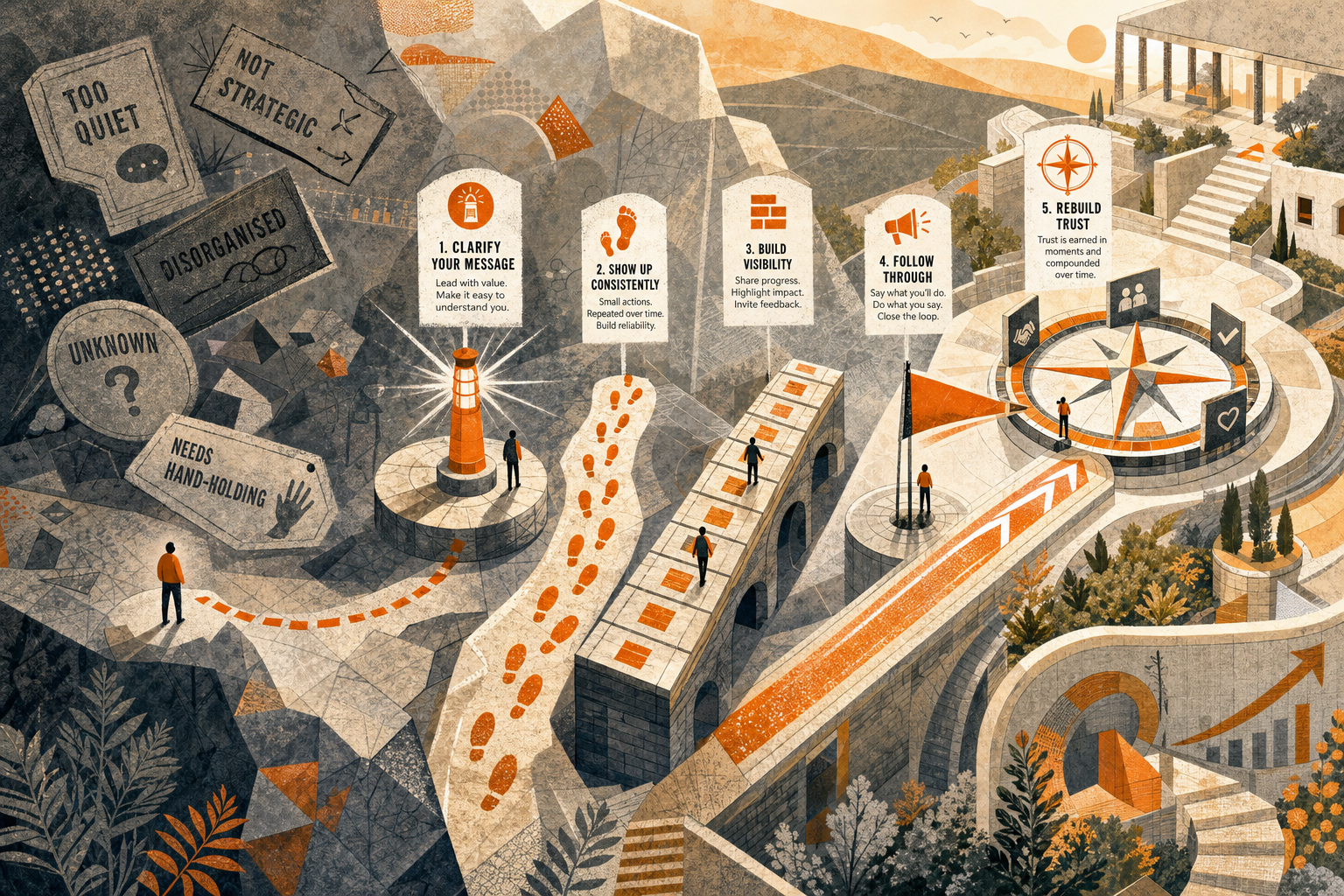
The first few weeks are when your working relationship gets set on default. If your manager gets used to receiving vague updates, they will keep expecting vague updates. If they get used to last-minute surprises, they will start treating last-minute surprises as normal. If they get used to you translating chaos into crisp summaries, they will trust you faster and bother you less.
That means the opening month is not a warm-up lap. It is the period when habits harden.
A useful way to organize that period is around four buckets:
1. Priorities
What matters right now, not what lives in a stale quarterly slide deck.
2. Preferences
How does this person like information? Bullet points or discussion? Early drafts or polished work? Slack for quick flags, email for context, or live conversation for messy decisions?
3. Proof
How will they decide you are doing well? Speed? Fewer surprises? Strong stakeholder feedback? Cleaner project management? If you do not know what evidence counts, you are performing in the dark.
4. Escalation
What should you bring up early, and what do they expect you to solve independently? This one matters because some managers interpret “kept you informed” as maturity, while others interpret it as dependency. You need to know which movie you are in.
You do not need to make this awkwardly corporate. In a 1:1, ask normal human questions:
- “What would make me especially useful in the next few weeks?”
- “When you get an update from me, what do you want to see first?”
- “What’s something you’d rather hear about early, even if I don’t have a solution yet?”
- “When you think someone is doing strong work on this team, what are you noticing?”
Those questions are not needy. They are adult.
Pick two of them and bring them into your next 1:1. Not someday. The next one.
Use written recaps before anyone has a memory problem
There is a very predictable office tragedy: nobody writes anything down, priorities drift, a deadline slips, and suddenly everyone remembers the meeting in the version most flattering to themselves.
You do not have to participate in that.
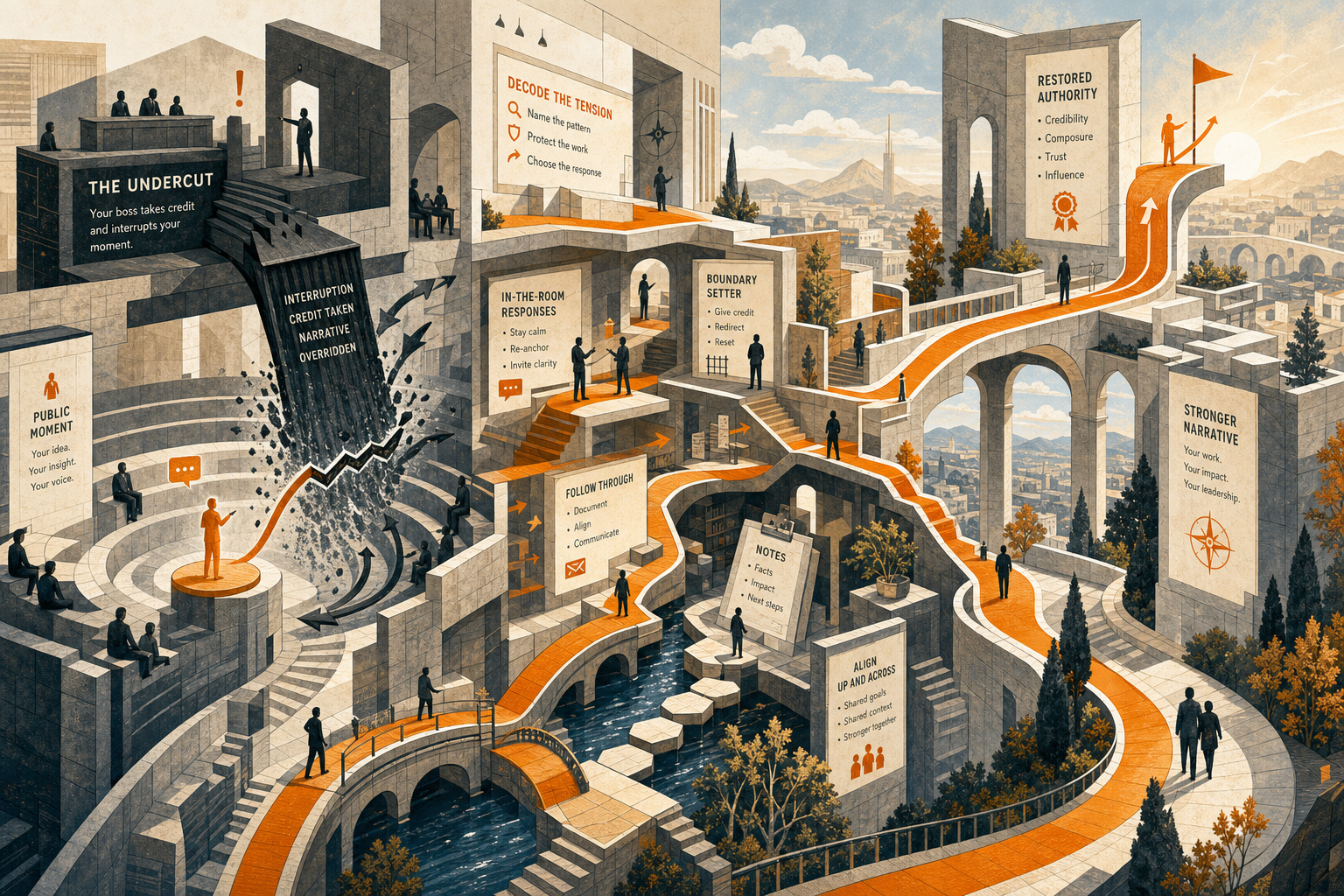
A short recap after a 1:1 or project conversation can save you weeks of future aggravation. Not a transcript. Not a mini novel. A clean note with three parts:
- what we decided
- who owns what
- what is still unresolved
That’s it.
Example:
Quick recap from today:
- Priority this week is finishing the client draft before the internal deck
- I’ll send version 1 by Thursday noon
- Open question: whether legal needs to review before client share
- If legal review is required, timeline moves to Tuesday
That email does several jobs at once. It helps your new manager look organized. It gives them a stable record when everything else is moving. And if the story later starts mutating into “I thought you were handling that,” you have something sturdier than your own blood pressure.
Some employees worry this will look stiff or political. In reality, the people who hate written clarity are usually the people benefiting from confusion.
If you are in a messy transition, send one recap this week after a meeting that currently exists only in everyone’s unreliable memory.
Your manager does not need more effort from you. They need cleaner signal.
This is where smart people often make the worst mistake.
The boss is new, so you try to prove commitment through sheer volume: faster replies, more meetings, more visible hustle, more “just circling back here!” messages, more late-night polishing. It feels noble. It also buries the useful information under a pile of nervous energy.
Most new managers are not starving for effort. They are drowning in fragments.
What helps is signal. Clear, compressed, decision-ready signal.
A strong update usually answers four questions fast:
- What happened?
- What matters about it?
- What decision or help is needed?
- What happens next?
That sounds basic, but most workplace updates fail on exactly those points. People hand over a sack of details and call it communication. The manager then has to reconstruct the actual issue from scraps, which is exhausting even when they know the system well. When they are new, it is brutal.
Compare these:
Weak update:
“Design had some feedback and legal still hasn’t responded, so we’re working through a few things. I can keep you posted.”
Useful update:
“Main risk is timeline. Design changes are minor, but legal approval is still outstanding. If legal replies by Thursday, we can launch Monday. If not, Tuesday is the earliest realistic date. I need your help nudging legal if Monday is firm.”
The second version respects the other person’s brain.
It also protects you. You are not just reporting activity; you are making the tradeoff visible before it becomes your fault.
Here’s the move: take one recurring update you send and rewrite it in that four-part format. Your manager may not thank you dramatically. They may just start seeming less confused around you, which in office life is basically a standing ovation.
Disagree like a grown-up, not like a frustrated prophet
Watching a new manager make a preventable mistake is maddening.
You see the dependency they missed. You know that deadline is fantasy. You can already picture the meeting next Tuesday where everyone pretends to be surprised by the problem you saw five days earlier. This is one of the loneliest little workplace feelings, especially when you are junior enough that saying “this is a bad idea” carries social risk.
Still, how you raise the concern matters.
Blunt disagreement often lands as ego friction, especially with a manager still trying to establish authority. Framing the issue as a risk lands much better because it gives them something to solve rather than something to defend against.
Less effective:
“I don’t think this plan is going to work.”
More effective:
“The biggest risk I see is that we’re committing to a date before legal review is in motion. If the date is fixed, we probably need to cut scope or escalate that dependency now.”
Same insight. Much better delivery.
There is emotional discipline in this. Being right is satisfying for about six seconds. Being understood is what changes outcomes. In office politics, clear framing beats wounded brilliance every time.
So when you feel that hot, irritated urge to say “this makes no sense,” force yourself to answer a better question first: what is the concrete risk, and what are the options? Use that language in the room.
Be helpful, but do not let your role turn into a junk drawer
New managers create ownerless work all the time.
Not because they are evil. Because they do not yet know where everything belongs.
That produces a familiar stream of requests: - “Can you just take this for now?” - “Can you sit in on this?” - “Can you clean this up quickly?” - “Can you help bridge the gap until we figure out ownership?”
Any one of those is normal. Ten of them, spread across two weeks, can quietly eat your real job alive.
This is where a lot of early-career people get themselves in trouble. They say yes to everything because they want to be seen as adaptable, calm, collaborative, indispensable. The immediate reward is praise. The delayed cost is role erosion. Your priorities blur. Your best work slows down. Your reputation shifts from “strong owner” to “helpful person who handles loose ends.”
That is not a promotion path. That is a trap with nice wording.
You do not need to reject every extra task. You need to make the tradeoff visible. Try lines like:
- “Happy to help. Which current priority should move back so I can do this well?”
- “I can cover this this week, but I want to flag that it will delay the reporting draft.”
- “I’m noticing I’ve picked up several in-between tasks recently. Can we sort what should stay with me versus what belongs elsewhere?”
That last one is especially useful because it names the pattern without sounding dramatic.
Your Move: make a quick list of the “temporary” tasks you have absorbed in the last month. If the list surprises you, bring it into your next 1:1 and ask for a reset on ownership.
Learn the difference between transition noise and a bad pattern
Not every awkward week is a red flag. Some confusion is normal. Some delays are normal. Some clunky meetings are just what clunky meetings look like when a new person is learning the map.
The harder skill is telling the difference between temporary turbulence and the start of something corrosive.
Transition noise sounds like this: - “This is bumpy, but it’s getting clearer.” - “They asked a lot of questions, but decisions are improving.” - “There were mixed signals, then we clarified them.” - “The workload spiked, but it is not becoming the new baseline.”
A bad pattern sounds like this: - priorities change every few days and nobody admits the cost - after-hours urgency becomes routine - you are held responsible for work that was never clearly assigned - your manager forgets decisions and then acts as though you failed them - your stress stays high even when the work itself is manageable
Your body often notices this before your calendar does. Sunday-night dread gets sharper. You feel a weird electric relief after a good 1:1 because decent communication has become rare enough to feel medicinal. You start rehearsing innocent explanations before meetings. You sleep badly before check-ins. None of that is proof on its own, but it is data.
That is why tracking your own patterns matters. Not in a fluffy self-care way. In a career-protection way.
At minimum, keep a weekly note with: - major wins - points of friction - unclear decisions - extra work you absorbed - stress level from 1–10 - anything that made you feel smaller, foggier, or more replaceable than usual
Do this for a month and the pattern usually stops hiding.
Make your work easy to explain to other people
A lot of “managing up” advice is just polished impression management. Smile more. Be visible. Build relationships. None of that is useless, but it is incomplete.
The deeper skill is explainability.
Can your manager explain your work upward when their boss asks what your team is doing? Can they defend your timeline to another department? Can they describe your judgment without you in the room? Can they summarize your project without wandering into hand-wavy nonsense?
If not, your work is too dependent on your presence. That is risky in any job. During a management transition, it is especially risky.
Explainability comes from a few repeatable habits: - naming risks early - showing tradeoffs clearly - documenting decisions - summarizing progress in plain language - connecting your work to team priorities, not just your own task list
This is also why I built Career Compass the way I did. New-manager transitions are exactly when people need more than vague encouragement. They need a system for noticing what is changing before it turns into a story about their performance. Tracking weekly wins, stress, work-life balance, relationship health, and job satisfaction gives you something most employees do not have in a messy transition: evidence. The coaching nudges matter because they catch the pattern while it is still fixable, when a better update, a clearer boundary, or one honest conversation can still change the trajectory.
That is the point. Not endless self-monitoring. Earlier signal.
If your current situation feels slippery, start there. Capture the next two weeks instead of trying to “gut feel” your way through them.
The job is not to stabilize your manager’s emotions
Let’s end on the boundary a lot of people need to hear.
Your job is not to calm your manager down, absorb every loose end, decode every mood swing, and rescue the team from transition chaos through personal sacrifice. That is not maturity. That is unpaid emotional labor wearing a productivity costume.
Your job is narrower and more powerful than that.
Make your work clear enough to direct well, evaluate fairly, and defend later. Ask the questions that force hidden assumptions into daylight. Write things down. Flag risks while they are still small. Push back on role drift before your responsibilities turn into confetti.
A new manager does change your job for a while. But it does not remove your agency.
So here is the practical question to take into this week: where are assumptions currently living unspoken—priorities, deadlines, ownership, communication, or decision-making? Go there first. That is where the next preventable problem usually lives.
And if you want help spotting the pattern while you are still inside it, that is exactly what Career Compass is for: a place to track the signals, separate normal transition pain from genuine career damage, and make smarter moves before the chaos writes the story for you.