When Your Boss Misses Deadlines: Protect Your Reputation
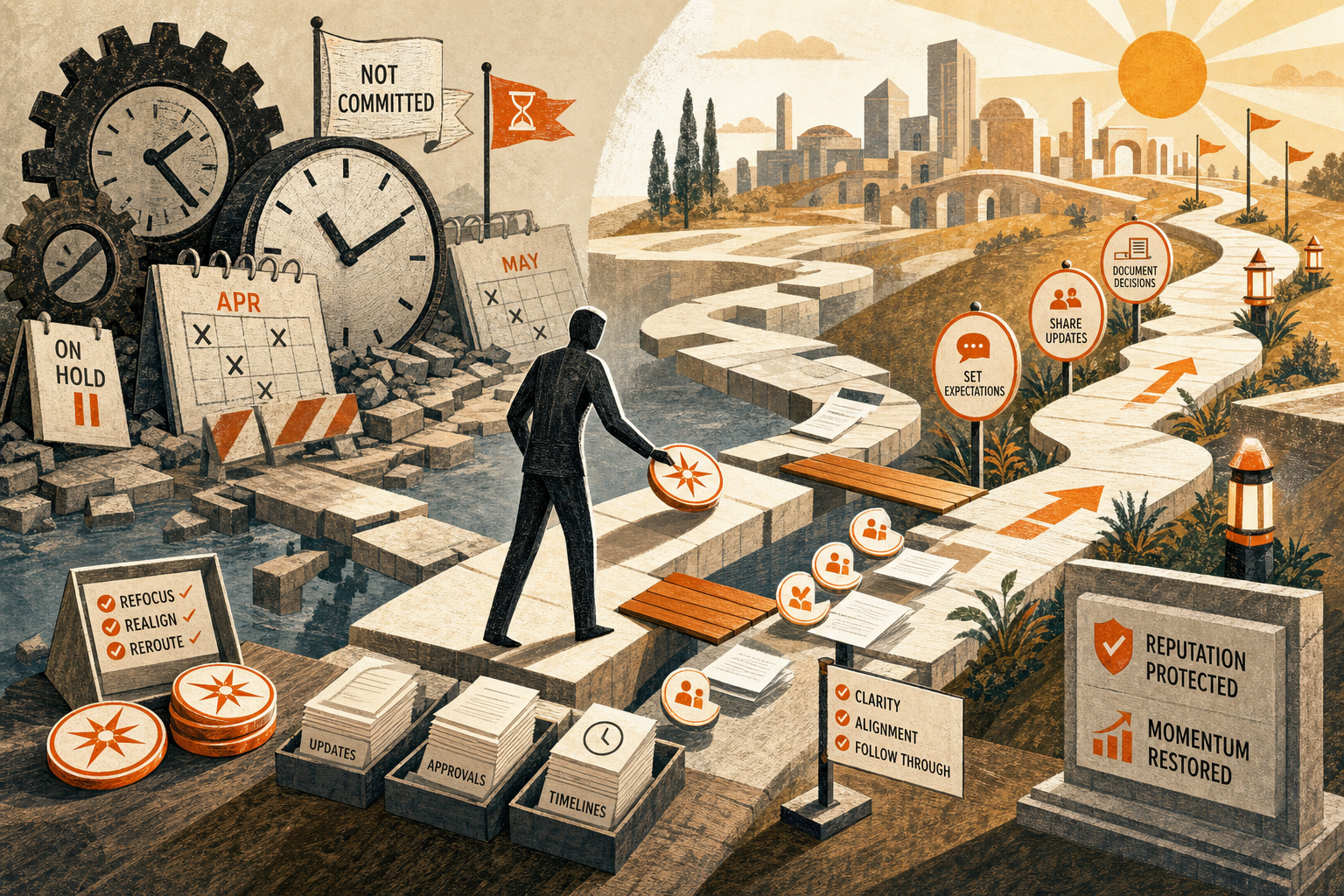
When Your Boss Misses Deadlines, Stop Carrying the Career Damage
Your manager misses a deadline, and your first instinct is usually to be gracious about it.
They’re busy. They’re senior. Their calendar looks like a knife fight. Surely your draft, your budget assumptions, your launch plan can wait another day.
So you wait.
Then the meeting arrives, and with it comes that awful, slippery feeling: the work is basically done, but not done done because one person above you has not approved, answered, decided, or bothered to look. Now you are the one giving a soggy update to a room full of people who do not care about the nuance. They hear “still in progress” and translate it into something much uglier: this person did not land it.
That is the moment to stop being nice in the wrong way.
A late boss is irritating. A late boss whose lateness gets mistaken for your lack of urgency, judgment, or follow-through is a career problem. And early in your career, silent suffering does not read as loyalty. It reads as weak ownership.
So let’s make this plain: your job is not to become a human reminder app with better punctuation. Your job is to make the dependency visible, specific, and boringly undeniable before their delay starts staining your reputation.
The danger is not the delay. It’s the blur.
One missed review does not mean your manager is useless. People get dragged into emergency meetings. Priorities change at 4:52 p.m. because someone important had a thought in a hallway. Fine. Corporate life is frequently a prank with a payroll system.
But a delay becomes dangerous when nobody outside the immediate conversation can see what is actually happening.
This is how the damage sneaks in:
- the deck is finished, but leadership cannot see it until your boss signs off
- the project scope is drafted, but design cannot start until your manager chooses a direction
- the budget is modeled, but Finance will reject it without one decision from above
- the client email is ready, but your boss promised feedback and then vanished into calendar fog
To you, the blocker is obvious. To everyone else, the project just looks late, mushy, or under-managed.
That gap matters more than most people realize. I think of it as borrowed risk: someone else creates the delay, but you absorb the reputational hit because the org chart disappears the second work starts slipping.
And the emotional toll is not small. It is the Sunday-night dread when you already know Monday’s status update will be weak. It is the stomach-drop before a team check-in. It is rewriting the same two-sentence update five times so you do not sound defensive, childish, or pointed. It is feeling embarrassed by a problem you did not create.
Do not wave that feeling away. It is useful data.
Sit with this question for five minutes: If an intelligent stranger looked at your project tracker right now, would they know exactly what decision is pending, who owns it, and what it is blocking? If the answer is no, fix that before you send another “just checking in.”
Stop “following up.” Start naming the decision point.
Most people make this worse by sending softer and softer reminders with harder and harder feelings underneath them.
Just checking in when you have a chance.
Bubbling this up in case it got buried.
Any thoughts here?
Those messages create social pressure, not operational clarity. Your boss feels vaguely nagged. You feel ignored. The project remains dead on the floor.
The better move is colder, cleaner, and more useful: document the decision point.
Every follow-up should quietly answer four things:
- What exactly is pending?
- What does it block?
- When does it start affecting the timeline?
- What will you do if no decision is made?
That last part matters. Without consequence, your message is just another polite cough in the hallway.
Here is the difference in practice.
Weak:
Just checking in on the homepage copy.
Stronger:
The homepage copy is finalized and ready for approval. Once approved, I can hand it to design the same day. If I don’t have a decision by Thursday at noon, the Friday handoff moves to Monday.
Weak:
Bubbling the Q3 budget assumptions.
Stronger:
Your review of the Q3 budget assumptions is the final dependency before submission to Finance. If it remains open after 5 p.m. today, I’ll send Finance a revised submission date tomorrow morning.
Weak:
Any thoughts on the client deck?
Stronger:
The deck is complete. I’m waiting on signoff for slides 8–10 before sending it to the client. If I don’t have approval by 3 p.m., I’ll shift the client review by 24 hours.
Notice what disappeared: apology haze. Performance politeness. The little dance where you try to be so pleasant that the actual problem evaporates.
Pick one stalled item today and rewrite your last follow-up in this format. Then send the clearer version, even if it makes your palms sweat a bit.
Protect the work before you protect your boss’s comfort
This is where a lot of capable people freeze.
They think: I do not want to embarrass my manager. I do not want to sound political. I do not want to look like the kind of employee who turns every missed reply into a federal case.
Fair. Nobody enjoys the coworker who behaves like an internal audit wearing loafers.
But there is a huge difference between exposing your boss and making the workflow legible.
Say:
Draft is complete and pending final approval before submission.
Not:
I’ve been waiting on my boss for three days.
Say:
We’re blocked on scope confirmation.
Not:
I reminded her twice and still haven’t heard back.
One version keeps attention on the work. The other drags everyone into your frustration. And while your frustration may be justified, resentment is terrible project management language. The second you sound aggrieved, people stop hearing the process problem and start hearing office drama.
What you want is something more effective than moral victory: credibility.
Calm, factual language gives your manager room to answer without losing face. That matters because public humiliation is not a project accelerator. If your goal is movement, not catharsis, keep the message about the dependency.
Here’s the test: are you trying to make your boss feel bad, or are you trying to make the blocker impossible to misunderstand? Those are different instincts. Only one protects you.
Choose faster: proceed, pause, or escalate
A surprising amount of workplace stress comes from refusing to decide what kind of blockage you are actually dealing with.
People act as if there are only two options: keep waiting quietly, or stage a dramatic escalation. That is childish framing. There are usually three real choices, and you should label them sooner.
Proceed
Proceed when the missing decision is annoying but not fatal.
Maybe you can refine the analysis, tighten the copy, prep the deck notes, line up stakeholders, or finish the parts that do not require final approval. Good. Do that. Do not sit there in ornamental helplessness because one piece is pending.
Pause
Pause when the open decision affects money, scope, legal exposure, client trust, or another team’s schedule.
This one feels bad because pausing can feel like failure, especially if you were raised professionally on a diet of “be proactive.” But there is nothing proactive about shipping the wrong thing just to avoid the feeling of waiting. Sometimes stopping is the grown-up move.
Escalate
Escalate when the cost of silence is now higher than the discomfort of visibility.
This does not mean running to your skip-level because your manager missed one internal deadline. It means widening the circle when dates, handoffs, or external commitments are now at risk and someone else needs to help decide the tradeoff.
A useful escalation sounds like:
We’re at the point where approval on X determines whether we can hold the current launch date. I want to surface that now so we can decide whether to keep the date or communicate a change.
That is not tattling. That is project ownership with a pulse.
Try This: Take one blocked project and force it into a bucket: proceed, pause, or escalate. If you cannot classify it, that uncertainty is probably what is frying your brain.
If it keeps happening, stop calling it a busy week
One late approval is weather.
Five late approvals in two months is climate.
This is where early-career people get trapped: they keep treating a pattern like an exception. Every week they tell themselves some variation of, Okay, but this time she knows it matters. Then Thursday rolls around, the decision still has not landed, and they act surprised all over again.
Hope is not a workflow. Optimism is lovely at brunch and useless in operations.
If your manager regularly misses review deadlines, forgets commitments from the 1:1, goes silent before handoffs, or leaves decisions marinating until they are no longer useful, you need a redesign, not fresh disappointment.
That redesign might include:
- asking for review earlier than feels reasonable
- sending shorter drafts because giant documents die in inboxes
- putting the real decision deadline, not the fantasy deadline, in the calendar invite
- summarizing verbal approvals in writing five minutes after the meeting
- building buffer before cross-functional handoffs
- flagging risks 48 hours sooner than your instincts prefer
- assuming “needed by Friday” actually means “must be decided by Wednesday”
This is not cynicism. It is pattern recognition.
And yes, emotionally, this can sting. There is something lonely about realizing the elegant process in your head is not the process you actually work inside. But that realization can also be relieving. Once you stop expecting a system to behave differently than it does, you can build around it instead of getting ambushed by it every week.
The move this week is to redesign one part of your process for the manager you actually have, not the one your calendar invitations keep pretending you have.
Use status updates like a shield, not a shrug
Status updates are where reputations quietly rise or leak out through the floorboards.
Bad status language sounds harmless, but it creates the worst kind of ambiguity:
Still working on it.
Waiting to hear back.
Hoping to wrap soon.
Those phrases make you sound foggy, passive, and slightly out of control. They are the workplace equivalent of showing up with wet papers and no explanation.
Better status language creates clean accountability without turning the meeting into a public indictment.
Try:
Draft complete; pending final approval before submission.
Analysis finished; awaiting budget signoff before Finance review.
Ready for launch once legal approves revised language.
That style does two things at once. It shows the work is managed, and it records the dependency in plain English. No whining. No blame theater. Just facts.
A little dryness helps here. In office politics, “boring and specific” is often the strongest possible tone. Warm vagueness gets people in trouble because it sounds pleasant while erasing responsibility.
Before your next check-in, rewrite your update on paper. Strip out every phrase that sounds like helpless waiting. Replace it with one sentence that names what is done, what is pending, and what the timeline impact is.
Calm will save your credibility; resentment will set it on fire
Now for the part people like to skip because it sounds soft: this situation messes with your head.
When your boss repeatedly misses deadlines, you do not just feel inconvenienced. You feel trapped, then irritated, then ashamed of feeling irritated, then weirdly small for having to keep asking for something that should already be handled. By the fourth round, even a Slack notification can feel electric in your body. You start fantasizing about saying exactly what you think. You start drafting little prosecutor emails in your head.
Of course you do. You are carrying consequences without authority. That is a maddening arrangement.
But resentment has a cost. It makes your messages sharper in the wrong places. You add “helpful context” that is really a complaint wearing a blazer. You start narrating the history of the delay instead of naming the current decision. The more right you feel, the less strategic you often sound.
Calm is not morally superior. Calm is just useful.
It lets you separate two questions that should never be fused:
- Why is my manager like this?
- What does the work require right now?
You may never get a satisfying answer to the first. You can absolutely act on the second.
Read your next message out loud before you send it. If it sounds like evidence in a trial, rewrite it. If it sounds like a steady operator naming facts, deadlines, and tradeoffs, hit send.
Track the pattern before it starts rewriting your self-esteem
If this affects more than one project, stop relying on memory.
Memory is emotional. Records are clarifying.
Keep a plain log for yourself: - date - project - decision needed - when you requested it - when it arrived - what slipped - what rework it caused - how often you had to explain weak status because of it
And yes, include how it felt. Not because you are building a dramatic case file. Because chronic ambiguity has a physical effect. It can make Sunday nights heavier. It can make a perfectly innocent “quick question” Slack ping feel like a threat. It can make solid performers start doubting their own competence because they are constantly standing in the exhaust of somebody else’s indecision.
Patterns are much easier to respond to when they are visible. They help you decide whether to escalate earlier, redesign more aggressively, or admit that this job is asking you to absorb too much borrowed risk for too little support.
If you have been feeling vaguely fried, start with the log. Vagueness is what keeps bad patterns alive.
The real shift: stop asking how to remind better
The least useful question in this situation is usually the one people ask first: How do I remind my boss again without sounding annoying?
That question traps you in the role of pursuer. It assumes the main challenge is tone management. It keeps your attention on their comfort instead of your clarity. And if you stay there too long, you start organizing your work around somebody else’s delay habits while your confidence quietly drains out the side door.
The better question is this: What do other people need to see, in writing, so this delay does not get attached to my performance?
That is the mindset change.
Once you ask that question, your behavior shifts. You stop sending soft nudges and start documenting decision points. You stop giving fluffy updates and start naming dependencies. You stop acting shocked by a pattern and start building process around reality. Most importantly, you stop confusing patience with professionalism. They are not the same thing. Patience without visibility is how good people end up carrying blame they never earned.
This is also why tools like Career Compass matter more than they first appear to. Not because you need a place to vent about a flaky manager, but because repeated, “small” delays can distort your whole read on your career if you do not track them somewhere honest. When you use Career Compass to log stress, blockers, wins, work-life strain, and the patterns underneath your weekly frustration, you get something most people never build: a record of what the job is actually costing you and teaching you over time.
So the next time your boss misses a deadline, do not reach for a chirpy follow-up and a clenched jaw. Name what is done. Name what is pending. Name what it blocks. Name when the tradeoff becomes real. That is not bureaucracy. That is self-respect with documentation. And people who learn that early protect more than a timeline — they protect their reputation, their nervous system, and their ability to tell the difference between a hard week and a role that is slowly making them smaller.