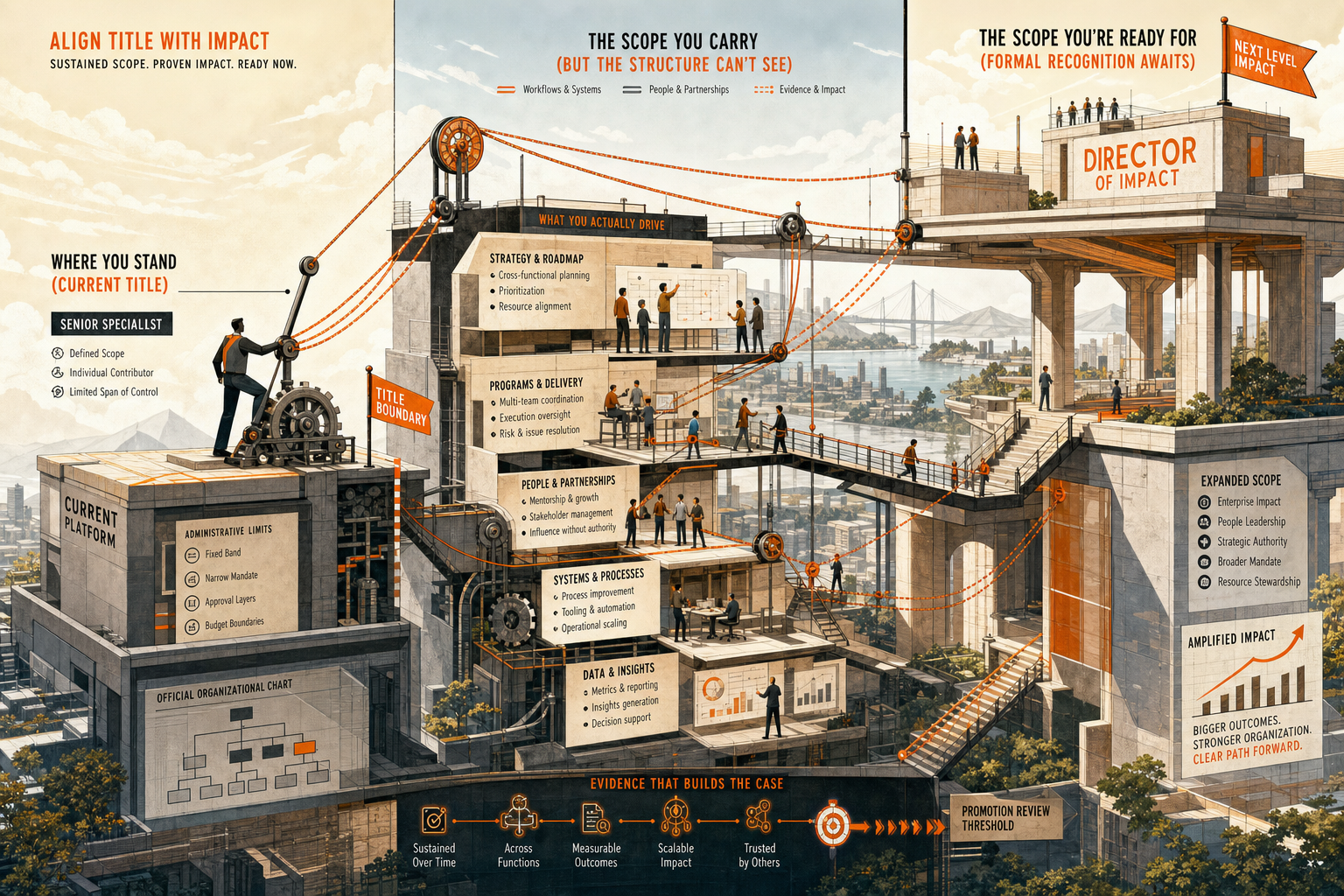
Build a Promotion Packet Your Manager Can Use

A lot of promotion packets are just anxiety wearing bullet points.
They are stuffed with launches, rescues, late-night fixes, glowing Slack replies, and every extra chore you picked up when the team was underwater. You can feel the Sunday-night dread in the spacing. You can hear the post-1:1 overanalysis in the verbs. Did my manager mean that? Was that encouragement or stalling? Am I close, or am I being gently sedated with praise?
Then you send the doc. Your manager says, “This is strong.”
And then: nothing.
That usually does not mean your work was invisible. It means your packet asked the wrong thing of the reader.
A promotion packet is not a museum of your effort. It is a portable argument your manager can carry into a room where you are not present, attention spans are malnourished, and someone more senior is asking, “Why this person, at this level, now?”
If your manager cannot explain your case in two crisp minutes without translating your bullets into English, you do not have a promotion packet. You have a junk drawer with timestamps.
The short version
- A promotion packet is not a brag doc. It is a case for next-level scope.
- “I worked really hard” is emotionally true and promotion-wise flimsy.
- The best packets are selective, reusable, and easy to say out loud.
- Every strong example does four jobs: situation, action, outcome, level signal.
- Build the case before review season turns everyone into a hostage negotiator.
- Talk about compensation after you establish level and scope.
- A strong packet improves advocacy. It does not vaporize budget freezes, headcount limits, or bad timing.
Stop writing for fairness. Start writing for portability.
Most people write the packet they wish the company morally owed them.
That version says: Look how much I carried. Look how often I cleaned up other people’s messes. Look how quietly I suffered. Please finally be decent about this.
Reasonable feelings. Weak document.
Promotion conversations are not evaluating whether the universe has been fair to you. They are testing whether your work already resembles the next job in a way other people can summarize, compare, and defend. Your manager does not need your full emotional weather report. They need a claim, proof, and a few lines sturdy enough to survive pushback from someone who barely knows your name.
So start there.
Before you add one project bullet, answer this: if your manager had to advocate for you tomorrow with no prep, what are the three sentences you want them to say?
Three. Not thirteen. Not a timeline of your suffering.
A solid opening might be:
I am ready for Senior Product Manager because my work already shows next-level ownership in cross-functional execution, independent judgment, and measurable business impact.
Now the rest of the packet has a real job. It exists to prove that sentence, not wander away from it like a loose shopping cart.
The move this week is simple: write your promotion claim in one sentence. If you cannot name the level and the reason in one breath, stop gathering more evidence and fix the claim first.
Organize around proof, not effort
Here is the rude little truth at the center of all this: “I worked incredibly hard” is persuasive to your friends and nearly useless in calibration.
Effort matters. It just does not answer the question promotion committees are actually asking: does this person’s scope already look like the next role?
The evidence that tends to matter falls into five buckets:
- results
- teamwork
- leadership
- bigger responsibilities
- strategic impact
Those buckets force discipline. They make you stop asking, How much did I do? and start asking, What does this prove about the level I’m operating at?
That shift kills a shocking amount of filler.
The distinction matters:
- Busy work: I handled a lot.
- Strong work: I handled it well.
- Promotable work: I changed outcomes beyond my own task list.
That last category is where people routinely undersell themselves, especially if their contribution was judgment, coordination, prioritization, risk reduction, or process design rather than one sparkly launch with a giant revenue number glued to it.
Here are a few hypothetical examples.
Example 1: Product manager at a SaaS company
Weak
“I supported the Q2 product launch and kept teams aligned.”
Useful
“As PM for the Q2 admin-permissions launch, I ran a weekly decision review across engineering, design, support, and sales enablement for a 12-person working group. I identified that legal approval and migration messaging were likely to delay release, pulled those decisions forward by two weeks, and changed the rollout sequence to reduce customer confusion. The feature shipped on schedule to 18,000 workspace admins, support tickets came in 22% below forecast during launch week, and sales used the release in 14 expansion conversations that quarter. This signals next-level scope because I was not just tracking tasks; I was reducing cross-functional risk and making decisions with revenue consequences.”
Example 2: Operations analyst at a healthcare organization
Weak
“I helped improve referral processing.”
Useful
“I audited referral delays across three specialty clinics after patient complaints rose, found that manual handoffs between intake and scheduling were creating a 2.4-day lag, and proposed a new routing workflow with a same-day exception queue. I partnered with two clinic managers and IT to pilot the change for six weeks. Average referral processing time dropped from 5.8 days to 3.1 days, and the backlog over 10 days old fell from 146 cases to 39. This points to next-level performance because I moved beyond reporting a problem and redesigned a process that reduced patient delay and operating risk across departments.”
Example 3: Account manager at a marketing agency
Weak
“I managed a difficult client relationship and kept the account on track.”
Useful
“For a $420,000 annual retail account at risk of churn, I noticed delays were being driven by muddy approval rights on the client side and repeated last-minute revisions on ours. I reset the governance model, established one weekly approval meeting with the client’s director and brand manager, and added an internal pre-review step that cut revision rounds. The client renewed for another year, expanded paid social spend by $90,000, and gave our team two additional product lines to manage. The signal here is not that I was ‘responsive.’ It is that I stabilized a revenue-risk account by changing how both sides made decisions.”
Example 4: Internal-facing individual contributor
Not every promotable example comes with fireworks.
If you work in recruiting, compliance, finance, L&D, support, or another internal function, your case may be about speed, consistency, cleaner handoffs, lower error rates, or risk reduction.
For example:
“I noticed monthly close requests were coming in through six different channels, built one intake tracker with owner and due-date rules, and trained 11 stakeholders to use it. The number of overdue close-related tasks dropped from 27 to 8 within two cycles, and we stopped missing the controller review deadline. This signals bigger scope because I standardized a process used across functions instead of just completing my own assigned tasks faster.”
Pick two recent projects and rewrite them that way today. No poetry. No corporate incense. Just scope, intervention, outcome, meaning.
Your manager needs talking points, not a scrapbook
When people are scared their work is being missed, they respond with volume.
More bullets. More screenshots. More praise. More context. More “just in case.” It is the professional version of bringing six suitcases for a weekend trip because maybe one restaurant will feel “dressier.”
That instinct is understandable and disastrous.
A bloated packet makes every project look equally important, which is another way of saying nothing looks important. The people reading it are not curled up with tea, lovingly tracing your career arc. They are scanning. Comparing. Hunting for reusable language.
So be selective on purpose.
Think one-page argument with backup, not twelve-page diary written during a blood-sugar crash.
Cut anything that only proves you were busy. Cut anything that takes five minutes of oral explanation to make sense. Cut anything that makes your manager perform interpretive labor you should have done yourself.
Here is a brutal but useful test: if 70% of this file vanished, which three examples would make you physically tense to lose? Put those near the top. Everything else is support material or clutter.
Every example needs four parts
Most weak packets are not empty. They are under-finished.
The writer describes the work. Sometimes they even include a nice result. Then they stop one inch before the most important line: why this example shows readiness for the next level.
Use this structure:
- Situation — What was happening?
- Action — What did you specifically do?
- Outcome — What changed?
- Level signal — Why does this indicate next-level scope?
That fourth line is where the packet stops sounding like “great job” and starts sounding like “yes, this is bigger.”
A result can still read as excellent execution at your current level unless you interpret it. Did you define the approach instead of just following one? Influence peers without formal authority? Spot the issue before anyone assigned it to you? Improve the system, not just your own deliverable?
Sit with this question: if a skeptical leader read your example cold, would they say “helpful” or “operating above level”?
If the answer is “helpful,” the example is not done.
What a usable packet actually includes
You do not need a literary masterpiece. You need a document another person can use under mild stress.
A strong packet usually has four layers, in this order:
1. One-sentence recommendation
State the level and the case plainly.
I am making the case for promotion from Product Manager II to Senior Product Manager based on sustained cross-functional ownership, stronger decision-making in ambiguity, and measurable commercial impact.
2. Four-bullet summary
Preview the strongest themes, not every project you have touched since the invention of email.
3. Three evidence examples
Pick the best three. Not the ten freshest.
Each should include situation, action, outcome, and level signal.
4. Brief appendix
Only backup material: links, screenshots, extra metrics, stakeholder notes, or prior praise that actually adds weight.
That is enough for most people.
A rough length guide:
- 1 sentence recommendation
- 4 bullets summary
- 3 examples at 150–250 words each
- 1 short appendix if needed
Here is a hypothetical excerpt:
Promotion case: Product Manager II → Senior Product Manager
Recommendation: I am ready for Senior Product Manager based on independent cross-functional leadership, stronger risk judgment, and measurable commercial impact.Summary - Led admin-permissions launch across engineering, design, support, and sales enablement; shipped on schedule to 18,000 workspace admins with support volume 22% below forecast.
- Identified legal-review and migration-sequencing risks early, moved decisions forward two weeks, and prevented a launch delay.
- Became the default cross-functional decision owner for two adjacent workflow projects, expanding scope beyond assigned roadmap execution.
- Partner teams now involve me earlier in planning because I catch dependency risks and clarify tradeoffs before escalation.
Read it out loud. It sounds like something a manager could repeat without breaking eye contact with the room. That matters.
Try this: open your current packet and delete anything you would be embarrassed to read aloud in a calibration meeting because it sounds vague, needy, or oddly ceremonial.
Name the feelings. Then refuse to let them drive.
Promotion conversations are emotional long before they become procedural.
There is resentment when the loudest person in the room gets credit for work you know was mostly theatrical. There is embarrassment when you have to write about yourself in language that feels unnatural, as if you are auditioning to be your own LinkedIn parody. There is that electric relief after a good 1:1—finally, they see it—followed by the nasty little drop two days later when nothing concrete changed and you realize you may have mistaken warmth for movement.
All of that is real.
None of it should be driving the packet.
Your packet’s job is to translate feeling into evidence.
Instead of:
“I keep taking on extra work and nobody notices.”
Write:
“Over the past two quarters I absorbed onboarding for two new hires, became the point person for intake prioritization, and standardized project handoffs, which expanded my scope beyond individual execution.”
Instead of:
“Everyone depends on me.”
Write:
“Three partner teams now route planning decisions through me because I identify dependency risks early and assign ownership before deadlines slip.”
Same reality. Better language. Less smoke.
Pick one complaint you have repeated recently—to your spouse, your best friend, your Notes app, your ceiling fan at 1:07 a.m.—and rewrite it as a proof statement. That single move will improve your packet faster than adding another page of noble suffering.
Build the case before review season stiffens everyone up
The worst time to build a promotion packet is right after a disappointing review.
Can you do it then? Sure.
Will you be angry, defensive, and parsing every sentence like a cryptographer decoding a ransom note? Also yes.
Earlier is better:
- before review season
- before the decisions are mostly set
- when the praise is getting repetitive but the advancement path is still foggy
- when your responsibilities have plainly outgrown your title
A packet gives shape to a conversation that would otherwise drift into vibes, euphemisms, and everybody smiling too hard.
And one credibility note matters here: sometimes the case is good and the answer is still not now. Headcount freezes are real. Budget constraints are real. Org reshuffles are real. Promotion cycles get locked. A strong packet cannot karate-chop those constraints into dust. What it can do is force clarity about whether the issue is timing or level.
Send this before your next 1:1:
I’m putting together a promotion case based on scope and evidence. I’d like to use our next conversation to test which examples support the next level and where the case is still thin.
It is calm, adult, and annoyingly hard to dodge.
If the criteria are vague, force them into English
“Be more strategic.”
“Show more leadership.”
“Increase your visibility.”
These are not insights. They are office fog.
Your job is to keep pushing until the fog becomes observable behavior.
Start here:
- What would “more strategic” look like in my role over the next quarter?
- Which behaviors would make you say I am already operating at the next level?
- Is the gap about scope, consistency, stakeholder influence, or business impact?
- Which recent example was close to promotion-level, and what was missing?
A quick example:
Manager: “You’re doing well. I’d like to see more strategic leadership.”
You: “Can you translate that into something I could demonstrate this quarter?”
Manager: “I want you thinking bigger, not just executing.”
You: “What would that look like here—identifying cross-team risks earlier, shaping roadmap decisions, or influencing stakeholders without escalation?”
Manager: “Probably more of the cross-team influence piece.”
You: “Helpful. Can you point to a recent project where I was close but didn’t quite show that?”
Manager: “On the onboarding rollout, you coordinated well, but I wanted you to push harder on policy decisions with operations.”
You: “Got it. So one sign of next-level performance would be not just coordinating the launch, but driving the unresolved cross-team decisions myself.”
Manager: “Yes.”
Now you have something useful.
Do not leave these conversations with a bouquet of adjectives. Leave with a behavior, an example, and a test.
Talk about pay after you establish scope
A lot of people combine promotion, pay, burnout, loyalty, inflation, and existential disappointment into one exhausted speech.
That speech is emotionally understandable and strategically muddy.
The cleaner sequence is:
- establish the scope
- show the evidence
- discuss compensation in relation to level and market context
That does not make the conversation fun. It makes it legible.
A stronger script sounds like this:
I’d like to talk about compensation in the context of scope. Over the past two quarters, my work has shifted from Product Manager II expectations toward Senior Product Manager responsibilities. Specifically, I’ve been leading cross-functional launch decisions, independently resolving dependency risk across teams, and owning outcomes that affected adoption and expansion revenue. Based on that scope, I’d like to discuss aligning my title and compensation to the Senior Product Manager level.
If you bring in market data, keep your tone sane:
I’m not treating market data as a perfect answer, but I reviewed published U.S. benchmarks for Senior Product Manager roles, and the range is higher than my current compensation. I’m using that as context alongside my responsibilities and impact.
And be ready for the most common answer in corporate America:
Manager: “I agree your scope has grown. The challenge is cycle timing and budget.”
Do not panic and start free-associating about rent.
Say:
Understood. If timing is the constraint, I want to separate that from whether we agree on level. Do we agree that my current scope aligns with Senior Product Manager expectations? If yes, what is the path and timeline for title and pay alignment? If no, which specific evidence is still missing?
That question is useful because it stops the conversation from dissolving into polite gelatin.
Here is a question worth sitting with before you book the meeting: can you explain why your compensation should change without mentioning burnout, loyalty, or cost of living? If not, your scope case needs another pass.
Build something your manager can carry — and something private you can think with
This is usually the moment people realize their current packet is not a case. It is a stressed-out scrapbook with a few excellent bullets trapped inside.
That is why tools only help if they solve the narrow problem that actually exists.
Career Compass’s Promotion Case is built for professionals in the United States preparing for a promotion or compensation conversation, and it is Available for iPhone in the United States. The product is not pretending to be your life coach, your therapist, or an infinite career chatbot. It is designed to help you turn scattered evidence into a cleaner case your manager can use.
The structure is practical. You complete role and pay setup. You approve one Evidence example in each of five Case Check areas—results, teamwork, leadership, bigger responsibilities, and strategic impact. Then you review the offer, separately authorize AI preparation if you want it, and complete the one-time US in-app purchase of $24.99 for one case per account, with no subscription required for that purchase. After that, you review both documents, make supported edits, and approve email delivery of two PDFs.
Those two PDFs matter because they solve a real tension. You get a manager-facing Promotion Case PDF and a separate private Conversation Guide PDF. Your manager needs the clean, portable version. You need a private place to keep the tougher framing, the compensation notes, and the sentences that help you think clearly but do not belong in the document you hand over. Evidence can be saved without AI drafting, and if you choose optional AI drafting and purchased document preparation, the permissions explicitly identify OpenAI. The app also includes published U.S. occupation benchmarks—or clearly labeled age-adjusted national earnings context when a reliable occupation match is unavailable—as context, not a verdict on your worth. And your employer cannot access your private account through the app; you choose what to share.
None of this guarantees a promotion, raise, salary increase, or any other employment outcome, because no honest product can promise that. What it can do is help you make the argument cleaner, sharper, and easier to carry. And that is more important than people think. A promotion conversation often does not fail because the work was weak. It fails because the case was mushy, overloaded, or left half-interpreted for someone else to finish.
So if your current packet feels like a pile of receipts and half-sentences, do not respond by making it longer. Make it more useful. Tighten the claim. Pick better proof. Translate emotion into evidence. Build something another person can repeat in a room you are not in.
That is the mindset shift: your job is not to document everything. Your job is to make the next-level story hard to misunderstand. If Career Compass helps you do that, great. If you do it on your own, great. But either way, stop handing over your stress and calling it a strategy. Hand over an argument.