How to Work With an Unreliable Boss
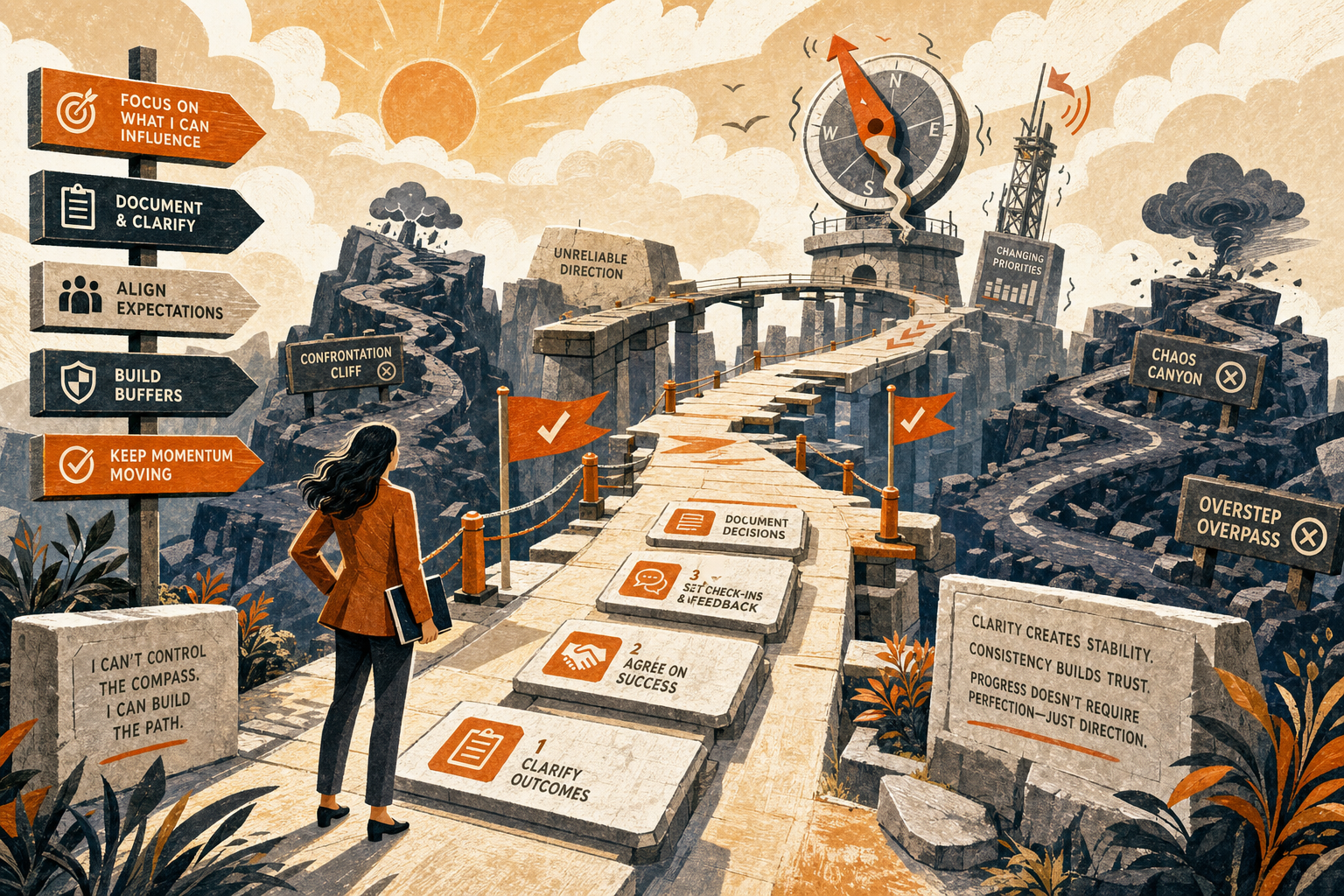
When Your Boss Is Unreliable, Stop Managing Their Personality and Start Managing the Risk
Early in your career, it is very easy to spend half a year solving the wrong problem.
You keep turning the situation over in your mind like you are preparing a legal defense: Is my boss actually that bad? Am I being dramatic? Maybe this is just corporate life? Maybe I need thicker skin? Meanwhile the real damage is not philosophical. It is operational. Deadlines wobble. Other teams start asking careful little questions that mean, “Should we be worried?” You open your laptop on Sunday night and feel that sour, metallic dread because tomorrow’s priorities depend on a person who treats follow-through like a loose suggestion.
That is the real issue. Not whether your manager is “toxic” enough to win a debate on the internet. Whether their pattern is creating risk for your work, your reputation, and your nervous system.
There is a specific kind of management failure that does not look dramatic from the outside, which is why it is so corrosive. No screaming. No desk-slamming. No cartoon villain behavior. Just a constant drip of unreliability: the canceled 1:1, the approval that never arrives, the stakeholder update they swore they sent, the meeting where they talk as if a decision exists because it would be embarrassing to admit it does not. It creates fog.
Fog is expensive.
And because it is low-drama, people above you often miss it completely. They do not see the six tiny failures that produced the mess. They see the launch that slipped, the partner team that lost patience, the work that somehow came in sideways. If you are conscientious, ambitious, or still learning how much chaos is not normal, you can end up telling yourself the most expensive lie in the workplace: Maybe I’m the disorganized one.
Sometimes you are. Often you are not. Often you are standing inside a weak management system that is quietly training you to absorb disorder and call it professionalism.
So let’s get cleaner about the job in front of you. This is usually not a confrontation problem first. It is an execution problem first. Your task is not to psychoanalyze your boss, deliver a moving speech about accountability, or become their unpaid executive function. Your task is to make the work harder to drop.
First, separate a rough patch from a real pattern
Every manager drops a ball sometimes. Good managers get overloaded. Smart managers get scattered during ugly quarters. People have family emergencies, bad weeks, bad launches, bad months. One delayed reply is weather.
A pattern is climate.
Your body often knows that before your calendar does. A pattern sounds like this:
“I don’t trust verbal decisions anymore.”
“I need everything in writing or it somehow becomes fictional.”
“I spend more time reminding my boss what they agreed to than doing the thing they agreed to.”
“I feel an absurd jolt of relief when they show up to a 1:1 prepared.”
That last one is a giant clue. If basic managerial competence feels like finding water in the desert, the baseline is off.
Unreliability becomes your problem when your ability to do good work now depends on your ability to compensate for their inconsistency. Not once. Repeatedly. Enough that your job quietly splits in two: the role you were hired for, and the invisible maintenance work of reminding, clarifying, documenting, buffering, pre-explaining, and cleaning up.
Sit with four questions:
- In the last month, how many times did I restate a decision because my manager forgot, reversed, or blurred it?
- What messes have I quietly prevented that no one else knows almost happened?
- Am I being judged on outcomes that required approvals, updates, or decisions I could not force?
- Do I brace before meetings because I may need to correct the record in real time?
If several answers sting, stop asking whether your boss is “good” or “bad.” Start treating the pattern as operational risk. The move this week is to write down three concrete examples from the last two weeks: what happened, what changed, and who got affected.
Why this scrambles you so badly early in your career
The trap is not just that your boss is inconsistent. It is that you assume inconsistency is more visible than it is.
It isn’t.
Senior leaders are almost never in the places where the real damage happens. They are not watching your manager disappear from Slack for two days while a dependency sits there aging like milk. They are not hearing the direction change for the third time. They are not the person having to say “we’re still aligning” in that careful professional tone that really means “nothing is settled and I hate being the one saying this.” They just see outcomes.
And outcomes are rude. They do not arrive with explanatory footnotes.
That is why unreliable management becomes your performance problem so quickly. You are the nearest visible surface when things go wrong. The organization does not always know where the crack started; it just notices where the water came through.
This is also why the emotional experience gets so weird. You are frustrated, then embarrassed to be frustrated, then guilty for sounding uncharitable, then angry that you are now managing your own anger on top of the actual work. Sunday night dread shows up. A calendar invite from your manager gives you a little flash of adrenaline. Then, on the rare week when they are clear and steady, you feel almost euphoric. That electric relief is data. Your body is not celebrating excellence; it is reacting to the temporary absence of instability.
Do not dismiss that. Feelings are not the whole case, but they are part of the evidence. If you want to get out of self-doubt, start with specifics. Write the moments down while they are fresh, before your brain does its favorite trick and tries to smooth the whole thing into “it was probably fine.”
Stop chasing the perfect honesty conversation
People love to say, “Just be direct.”
That advice is cheap because it gets to feel brave without having to be useful.
Yes, sometimes a clean conversation helps. But with an unreliable boss, the big honesty talk often collapses into one of two dead ends. Either it turns into a little therapy session where you explain your disappointment to someone with weak operational discipline, or it becomes a tone trial where they focus on whether you sounded frustrated instead of the broken process that made frustration inevitable.
Neither outcome gets the project approved by Thursday.
A better sequence is much less cinematic: clarify, externalize, checkpoint, then escalate if needed.
That order matters because it answers two different questions in the right sequence:
- Can this manager function better if the work is structured more clearly?
- If not, can I make the risk visible before it lands on me?
Those are adult questions. “How do I finally make them understand how this makes me feel?” may be emotionally real, but strategically it is often a trap.
So before you schedule the courageous conversation in your head for the fiftieth time, build a work environment where reality leaves receipts.
Clarify: get decisions out of the air
Unreliable managers love verbal fog because verbal fog is easy to revise later.
You leave a meeting thinking a decision was made. They leave with a hazy sense that some options were discussed. By Thursday, the team is working from three incompatible versions of reality, and by Tuesday you are in a meeting that feels like a hostage exchange over facts that were supposedly settled last week.
The fix is boring. Good. Boring fixes are underrated.
Send the recap.
After any meeting that contains a decision, tradeoff, deadline, owner, or dependency, send a short written summary. Not a manifesto. Not a performative CYA novel. Just a clean note that pins the work to the page.
For example:
Quick recap so we stay aligned: - Decision: We’re moving forward with version B - Owner: I’ll update the deck by Wednesday - Approval needed: Final sign-off by Thursday at noon - Timing risk: If sign-off moves, client send shifts to Friday
That message does four useful things at once. It sharpens memory. It reduces later revisionism. It gives other people something stable to reference. And if your manager is disorganized rather than slippery, it genuinely helps them.
A lot of early-career people resist this because they worry it will seem stiff, paranoid, or overly formal. Ignore that instinct. In vague environments, clarity feels “formal” the way a seatbelt feels restrictive right before the crash.
Pick one recurring meeting and start sending recaps after it today. If your stomach tightens just imagining that, that is probably a sign the fog has been doing too much work.
Externalize: if the work lives only in their head, you are exposed
Some teams are run on documents. Some are run on memory, vibes, and a handful of private messages sent at unholy hours.
The second kind is where careers get dented.
If key decisions, open questions, and deadlines live only in your manager’s head—or worse, in ten half-formed side comments scattered across Slack, hallway chats, and rushed calls—then your work is being run on weather. Some days it is fine. Some days lightning hits the building and everybody acts shocked that lightning exists.
Move the work into a shared artifact.
That could be a project doc, task board, weekly update, standing email thread, decision log, or even one absurdly simple shared note that everyone can see. The tool matters much less than the fact that the system is visible and not dependent on one person’s memory.
A lightweight structure is enough:
- what was decided
- what is still open
- who owns what
- what date matters next
- what is blocked, and by whom
If you want a hard test, ask yourself this: If my manager vanished for three business days, would the team still know what is happening? If the answer is no, your operating model is too dependent on an inconsistent narrator.
So build one shared source of truth for one active project. Do not wait for permission to make the work more legible.
Add checkpoints before the blast radius gets big
One of the most expensive habits smart junior employees develop is polite waiting.
You know approval is needed Friday, so you ask Friday. You know your manager has to brief the stakeholder next week, so you mention it next week. You know changing direction late will blow up the timeline, so you hope nobody changes direction late.
Then the fire arrives exactly on schedule.
Do not play deadline chicken with an unreliable manager.
If approval is needed Friday, create a Wednesday checkpoint. If another team needs an update next week, draft it this week. If a decision reversal would waste days of work, surface that tradeoff before people are already halfway through the wrong version.
This is not nagging. It is sequencing. It is the grown-up version of refusing to stand on train tracks because everyone else seems relaxed.
A line that works well here is:
To stay on timeline, I’m planning around a Wednesday approval checkpoint. If that shifts, I’ll need to move the client send date.
That sentence is useful because it is not emotional and not passive-aggressive. It links timing to consequence. Adults may ignore your vibes. They have a much harder time ignoring a clearly named tradeoff.
Try This: look at one deliverable due next week and pull the critical dependency forward by 48 hours. Put it on the calendar or in writing. Future-you will be thrilled.
Managing up is not about being nice. It is about being legible.
A lot of people think managing up is mostly diplomatic phrasing with good posture.
Not really.
When your boss is unreliable, the goal is not to sound agreeable. The goal is to make the work impossible to blur.
“You keep forgetting things” might be true. It is also weak. It invites denial, defensiveness, and a pointless scavenger hunt for exceptions. “If final copy is not confirmed by 3 p.m. Thursday, design loses a day and launch email slips” is stronger because it ties the issue to work that exists in time.
The best managing-up language is specific, neutral, and forward-moving. Use sentences that create edges:
- “Here is my understanding of the decision and next step.”
- “This remains open on my side until we confirm X.”
- “If we choose option A, the tradeoff is Y.”
- “I want to flag the risk now rather than discover it at deadline.”
- “Before I proceed, can you confirm owner and timing?”
That is not robotic. It is disciplined. And discipline is especially valuable when you are resentful.
Because yes, resentment is usually in the room by now. Of course it is. You are doing conscientious work inside someone else’s inconsistency. Your email drafts start getting a little sharper. Your meeting comments get a little more pointed. You are not imagining the unfairness. But once your frustration becomes visible, weak managers love to switch topics—from the broken process to your tone.
Do not gift them that escape hatch.
The better question is not “How do I say this nicely?” It is “How do I say this so clearly that the work cannot hide?” Pick one phrase from the list above and use it in your next status update.
Do not become the secret cleanup crew
This is where high performers get trapped.
At first, compensating for your boss feels smart. Mature, even. You remind them before every deadline. You restate their commitments to other teams. You fix confusion quietly because it is faster than letting the confusion become public. The work moves, mostly. People praise you for being adaptable, steady, easy to work with.
Be careful with that compliment. It has swallowed a lot of promising careers whole.
What is being praised may not be healthy competence. It may be over-functioning: doing your job plus the missing executive function of the person above you. From the outside, you look polished. From the inside, your calendar fills with invisible maintenance, your stress level never quite comes down, and your reputation starts depending on your willingness to absorb dysfunction without naming it.
Worse, your effectiveness can hide the real problem so well that nobody realizes there is a problem at all. You become the human gasket in a badly built machine. Everybody is grateful the leaking is quieter, and nobody asks why there is so much pressure in the system.
Here is the uncomfortable question worth asking: If I stopped compensating so aggressively for two weeks, what would become visible? Whatever answer comes up is the shape of the unpaid labor you have been performing.
You do not need to stop being helpful. You do need to stop making the dysfunction disappear so completely that it can never be addressed.
When to escalate
Do not escalate the first time your manager flakes. Also do not wait until you are fantasizing about throwing your laptop into a river.
The right time is usually when three things are true:
- you created reasonable structure
- the same breakdown kept happening
- the consequences now affect other people, deadlines, or commitments
That is the shift. Once the damage is shared, this stops being a private “relationship issue” and becomes an execution issue.
Escalation does not always mean dramatic confrontation. Sometimes it means pulling another stakeholder into a status note. Sometimes it means documenting the unresolved dependency in a shared project update instead of carrying it silently. Sometimes it means saying, in a place others can see, “We still need final sign-off today to avoid moving the timeline.”
And sometimes, yes, it means a skip-level conversation.
If you get there, do not show up with a personality indictment. Show up with a pattern:
- what repeated
- what structure you already put in place
- what risk now exists
- what support or clarity is needed
That is a much stronger position than “I’m frustrated.” Frustration may be justified, but a visible execution pattern is what organizations can actually act on.
Your move: look at one active project and ask, Where am I still solving this privately? Then stop solving that part privately.
Some managers are coachable. Some are chronic.
This is important because not every unreliable boss is a lost cause.
Some are new and improve fast once the work is structured. Some are drowning in one terrible quarter and come back to life once the pressure eases. Some genuinely need a direct report who documents well and builds rhythm around the work. Those situations are frustrating, but they can get better.
Then there is the chronic version.
The chronic version has a smell to it. Repeated reversals. Promises made in meetings and forgotten by the next morning. Approvals that appear only after everything is already on fire. Other teams slowly losing trust. Your role quietly mutating into translator, tracker, chaser, and damage-control unit.
In chronic situations, every system you build eventually reveals the same thing: the issue is not a missing template. The issue is the manager.
That is when you need a harder question than “How do I make this work?” Ask: What is staying here teaching me?
Maybe the answer is useful: sharper stakeholder management, better written communication, stronger judgment under ambiguity. Fine.
But maybe the answer is uglier: to distrust your own read, normalize chaos, suppress anger, and carry anxiety like a second laptop. If that is the lesson plan, the tuition is too high.
Especially early in your career, environment is not a side detail. It is formative. One messy stint will not ruin you. Spending years in a system that erodes your confidence and retrains your definition of normal absolutely can.
The line in the sand
Here is the rule more young professionals should use:
If the pattern remains after the work is visible, stop protecting it with private effort.
That means stop relying on verbal approvals alone. Stop shielding your manager from looking disorganized to other teams. Stop editing reality in your own head so the system feels more coherent than it is. Stop assuming that if you become calmer, nicer, more patient, more organized, or somehow spiritually superior, the structural problem will disappear.
Personal excellence is not medicine for managerial unreliability.
Your job is to create clarity, not perform miracles.
So no, the next step is not to become tougher in some abstract personality sense. It is to become more concrete. Document one decision. Create one early checkpoint. Name one dependency before it explodes. Small moves, yes. Small in the way a smoke detector is small.
They change your position. You stop being the confused participant trapped inside someone else’s inconsistency and become the credible operator who can see risk, name risk, and reduce risk.
That shift matters because it protects more than the project. It protects your self-trust. The most corrosive part of an unreliable manager is not just the extra work; it is the way they make you question your own read on reality. You start wondering whether your stress is overblown, whether your memory is wrong, whether this is just what being “professional” feels like. It isn’t. Professionalism is not endless private cleanup performed with a cheerful face.
And if you need help seeing the pattern clearly before burnout makes the decision for you, this is where Career Compass is genuinely useful. Not as a motivational slogan, but as a way to track what your week is actually costing you: your stress, your satisfaction, your working relationships, the repeated friction points, the moments of relief that should not feel so dramatic. When your environment is confusing, clear reflection is not indulgent. It is instrumentation. It helps you tell the difference between a fixable management gap, a chronic problem, and a role that is slowly teaching you the wrong lessons.
So take the argument of this piece seriously: stop trying to manage your boss’s personality like it is a side project that might finally pay off. Manage the risk. Make the work visible. Let the pattern show itself. Then decide from there, with your eyes open. That is a better career move than waiting until you are exhausted and calling it resilience.