Invisible Capacity at Work: How to Make It Visible
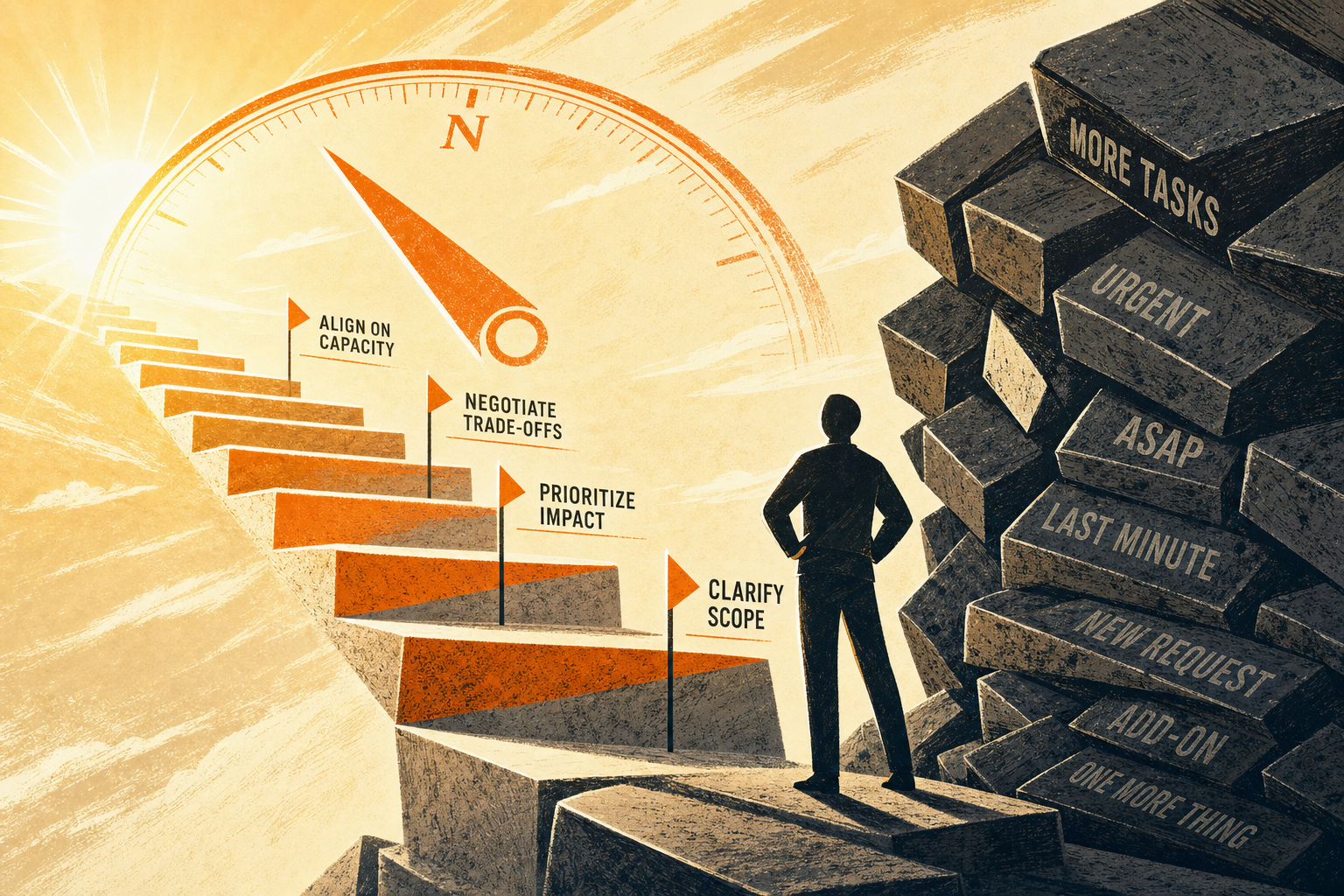
Your Workload Isn’t the Problem. Invisible Capacity Is
A lot of early-career professionals reach for the same explanation when work starts feeling impossible:
“I just have too much on my plate.”
Sometimes that’s exactly right.
But often the real problem is more specific, and more dangerous: people can see the tasks getting assigned, yet they cannot see the capacity those tasks are consuming. So when something slips, the story told about you is rarely this person was carrying an unrealistic load. It becomes this person dropped the ball, or struggles to prioritize, or looked strong until things got real.
That’s what stings. Not just the overwork itself, but the lonely, nauseating experience of being judged for constraints you never made visible.
I learned this the expensive way. Early in my career, I said yes too quickly, wore “helpful” like a personality, and kept treating strain as a private problem I should be able to outwork. Eventually I burned out hard enough in a leadership role that I had to resign and disappear for a month just to recover.
One lesson from that collapse never left me:
If you keep your strain private, the consequences go public.
TL;DR
- “Busy,” “overloaded,” and “blocked” are three different states. If you blur them, your manager will too.
- “I’m slammed” communicates pain. It does not communicate a decision.
- Most reputational damage comes from invisible capacity, not high workload by itself.
- Strong operators do not act like emotional support pack mules for everyone else’s urgency. They surface tradeoffs early.
- A short written recap after priorities change is one of the highest-return habits you can build.
- If you want less resentment, fewer surprise misses, and fairer reviews, make your bandwidth legible.
The real danger is not hard work. It’s hidden tradeoffs.
There is nothing admirable about silently deteriorating at your desk while still sending “Sounds good!” on Slack.
A lot of smart people were trained into this posture. Be easy to work with. Be grateful for the opportunity. Don’t be high-maintenance. Say yes quickly. Figure it out privately. Don’t make your stress other people’s problem.
Then Sunday evening arrives, and that familiar dread starts humming in your chest. Your stomach tightens before your laptop even opens because you already know what Monday will bring: three fresh requests dropped onto a week that was full on Friday, plus the cheerful fiction that all deadlines remain unchanged.
That feeling is data.
The dread, the irritability, the strange urge to throw your phone into a river when another “quick ask” lands—those are often signs that your workload is no longer just a personal productivity issue. It has become a coordination failure.
Hidden capacity is what happens when your workload passes the point of realism, but nobody else has been shown the consequences in concrete terms. You know your bandwidth is gone. Maybe your manager vaguely suspects it. But there is no shared record that says, “If this gets added now, this deadline moves, this work gets less review time, and this quality risk goes up.”
And when there’s no record, people invent stories.
They usually do not invent the generous one.
They invent the one that makes your miss look like a character flaw.
So before you tell anyone you’re “busy,” diagnose the actual state:
- Busy: My week is full, but the work is still doable.
- Overloaded: Something will slip unless priority, scope, or timing changes.
- Blocked: The problem is not effort. I’m waiting on approval, input, access, or a decision.
Those are not synonyms. They are three different management situations, and they require three different conversations. The move this week is simple: catch yourself the next time you say “busy” and replace it with the real diagnosis.
Why “I’m slammed” rarely gets you help
When conscientious people finally speak up, they often do it late and vaguely.
Not because they’re weak. Because they’re trying to be impressive.
They want to be seen as capable, resilient, calm under pressure. They want the little identity thrill of being the person who can “handle a lot.” So they wait until they’re fried, then unload in a 1:1 with some version of:
“I’m underwater.” “I’ve got too much going on.” “I’m completely slammed.”
All true. Still not useful.
That language describes emotional weather, not operational reality. Your manager hears thunder. They still don’t know which roof is leaking.
Should they move a deadline? Cut scope? Reassign work? Confirm that one priority now outranks another? Most managers are much better at responding to a decision than to distress.
This is the shift: stop reporting strain and start describing consequence.
Compare these:
- “I’m slammed.”
- “If I add the recruiting analysis today, the client deck either moves to Monday or goes out with a weaker QA pass. Which tradeoff do you want?”
The second sentence does something the first one doesn’t: it drags reality into the room and makes somebody else participate in it. That is the job. You are not begging for sympathy. You are forcing a choice.
Use lines like these if your brain goes blank under pressure:
- “I can take this on. If it stays on top of current priorities, the reporting update moves from Thursday to Monday.”
- “Right now I’m committed to A and B. If C is now first, which of the first two should slip?”
- “Happy to handle this. I want to confirm whether this changes the original timeline or sits alongside it.”
- “I can get you speed or polish by Friday, but not both at this scope.”
That last line is especially useful because many workplace messes are caused by pretending speed, quality, and unchanged scope can all live together forever. They can’t. At some point, one of them gets mugged in the parking lot.
Pick one stakeholder and send one version of that message today.
Make workload visible before it becomes a reputation problem
The best capacity conversations are not dramatic. They are specific.
You do not need a brave speech. You do not need a twelve-tab dashboard titled “Why I Am Suffering.” You need a clean way to show four things:
- What you were already responsible for
- What is newly being added
- What changes if the new work is accepted now
- What you recommend
That’s it.
Writing helps because meetings are full of fake clarity. Everyone nods. Everyone says “Yep, makes sense.” Then two days later, you discover six people walked out with six different versions of what was agreed.
A short follow-up note fixes that.
For example:
| Work item | Original timing | If new request is added now |
|---|---|---|
| Monthly report | Thursday | Moves to Friday morning |
| Presentation | Friday | Gets one less review round; error risk increases |
| New analysis | Not planned | Can be delivered Wednesday if above tradeoffs are accepted |
That level of specificity kills magical thinking. It also protects you from one of the most maddening experiences in office life: everyone informally agreeing to overload you, then acting surprised when outcomes change.
Here’s a version you can steal:
Following up on the new analysis request from today. I’m currently working toward the monthly report for Thursday and the presentation for Friday.
If the analysis is now needed by Wednesday, I can do that, but it would likely move the report to Friday morning and reduce review time on the presentation.
My recommendation would be either:
1. keep the current deadlines and move the analysis to Thursday, or
2. prioritize the analysis for Wednesday and accept the timing and quality tradeoffs above.
Let me know which option you’d prefer.
That email is doing adult work. Calm tone. Clear tradeoffs. Written memory.
Try This: the next time a “quick ask” lands, send a written recap within 15 minutes. Not polished. Not literary. Just unmistakable.
Early escalation is not drama. It is part of the job.
A lot of people wait too long because they think raising capacity concerns will make them look fragile, difficult, or less capable than their peers.
So they push.
They stay online a little later. Answer too quickly. Skip lunch. Tighten their jaw. Tell themselves they’ll get through this week and reset next week, as if next week is a spa that has been lovingly reserved in their honor.
Then the whole thing starts to feel gummy. Every task is urgent. Your thinking gets shallow. You make dumb errors you normally wouldn’t make. You start resenting requests you might have handled fine if they had arrived into a sane system.
That is the moment to escalate—not when you’re one Slack message away from crying in a bathroom stall.
Escalation is appropriate when:
- new work keeps getting added without anything being deprioritized
- a deadline is now likely to slip
- quality is going to drop in a way that matters
- you are blocked on something no amount of effort can solve
- expectations changed, but nobody has acknowledged the change
Notice what’s not on that list: “I am only allowed to raise this when the building is already on fire.”
You do not earn professionalism points for becoming expensive before you become honest.
If direct statements feel hard, use questions. Questions can surface the tradeoff without sounding combative:
- “Given the new request, which deliverable should take precedence?”
- “Do you want me optimizing for speed here or completeness?”
- “Is it acceptable if X moves in order to accommodate Y?”
- “Which risk would you rather absorb: timeline or quality?”
Sit with this for a minute: where in your work do you most often stay quiet too long? That’s the exact pattern to interrupt next time.
This is not weakness. It’s judgment.
People worry that naming capacity makes them look less strong.
In decent teams, the opposite is true.
The people I trust most at work are not the smiling overcommitters who say yes to everything and then generate chaos behind the scenes. They are the ones who can hear a request and say, with zero melodrama, “Here’s what that changes.”
That is judgment.
It shows you understand work as a system, not as a sad pile of tasks sitting in a to-do list. Deadlines interact. Review time matters. Dependencies matter. Sequence matters. Human attention is not an infinite natural resource, despite what some workplaces appear to believe.
This matters in performance reviews, too. When priorities change informally and nobody captures it, you can get judged against the old plan and the expanded plan at the same time. That’s how people receive nonsense feedback like “needs to prioritize better” when what actually happened was silent scope growth plus terrible decision hygiene.
A short written note is not bureaucracy. It is memory.
It says:
Here’s what I was asked to do.
Here’s what changed.
Here’s what I flagged.
Here’s what was decided.
That record can save your reputation three months later, when everyone else has conveniently developed selective amnesia.
Your move: ask yourself whether the people around you understand your judgment, or only your willingness to work late. If it’s mostly the second, start correcting that this week.
The career skill underneath all of this
Once you get good at making capacity legible, your role starts to change.
People stop seeing you as merely hardworking and start seeing you as credible. They trust your read on timelines. They pull you in earlier. They ask for your recommendation, not just your labor. You become the person who reduces ambiguity instead of quietly absorbing it like a shop towel soaked in everyone else’s panic.
That compounds over an entire career.
Because careers are not built on output alone. They are built on judgment, expectation-setting, relationship management, and the ability to keep reality intact when everyone else is tempted to wave it away with “We’ll make it work.”
That is why this habit matters so much, especially early. If your pattern is always to absorb first and clarify later, people will mistake self-erasure for strength. And at first, that can even look rewarded. You’ll get praised for being responsive, positive, reliable, all the flattering words that sometimes mean “we’ve noticed you don’t make us reckon with consequences.”
But eventually the bill arrives. It shows up as resentment, sloppy work, weird review feedback, Sunday dread, and that particular exhaustion that feels less like being tired and more like being erased.
The better mindset is this: capacity is not a private moral test. It is shared operating reality. Your job is not to prove you can absorb infinite requests with a pleasant expression. Your job is to help the people around you make informed decisions while there is still time to make them.
So the next time priorities shift, do not nod, open eight tabs, and promise yourself you’ll “figure it out.” Name what was already in motion. Name what changed. Name the consequence. Make a recommendation. Then write it down.
That one habit is small, but it changes the emotional texture of work. It replaces vague panic with visible choices. It replaces private resentment with shared accountability. It creates one of the best feelings in modern professional life: the electric relief of a 1:1 where everyone is finally talking about the same reality.
And if this is a pattern you’re trying to change, that’s where Career Compass can help. Not as a guilt machine. Not as another productivity scold barking at you to optimize harder. As a tool for building better professional judgment before the week goes sideways. It helps you track the signals that capacity is slipping, reflect on tradeoffs before they become disasters, and build the habit of seeing your work as a system—not just a stack of demands you’re supposed to silently survive.
You do not earn trust by acting infinitely absorbent. You earn it by making the edges visible before the work tears there.