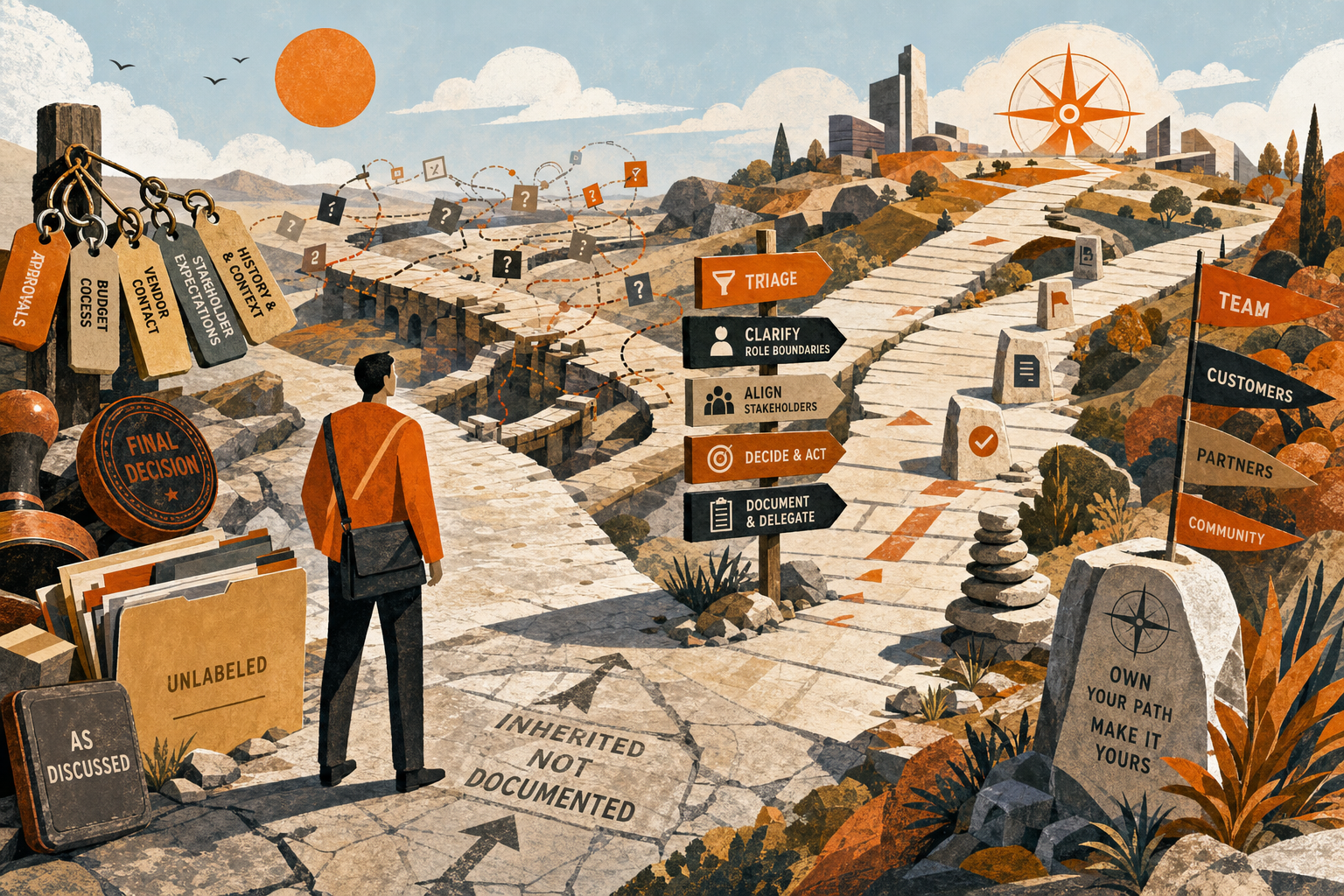
Missed a Deadline After Priorities Changed?

Missed a Deadline Because Priorities Changed? Don’t Defend Yourself. Reconstruct the Decision.
Most missed deadlines at work are not time-management failures.
They are memory failures with office clothes on.
On Monday, everybody agrees to pause Project A because the urgent thing just landed. On Tuesday, the urgent thing gets bigger, louder, and somehow acquires a review cycle. By Thursday, three people have forgotten the tradeoff, one person assumes you are “still on track,” and by Friday the original deadline strolls back into the conversation acting like it was never moved at all.
That is when the dread hits: the Slack notification you do not want to open, the meeting update you are trying to word “carefully,” the stupid little fantasy of moving to a cabin and becoming unavailable to all project management software forever.
If you are early in your career, this situation is especially brutal. You usually do not have enough authority to reset expectations with a shrug and a sentence. But you absolutely have enough visibility to get tagged as the person who “missed the date.” Which means the skill that saves you here is not charm, hustle, or heroic late-night effort. It is making the sequence visible before people start inventing their own version of it.
That is the whole argument of this piece. Your job is not to win a trial. Your job is to reconstruct the decision.
TL;DR
- When a deadline slips because priorities changed, the actual problem is usually invisible tradeoffs, not laziness.
- The worst move is waiting until after the deadline is missed to explain what happened.
- The right move is a calm written recap showing: the original plan, what changed, what got displaced, and the new realistic date.
- Managers do not need a long emotional defense. They need a clear decision in front of them.
- If this keeps happening, stop calling it a personal productivity issue. It is an expectation-setting issue.
- The reputation-protecting skill is not “working harder.” It is making changing priorities legible while there is still time to adjust.
First, stop swallowing blame that belongs to the system
Conscientious people are terrible at this part.
When something slips, they immediately look inward. I should have managed my time better. I should have worked faster. I should have seen it coming. It feels mature to assume responsibility early. Sometimes it is. Sometimes it is just misdirected guilt wearing a tie.
There is a huge difference between failing to execute and being handed a moving target. If the scope stayed the same, the priority stayed the same, and you simply did not do the work, that is one conversation. If the work got interrupted, expanded, rerouted, or quietly demoted while everyone kept speaking as if nothing changed, that is a completely different conversation.
The emotional confusion comes from the mismatch. You know you were working. You know you were responding to the team. You know your week got hijacked by things nobody is now mentioning. Yet the external story starts drifting toward, “So why wasn’t this done?” That gap between reality and perception is where dread lives. It is also where smart people start sounding weirdly apologetic for things they did not actually choose.
So name the category of problem before you draft a single message. Ask yourself: did I fail to execute, or did the plan change without the expectations changing with it? If the second one is true, your next move is not self-punishment. It is clarification. Open a notes doc and write the sequence in four lines while it is still fresh.
The trap is not the missed deadline. The trap is the silence before it.
Most people do not mess this up because they are deceitful. They mess it up because they are trying to be agreeable.
They think, Everybody knows we switched priorities.
They think, I don’t want to make this dramatic.
They think, I’ll just power through and somehow do both.
That last one is workplace catnip and reputation poison.
What usually follows is painfully predictable. You absorb the new request. You reassure yourself that you can “figure it out.” You keep the original deadline alive in conversation because admitting it is at risk feels like creating a problem. Then your updates start getting foggy. You say things like “making progress,” “working through a few things,” or “still on track for now,” which is corporate dialect for I am deeply uncomfortable and hoping reality changes first.
By the time someone asks directly, you are already late, cornered, and trying not to sound defensive. Which is hard, because now you are literally defending yourself.
Timing matters more than eloquence here. The note does not need to be perfect. It needs to exist before the miss hardens into a surprise. If you are in this situation right now, pick one stakeholder and send the clarifying message today. Not tonight when you feel calmer. Today, while the sequence is still a sequence and not a post-mortem.
What to document: causality, not your suffering
Documentation gets a bad reputation because people imagine a private evidence locker full of screenshots and passive aggression.
That is not what you are doing.
You are not preparing a case for the Hague. You are preserving causality in a workplace where memory is flimsy and everyone is half-looking at three things at once.
A useful written recap needs only four ingredients:
- What the original commitment was
- What changed
- What work moved because of that change
- What date or scope is now realistic
That is it.
Notice what is missing: the paragraph about how stressed you are, the subtle suggestion that someone else created this mess, the dramatic inventory of how hard you have been trying, and the little courtroom flourish where you prove you are a good employee. All emotionally understandable. All strategically useless.
A strong recap sounds almost boring. That is a compliment. It says: here was the plan, here was the redirect, here is the consequence, here is the decision we need. Boring is beautiful when people are scanning messages between meetings and deciding what to care about.
Use this skeleton if you need one:
- We planned to deliver X by date.
- On day/time, we shifted to Y.
- That displaced X by amount/scope.
- With current priorities, the realistic delivery is new date.
- If the original date still stands, we need to reduce scope or move another priority.
Then stop. Send it.
Here is a useful gut check: open your last three status updates. Did they describe cause and effect, or did they merely describe motion? If they are full of “working on,” “continuing to,” and “making progress,” you are narrating activity when you need to be naming tradeoffs.
What your manager actually needs from you
When priorities change, your manager does not need a diary entry. They need a dashboard.
Specifically, they need three things.
First: a clean description of the change. “Things shifted” is mush. Shifted how? Did an executive request jump the line? Did the deliverable go from rough notes to polished presentation? Did legal add a review loop that did not exist last week? If you cannot explain the change in one or two plain sentences, the whole issue stays vague, and vague situations are where blame multiplies like mold.
Second: displacement. This is the part early-career people skip because it feels so obvious from inside the work. It is not obvious from outside it. Say the actual thing that moved. I paused the report to prep the board deck. I spent Thursday reworking the analysis for a different audience. The additional review round pushed the original draft work back by a day. Work is delayed by replacement, not by magic.
Third: a decision. This is where weak updates die. They end with “just wanted to flag,” which should be retired with full honors and never used again. Flag it for what? To admire it? To worry privately? A good update ends with a choice: confirm the new date, cut scope, or restore the original priority and move something else.
Try this test before sending your note: if your manager read only the first and last sentence while walking into another meeting, would they understand what changed and what you need from them? If not, your message is still about your experience instead of the decision.
Bad language makes you look panicked. Precise language makes you look senior.
Tone is not decoration here. Tone changes whether people hear “useful operator” or “flustered subordinate.”
When people feel exposed, they write like they are pleading to be understood. The result is a swampy sentence like this:
“I’ve had a lot on my plate this week because priorities have been changing quickly, and I was also asked to help with the deck, so I haven’t been able to finish the report yet, but I’m doing my best to get it done as soon as possible.”
Every part of that is human. None of it is useful.
Now compare it to this:
“We switched to the board deck Wednesday afternoon, so I paused the hiring report. That puts Friday’s delivery at risk. With the current scope, I can send the report Monday. If Friday is fixed, I need to cut the analysis section or move the deck review.”
Same reality. Completely different effect.
The second version works because it is calm, specific, and mildly unsentimental. It gives the reader something to decide, not just something to sympathize with. That is what credibility sounds like at work.
So do a small drill. Draft the panicked version first—the one you are tempted to send when your heart rate is up and Slack feels haunted. Then rewrite it into sequence, impact, decision. The contrast will teach you more than another week of vague updates ever will.
A real example, because abstract advice is cheap
Let’s make this unpleasantly concrete.
You are halfway through a market analysis due Friday. On Wednesday at 2:00 p.m., your director asks for a customer-facing deck by Thursday morning because leadership wants it before an external meeting. You switch immediately, because of course you do. Wednesday evening disappears. Thursday vanishes into edits, reviews, and one bizarre request to “make it feel more strategic.” Friday arrives. The market analysis is not done.
A lot of people would wait until Friday afternoon and say, “Sorry, got pulled into something urgent.”
At that point, it sounds like an excuse because the timing has turned it into one.
The better move was the two-minute note on Wednesday:
Quick heads-up: I’m shifting from the market analysis to the customer deck for tomorrow morning’s leadership review. That means the analysis is no longer on track for Friday as currently scoped. I can send it Monday, or I can trim the recommendations section and still get a version out Friday. Let me know which you prefer.
That message quietly does four important things. It records the redirect. It names the cost. It proposes options. And it tells your manager, without saying it out loud, I understand that priorities have consequences and I will surface them early.
That last part is what earns trust. Not the fantasy that you can somehow do three incompatible things at once without tradeoffs. Not the theater of staying “super responsive” while your actual commitments become fiction. Trust comes from making the work legible before it becomes a surprise.
So here is the question to sit with: in your current workload, what has already been displaced that nobody has explicitly acknowledged yet? Write that sentence today, before the week writes a worse one for you.
If this keeps happening, the real problem is expectation design
One missed deadline caused by a priority shift is normal.
A pattern is structural.
Some teams are addicted to verbal reprioritization. A senior person says, “Can we do this first?” Everyone says yes because nobody wants to be the difficult one. The team pivots. The old commitment remains on the calendar like an abandoned suitcase. Then, a few days later, people act baffled that reality has limits.
That is not agility. It is sloppy expectation management with good branding.
If you work in that kind of environment, the danger is not only overwork. It is reputation drift. You can be responsive, diligent, and genuinely cooperative while still developing a shadow reputation for being “a little inconsistent” if no one ever translates changing direction into changing commitments. That is the part that makes people quietly furious. They are doing what the team asked and still absorbing the cost of the team’s amnesia.
The fix is what I think of as expectation design: attaching the tradeoff to the new priority the moment it appears.
Say things like:
- “Happy to switch to this. That moves the original draft to Tuesday.”
- “We can add that section, though it pushes review into next week.”
- “If this is now first, which item would you like me to move back?”
- “I can do both, but not on the current timeline.”
None of that is dramatic. None of it is insubordinate. It is just adult supervision for shape-shifting work.
If this language feels scary, that is useful information. It means you have probably been over-relying on being “easygoing” as a professional strategy. The move this week is to ask one explicit tradeoff question in writing the next time priorities change. You do not need a manifesto. One sentence is enough to start retraining the room.
This is not about covering yourself. It is about becoming legible.
A lot of smart people resist documentation because they think it makes them look stiff, territorial, or bureaucratic. They do not want to be That Person with the recap email.
But lightweight documentation is not bureaucracy. It is kindness to future reality.
Work is messy. Memory is unreliable. Managers are busy, distracted, and usually making decisions from partial context while eating something sad over their keyboard. They are not reconstructing your exact week unless you make it easy for them to do so. When you provide that clarity, you become easier to trust in the best possible way: not because you are effortless, but because you are legible.
There is also an emotional benefit people underestimate. Once the sequence lives outside your body, your nervous system calms down. The free-floating dread drops. The Sunday-night stomach clench eases a little because you are no longer carrying ten invisible tradeoffs in your head like loose knives. And when you have a good 1:1 after a week like that—when your manager says, “Yep, that makes sense, let’s move the date”—the relief feels electric. Not because the workload vanished, but because reality and expectation finally snapped back together.
So ask yourself: where are you relying on shared memory instead of visible agreement? That is usually where the next reputational mess is already incubating.
Build a tiny system so this stops becoming the same bad movie
You do not need a dramatic personal overhaul. You need a boring, repeatable habit.
Keep active deadlines in one place. When a new priority lands, note what it displaced. Send the recap when a date becomes risky, not after it breaks. And when you notice a pattern, bring it to your 1:1 as a system issue instead of treating each incident like random weather.
If you want to make this stick, make it ridiculously small. A running note. A standing section in your weekly update called “tradeoffs.” A personal rule that every major redirect gets one written recap within fifteen minutes. The point is not elegance. The point is that your future self should not have to reconstruct an entire week from stress residue and half-remembered Slack messages.
And over time, this changes something bigger than deadline management. You stop treating reliability as a personality trait and start treating it as a communication practice. That is a much more useful mindset, especially early in your career, when people are often judging your “professionalism” based less on raw output than on whether you can make complexity understandable.
This is also where Career Compass fits naturally. Not as some magical fix for chaotic workplaces, and definitely not in the cheesy “optimize your life in three clicks” sense. The useful part is having one place to notice your recurring patterns: where you go silent, where your workload repeatedly gets reshuffled, where you default to over-accommodation, and where a simple tradeoff conversation would save you three days of anxiety. When you can actually see those patterns, you can coach yourself differently—or use Career Compass to help you do it with more structure and less guesswork.
Because that is the real shift here: a missed deadline after a priority change is not always a verdict on your discipline. Often, it is a test of whether you know how to surface reality before fiction hardens around it. The people who seem “senior” are not the ones who never get interrupted. They are the ones who make the interruption visible, attach a consequence to it, and ask for a decision while there is still room to make one.
So the next time priorities change, do not wait under the blame cloud and hope nobody notices. Mark the shift. Name what moved. Put the choice in front of the person who can make it. That is how you protect trust, stop unnecessary self-blame, and build a reputation for clarity instead of quiet heroics.