When Stakeholders Keep Changing the Ask
When Stakeholders Keep Changing the Ask
Early in your career, this problem is easy to misdiagnose.
You tell yourself, This team is just moving fast. Or, I need to be more adaptable. Or the especially cruel version: If I were better at this, people wouldn’t keep changing their minds after I start.
Sometimes, yes, your first draft misses the mark.
But a lot of the time, that is not what’s happening.
What’s happening is that nobody has clean decision ownership, nobody wants to say the tradeoffs out loud, and the person closest to the work—you—is expected to absorb the turbulence quietly, cheerfully, and without sending up a flare.
So you do what conscientious people do. You revise the doc. Rebuild the deck. Recut the analysis. Update the timeline. Nod in the meeting. Pretend this is all part of some healthy, sophisticated process called “iteration.”
Three weeks later, you are the one who looks slow.
That’s the real danger here. Changing asks don’t just waste time. They distort performance. They create a false record where everyone forgets the target kept sliding across the floor, and somehow your execution is the only thing being measured against the original plan.
I learned this in analytics roles where the spreadsheet itself was almost never the hardest part. The hard part was getting a room full of smart adults to decide what they actually wanted, by when, for whom, and what they were willing to sacrifice to get it. Once I understood that, my work changed—but more importantly, my stress changed. The Sunday-night dread got smaller. I stopped treating every new comment like a sacred commandment and started treating it as what it usually was: a fresh decision, with a cost.
TL;DR
- Repeated ask-changes are often not “good collaboration.” They’re decision failures wearing business casual.
- The career mistake is absorbing every change as extra labor instead of surfacing it as a new decision with consequences.
- Most churn comes from three places: no clear decider, invisible tradeoffs, or feedback that arrives after the decision window should have closed.
- Your job is not to be endlessly agreeable. Your job is to make the change visible: what shifted, what it affects, what you recommend, and who needs to decide.
- The people who earn trust are not the office shock absorbers. They are the ones who make confusion legible without turning theatrical.
This isn’t “a little messy.” It’s a performance distortion machine.
Let’s stop using polite language for a minute.
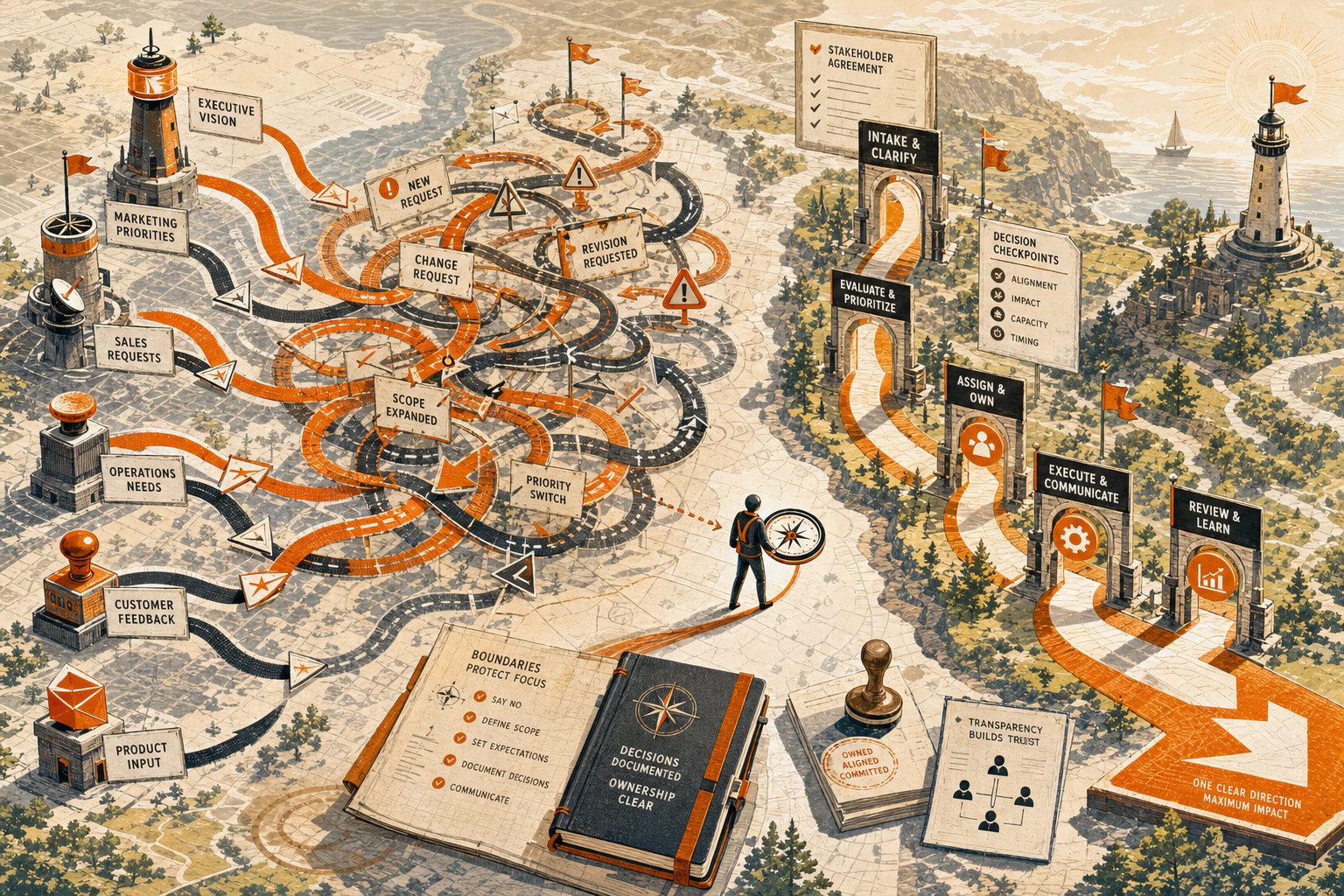
Stakeholder whiplash is what happens when the ask keeps changing—scope, audience, success criteria, deadline, framing—without anyone clearly acknowledging that the assignment itself has moved. It rarely arrives with a trumpet blast. It comes in scraps. A Slack message after the meeting. A casual hallway comment. A leader parachuting into the thread with a new preference after you already built version four.
One change is normal.
Five untracked changes are not iteration. They are evidence.
That distinction matters because healthy iteration sharpens the same goal. Stakeholder churn quietly swaps in a different goal while everyone keeps talking as if the original one still exists. That’s why the feeling is so maddening. You are not simply doing rework. You are operating inside a fake reality where the assignment keeps mutating while your accountability stays frozen in place.
If you’ve felt that gross mix of irritation, self-doubt, and exhaustion, there’s a reason. Your brain is trying to do two jobs at once: produce the work and reverse-engineer the decision process that should have happened before the work was handed to you.
That is not resilience. That is unpaid systems labor.
And it shows up in performance language in sneaky little phrases: “needs to tighten execution,” “could be more proactive,” “sometimes loses the thread.” Meanwhile nobody mentions that the thread was being yanked around like a dog toy by four different people.
So here’s the first move: stop using soft-focus language in your own head. Don’t say, This project is a little chaotic. Say, The decision process is unstable, and it is creating execution risk. That sentence sounds severe because it is accurate. The next time a deliverable starts wobbling, ask yourself: Has the goal become clearer, or has the goal changed? If you can’t answer quickly, you are no longer in normal iteration.
Most changing asks are really decision failures in a trench coat
A lot of early-career professionals blame themselves first because self-blame feels oddly productive. If the problem is you, then maybe you can fix it with more effort, more polish, more speed, more late-night heroics.
Unfortunately, many of these situations have very little to do with the quality of your work. They come from the same three culprits over and over again.
1. Nobody knows who actually has final say
This is the classic swamp. Three stakeholders all believe they are shaping the work. None of them has explicit decision rights. So every person edits as if they’re refining the deliverable, when really they are conducting a low-grade power struggle through your draft.
You can usually feel it before you can name it. Meetings get weirdly mushy. People stop making decisions and start releasing preferences into the air like scented candles.
“Maybe we could make it more strategic.” “I wonder if this should feel more executive.” “Could this be broader?” “Maybe simpler.” “Maybe with more detail.”
Great. Maybe it should also levitate.
If nobody closes the loop, everyone leaves believing they contributed, and you inherit the bill.
The fix is not asking, “What do you all think?” That invites a fresh parade of decorative opinions. Ask the question that pulls the real issue into daylight: “Before I revise, whose direction should I optimize for if feedback conflicts?”
That line is calm, polite, and deeply clarifying.
Pick one live project and write down the actual decider today. If you cannot name that person in one sentence, the work is already wobblier than it looks.
2. People request changes as if tradeoffs are fictional
This is one of the most socially accepted forms of nonsense at work.
A stakeholder wants more analysis, cleaner visuals, broader relevance, a faster turnaround, and fewer slides. Lovely. So does everyone. The grown-up question is: what comes off the table to make room?
Most teams are terrible at saying this part out loud. Revisions get treated like they float in from heaven without affecting anything else. But every meaningful change costs something: time, focus, depth, review space, quality, or another priority that now quietly dies behind the scenes.
When nobody names the cost, the most conscientious person pays it privately.
You need one sentence that forces reality back into the room. Use this and keep it handy: “Happy to make that change. The tradeoff is either a later delivery, a narrower scope, or less polish in section two. Which should I optimize for?”
That is not pushback. That is competence.
If saying something like that makes your stomach tighten, good. You’ve found the place where the real work starts. Send it anyway.
3. Feedback shows up after the decision window should have closed
Not all late feedback is bad. Sometimes somebody catches a real issue at the last minute and saves you from embarrassment.
The problem is repeated late feedback that reopens settled questions as if no work has happened since those questions were supposedly settled. That pattern is corrosive. It creates that specific emotional whiplash many professionals know too well: you spend all afternoon making real progress, then one 4:47 p.m. message blows the assignment back open like a kicked-in door.
That flash of dread is not you being dramatic. It’s your nervous system learning that “done” does not mean done on this team.
So tighten the review window before chaos gets sentimental. Say, “I can still incorporate comments through Thursday at noon. After that, additional feedback may push timing or require cutting another section.” People rarely respect boundaries they cannot see. Make the boundary visible.
If your team is addicted to late-drive-by input, test one explicit cutoff this week and watch who suddenly discovers urgency.
Being “easy to work with” can quietly ruin your reputation
This part deserves more honesty than it usually gets.
Early on, you are often rewarded for being accommodating. You answer quickly. You revise without complaint. You jump when someone pings. You become known as responsive, flexible, reliable, low-drama.
Then the bill arrives.
You get more ambiguity, not less. More last-minute changes. More half-formed requests. More projects where nobody bothers to define the ask properly because they assume you’ll sort it out. Your competence becomes a landfill for everyone else’s vagueness.
That is not a compliment. It is a tax dressed up as trust.
And the cruel part is that it can hurt your reputation while you are being praised for your attitude. You start getting associated with work that takes too many rounds, deadlines that keep drifting, deliverables that never quite look locked. None of that may be your fault. It still sticks to your name.
So let’s be blunt: silent accommodation is not professionalism. Very often, it is fear in a blazer.
Strong operators do not absorb confusion indefinitely. They surface it while it is still cheap to correct.
A useful filter: every piece of feedback is one of three things.
- Clarification: same goal, clearer details
- Preference shift: same objective, different framing or format
- Scope change: the audience, timing, success criteria, or ask has materially changed
These are not the same situation, and they should not get the same response. Clarification can usually be folded in. Preference shifts need prioritization. Scope changes require an explicit reset.
The move this week is to stop replying to every comment with “Got it.” Label what it is. Say, “Understood—this sounds like a scope change because the audience and success criteria have both shifted.” One clean sentence can do more than ten minutes of apologetic overexplaining.
Turn every new ask into a decision record
This is the habit that saves careers.
Not hustle. Not charm. Not becoming the office raccoon who survives on adrenaline and stale granola bars.
A decision record.
When the ask changes, stop treating it like loose conversation and translate it into four visible points:
- What changed
- What that affects
- What you recommend
- Who needs to decide
That’s it. No process cosplay. Just enough structure to stop everyone from pretending the change is free.
Here’s what that can sound like:
“Quick reset: the audience has shifted from internal leadership to external clients. That changes the framing, review needs, and level of detail. My recommendation is either keep Friday and cut section three, or keep the full content and move delivery to Monday. If client-facing is the priority, can you confirm that’s the direction we’re choosing?”
Notice what this does.
It names the change without whining. It names the impact without melodrama. It offers a recommendation instead of tossing the problem back into the group like a live grenade. And it forces someone to own the call.
That is stakeholder management.
What it is not is this: “You keep changing your mind.” True, maybe. Useful, rarely.
A surprising amount of casual chaos survives only because it remains casual. The moment you write it down with consequences attached, people become much more disciplined. Funny how fast “small tweak” energy disappears when someone has to choose between speed and scope in writing.
If you want something dead simple, use this in Slack or email:
Change: What is different now?
Impact: What does this affect—timeline, scope, audience, quality?
Recommendation: What is the cleanest path forward?
Decision needed: Who is confirming the tradeoff?
Your move: find one thread this week where the ask is drifting and send the reset before you open the file again.
Build a system that makes drift harder
One good rescue can save a project.
A repeatable system saves your sanity.
The people who handle stakeholder churn well are usually not magical communicators. They are just more disciplined about adding structure exactly where work tends to go blurry. They recap decisions. They define review windows. They package tradeoffs before the room gets intoxicated by “just one more thought.”
This sounds boring, which is unfortunate, because boring is often the most powerful thing in the building.
A two-minute recap after the meeting does more for alignment than thirty extra minutes of talking in circles. A clearly stated owner prevents a week of group-edit purgatory. An explicit cutoff for feedback spares you the soul-flattening experience of polishing version seven while someone new wanders in with a version-two opinion.
Three habits worth stealing:
Recap immediately after live discussions
Do not trust group memory. Group memory is fan fiction by lunchtime.
Send the recap: - what was decided - what remains open - who owns the next call - what timing is assumed
That note is not admin fluff. It is evidence. It reduces future confusion and the accidental gaslighting that happens when everyone remembers the meeting they wish had occurred.
Package the work before execution starts
Before you disappear into production mode, write down: - goal - audience - definition of done - decider - review moment - constraints
If that feels too formal for a small task, do it in one line each. The point is not bureaucracy. The point is making assumptions visible before they become expensive.
Signal risk while it is still cheap
Do not wait until the deadline is on fire.
Say, “Flagging a risk: we’ve had two scope additions since Monday, so keeping the current date now means either reducing polish or narrowing the analysis.” Calm early warning beats panicked late explanation every time.
Try This: choose one active project and add only one piece of structure it currently lacks—a decider, a recap, or a feedback cutoff. You do not need a grand methodology. You need one friction point that makes drift harder.
When people keep bypassing the process
Sometimes you do all the right things and the chaos keeps coming anyway.
A stakeholder DMs a last-minute change instead of using the review process. A senior leader revives a closed issue in a meeting with no context. Someone casually overrules the plan in Slack and then disappears, leaving everyone else to play archaeologist.
At that point, stop asking, “How can I be more accommodating?” Start asking, “How do I keep the work anchored in visible decisions?”
That may mean replying in the public channel instead of privately: “Noted. Since this affects the agreed audience and timing, I’m summarizing the tradeoff here so we can confirm direction.” It may mean forwarding the decision record to the owner. It may mean escalating ambiguity rather than carrying it around alone like a backpack full of bricks.
This matters because every unchallenged bypass teaches the team something. It teaches them that process is optional, that decisions can be casually reopened, and that your time is the cheapest place to dump the cost.
Do not teach people that lesson.
You are not trying to control anyone. You are refusing to let reality disappear.
That posture matters especially when you are junior, because people can smell apology from across the building. If you frame every clarification like a confession, you invite more mess. If you frame it like stewardship of the work, people usually respect it—even if they grumble first.
Sit with this question for a minute: Where, exactly, are people learning that it is safe to hand you ambiguity without owning the consequences? Your answer will tell you what boundary needs to exist next.
What good looks like in practice
Let’s make this less abstract.
Bad version:
“Sure, I can update that.”
Better version:
“Yes—I can update it. Since this adds a new audience and a new metric, I want to confirm whether we’re replacing the original framing or expanding scope. If we’re expanding, I recommend moving the deadline by a day or cutting the appendix.”
Bad version:
“There have been a lot of changes.”
Better version:
“We’ve made three material changes since kickoff: the audience shifted, the timeline moved up, and a new reviewer was added. I can support that direction; I just want us to choose which tradeoff we’re accepting.”
Bad version:
“Let me know what you want.”
Better version:
“My recommendation is option A because it preserves the original objective and keeps timing intact. If we prefer option B, I’ll need confirmation that we’re prioritizing breadth over speed.”
See the pattern?
Strong operators do not merely collect input. They convert input into decisions.
That sends a much better career signal than being the pleasant, frantic person taking notes while everyone else free-associates their preferences onto your workload. Pick one message you sent recently that was too deferential, too vague, or too eager to absorb the work. Rewrite it in the format of change, impact, recommendation, and decision. Save it. You will use it again.
Trust is built when you make the mess easier to see
A lot of career advice turns into wallpaper because it stays generic. Be collaborative. Be flexible. Be proactive. Fine. But when stakeholder churn is the problem, those words are too flimsy to hold any weight.
What actually matters is simpler and sharper: every meaningful change should have an owner, an impact, and a tradeoff attached to it. If it doesn’t, the team is not collaborating. The team is outsourcing confusion to whoever is conscientious enough to absorb it.
Maybe that has been you.
If so, it is worth naming the emotional cost plainly. It’s the low hum of resentment when another “quick tweak” lands at 5 p.m. It’s the self-doubt after a meeting where three people contradicted one another and somehow you walked out feeling underprepared. It’s the exhausted little bargain you make with yourself at night—I’ll just fix it now so tomorrow doesn’t get worse—even though that habit is exactly what keeps the pattern alive. And yes, it’s the electric relief of a clean 1:1 where a sane manager finally says, “You’re not crazy. The ask really has been moving.” Sometimes being accurately seen is half the cure.
The deeper mindset shift is this: your value is not proven by how much confusion you can personally metabolize. Your value is proven by how clearly you can help a team face reality. That means naming changes before they metastasize into “execution issues.” It means putting tradeoffs back on the table where they belong. It means refusing the role of silent absorber, even if that role once won you praise for being easy.
That is also why tools like Career Compass matter when you’re in this season of your career. Not as some cute add-on after the “real” advice, but because this is exactly where young professionals tend to lose the plot: when the work gets political, fuzzy, and hard to measure fairly. A good system helps you track wins that would otherwise vanish into churn, notice when stress is becoming your baseline, and build the language to respond before burnout starts masquerading as maturity.
So if this pattern is showing up in your week right now, do not answer it by working faster or becoming even more accommodating. Get one level more explicit. Name the change. Name the cost. Name your recommendation. Put the decision back where it belongs.
It will feel awkward at first. Especially if you’re junior. Especially if the loudest person in the room confuses vagueness with authority. Do it anyway. You are not being difficult. You are making the work governable. Over time, that becomes the reputation you actually want: not the person who tolerates chaos best, but the person who helps everyone else stop pretending chaos is free.