What “More Visibility” at Work Actually Means
“You Need More Visibility” at Work: What It Actually Means
When a manager says, “You need more visibility,” most people do not hear helpful coaching.
They hear a threat.
Cool. So now I have to become shinier? More chatty in meetings? More active on Slack? More willing to act like my calendar is a stage and my job is to emcee it?
That reaction makes sense. The phrase sounds cheap and slimy, like someone is asking you to replace competence with theater. If you already hate office performance art, the feedback can trigger a very specific kind of irritation: the exhausted feeling that your actual work matters less than whether people can feel your presence through the drywall.
But that is usually not what they mean.
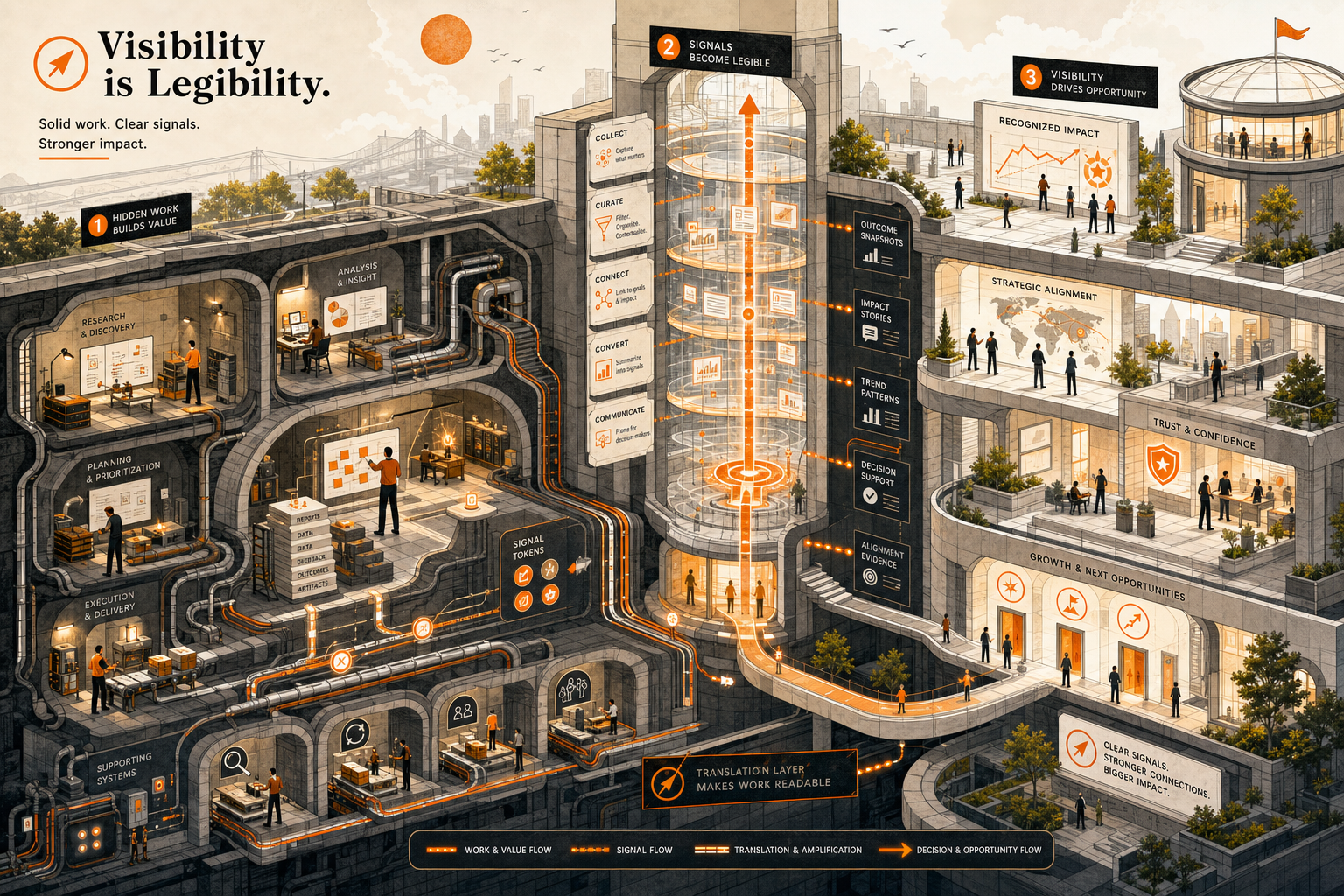
Most of the time, “more visibility” means your work is not traveling well. The people closest to you may know you are sharp, reliable, and quietly holding together more than anyone notices. The problem starts when your work has to move beyond your immediate lane. Your manager cannot summarize your contribution cleanly. A skip-level vaguely knows you are “helpful” but could not explain what you actually drive. A cross-functional partner benefited from your work and still would struggle to name, in one sentence, why it mattered.
That gap feels awful because it is not the same as failure. You are doing useful work. People like you. Projects move. Fires get prevented. And then review season arrives and your contribution turns into mist the second someone tries to explain it in a calibration meeting. That is when good people get bitter.
Here is the blunt truth: excellent work does not speak for itself. It never did. In real organizations, work gets rewarded when other people can understand it quickly, repeat it accurately, and connect it to something the business cares about.
If you are early in your career, this is one of the most valuable adjustments you can make. Not because you need to “market yourself,” a phrase that deserves to be launched into the sea, but because your effort needs a delivery mechanism. Otherwise, it dies in the gap between what you did and what other people can remember.
The short version
- “You need more visibility” usually means your impact is hard to see, explain, or retell.
- This is usually a signal problem, not a personality problem.
- Strong work disappears when you report tasks instead of consequences.
- Your manager is not going to reconstruct your value from scraps of Slack, half-remembered meetings, and vibes.
- The fix is not becoming louder. The fix is making your work easier to carry.
- If you get this feedback, ask: visible to whom, in what moments, and missing what?
Visibility is not charisma. It is legibility.
Here is the definition worth keeping: visible work is work the right people can describe, connect to outcomes, and trust without needing a guided museum tour.
That is different from being extroverted. Different from being polished. Different from talking so often in meetings that everyone starts looking spiritually unwell.
Some of the most visible people at work are quiet. They do not dominate the room. They simply make their contribution easy to understand. Everyone knows what they do, what tends to improve when they are involved, and what kind of mess they prevent.
Invisible work usually has a few predictable traits:
- it happens behind the scenes
- it lives in systems, analysis, planning, documentation, or operations
- it gets communicated as a checklist
- it gets absorbed into “the team did this,” which is nice for morale and terrible for attribution
That last one traps a lot of early-career people. The project succeeds. Everyone is pleased. You know you carried a meaningful chunk of it. But if someone asked, “What did you drive?” your answer would sound like you were apologizing during a hostage video.
That is the issue.
In analytics-heavy roles, I learned this in the most annoying way possible. Some of my best work made other people sound smarter in meetings. I built reporting frameworks, untangled ugly data, and stopped bad assumptions before they spread into expensive confidence. The work was valuable. It also had the glamour profile of a municipal drainage system. If nobody can see the chain from your effort to a decision, they file you under “reliable support” instead of “high-impact operator.” Same usefulness. Very different career trajectory.
So ask yourself a slightly painful question: if your manager had to explain your value to their boss in 20 seconds, could they do it without excavating Slack?
If not, start there. Not by panicking. By clarifying.
Why good work still gets missed
When managers ask for “more visibility,” they are usually pointing at one of three problems.
1. They do not have usable evidence
This is not the same as not appreciating you.
They may trust you. They may enjoy working with you. They may think you are strong. None of that helps much if they cannot walk into a performance conversation with crisp examples. “They work hard” is not a case. It is a shrug in business casual.
Managers need evidence that survives comparison.
If a peer can be described as, “She cut onboarding time by redesigning the intake process,” and your story is, “He was involved in a lot and everyone likes him,” guess who sounds promotable. That is not fair, exactly. It is just how memory works in overloaded systems.
Look back at the last month of your work. Can you name three outcomes, not activities, that your manager could reuse in a review conversation? If you cannot, start a note today and reconstruct them while they are still recoverable.
2. Senior people do not know your role in the result
This happens constantly on cross-functional teams.
The person who presents the final recommendation gets remembered. The person who prevented the disaster, simplified the process, surfaced the tradeoff, or did the hard stitching work often disappears into the wallpaper. Contribution and attribution are cousins at best.
That gap creates a weird emotional whiplash. You can feel proud of the work and invisible at the same time. You leave the meeting knowing the decision was better because of you, while everyone else leaves remembering the person with the cleaner slide transitions.
You do not fix that by becoming territorial. You fix it by naming ownership more clearly while the work is happening. In your next update, do not say, “We aligned on a new approach.” Say what you specifically drove inside that team effort.
3. Your work looks operational instead of strategic
This one enrages people because it often punishes the employees doing the most unglamorous, necessary work.
Cleanup. Maintenance. documentation. Coordination. Issue prevention. Process repair. These are career-saving contributions that many organizations treat like wallpaper until they break. Leaders often remember decisions, launches, and narratives. They forget the invisible labor that kept the numbers accurate, the rollout stable, and the customer experience from turning feral.
So if your work sits in operations, analytics, project coordination, research, systems, enablement, or any role where success often looks like “nothing caught fire,” you cannot rely on default visibility. You have to frame what you prevented, protected, accelerated, or made possible.
A useful question to sit with: what pain did your work remove that other people are now free not to think about?
That answer is often more valuable than your task list.
What your manager may actually mean
Corporate language has a fun habit of taking a simple issue and wrapping it in enough fog to humidify a conference room.
Here is what a few common phrases often mean underneath:
“You do great work behind the scenes”
Translation: I value you, but I cannot advocate for you upward with enough specificity.
“Speak up more”
Translation: Your thinking is arriving too late to shape the decision.
“People do not always know what you own”
Translation: Your contribution keeps getting absorbed into general team output.
“We want to see more leadership presence”
Sometimes fair. Often code for: your judgment is not visible in the moments that matter.
None of those require you to become a meeting goblin.
Talking more is not the same as becoming visible. In fact, indiscriminate talking often lowers your visibility because it buries the useful signal under verbal packing peanuts. People stop listening. Your point arrives wearing clown shoes.
Instead, make the important parts easier to notice.
In your next 1:1, try this exact question: “When you think about my recent work, what part of my contribution is easiest to see, and what part is still too fuzzy?” That phrasing is hard to dodge and specific enough to get past corporate mist.
Stop reporting activity. Start translating value.
This is where improvement usually happens fastest.
A lot of smart people give updates as if they are reading items off a kitchen whiteboard:
- finished the analysis
- coordinated feedback
- updated the dashboard
- aligned on next steps
- joined a discussion
- handled a few issues
Technically true. Professionally useless.
These updates tell people what you touched, not why it mattered. They force your manager to perform the interpretation step themselves. Most will not. Not because they are lazy villains. Because they are busy, distracted, and running on three browser tabs of memory.
A stronger update has four parts.
1. What happened
Give the basic factual movement.
Short is good. If people have to hunt you down for status, your communication has already become expensive.
2. Why it mattered
This is where weak updates die.
“Finished the analysis” is informational wallpaper.
“Finished the analysis on post-pricing conversion decline” gives people a reason to care. It tells them what business question the work touched.
Before you send your next update, look at each bullet and ask, “Would this matter to anyone who is not me?” If the answer is no, add context.
3. What changed
Visible work creates a before-and-after.
Did your work speed up a decision? Reduce risk? Save the team from bad data? Clarify ownership? Cut a review cycle? Prevent customer confusion? Turn a vague complaint into an actionable choice?
That is the meat. Without it, your update is just diary writing in office clothes.
4. What you owned
Not in a chest-thumping way. In a clean, adult, accurate way.
There is a huge difference between these:
- “We launched the new process.”
- “The team launched the new process, and I built the intake workflow that reduced duplicate requests and shortened support turnaround.”
One sentence erases you. The other makes your contribution legible without pretending you invented cooperation.
Here is what that sounds like in practice:
Weak: “Wrapped up the stakeholder deck and coordinated feedback.”
Better: “I consolidated conflicting stakeholder feedback into one decision-ready deck, which helped the group agree on the rollout approach without another review cycle.”
Weak: “Handled reporting issues and updated the dashboard.”
Better: “I fixed a reporting mismatch before the weekly business review, which stopped the team from using bad numbers and restored confidence in the dashboard.”
Weak: “Joined onboarding discussions.”
Better: “I flagged where the onboarding flow was creating drop-off and offered two simpler options, which moved the conversation from vague frustration to a decision.”
That is not spin. It is interpretation. Interpretation is part of the job.
Pick your last three updates and rewrite them today. If they sound like a to-do list, they are underselling you.
Do not chase broad visibility. Chase the right visibility.
One reason this feedback makes people miserable is that they respond by trying to become noticeable everywhere.
Bad plan.
You do not need the entire company to know your name. You are not running for prom court. You need the right people to understand your work in the moments that affect trust, growth, and opportunity.
Usually that list includes some combination of:
- your direct manager
- your skip-level
- a few key cross-functional partners
- the people who shape whether your ideas get used
- anyone who may be asked, formally or informally, “How is this person doing?”
That is a much smaller audience than your anxiety would suggest.
And different people need different things. Your manager may need reusable summaries and examples. A cross-functional partner may need clearer ownership boundaries. A senior leader may only need to hear from you when there is a real decision, risk, or milestone.
So replace “How do I become more visible?” with “Who specifically needs a clearer picture of my work, and in what setting?” That one question cuts through a shocking amount of nonsense.
Pick one stakeholder this week and make your next communication legible for them, not for some imaginary crowd.
What to say in your next 1:1
If you just got this feedback, do not walk into your next 1:1 promising to “be more proactive.” That phrase has done enough damage.
Go in with sharper questions that force the conversation into observable reality.
Try a few of these:
- “When you say more visibility, where is the gap showing up most?”
- “Who needs a clearer picture of my work right now?”
- “In performance or calibration conversations, what evidence of my impact feels thin?”
- “Can you point to one recent example where my work was strong but my contribution was hard to see?”
- “Would it help if I structured updates differently so the outcome and my role are easier to repeat?”
These questions do something useful: they move the conversation from vibes to specifics.
And if your manager cannot answer them, that tells you something too. It may mean the feedback is half-baked, borrowed, or standing in for a broader concern they have not articulated well. You still need to respond professionally. But you do not need to rebuild your personality around an incoherent sentence.
Leave that meeting with one example, one audience, and one behavior to change. Not a pep talk. A plan.
Visibility without cringe: three habits that work
You do not need a “personal brand.” You need cleaner operating habits.
Keep a proof file
Make a lightweight running record of wins, decisions influenced, risks caught, positive feedback, ugly problems cleaned up, and moments when your judgment changed the outcome.
Capture: - what happened - what you did - what changed - any evidence you have: numbers, messages, comments, outcomes
This is not vanity. It is memory support.
By review season, your brain will remember one random Wednesday from April and forget the five excellent things you did in May. A proof file keeps your work from dissolving into the blur.
Send smaller, better updates
Long updates are often a cry for help.
Aim for four things: - what moved - why it mattered - what is blocked - where you need input
That structure makes your work easier to trust and much easier to repeat upward.
Try This: Send one weekly update this month that is half the length of your usual version and twice as clear about outcomes.
Speak when the decision is still soft
You do not need to talk in every meeting. You do need to show up when your thinking can actually change what happens.
That may mean: - naming a risk before it becomes expensive - clarifying the tradeoff everyone is politely circling - summarizing the decision when the room turns mushy - stating ownership before accountability leaks out of the floorboards
That kind of contribution gets remembered because it changes the room, not because it fills air.
The move in your next meeting is simple: do not aim to say more. Aim to say one thing that reduces confusion.
If your work happens behind the scenes, packaging matters more
Some jobs are naturally visible. Others are not.
If you work in operations, analytics, systems, research, coordination, enablement, or any role where your best work often prevents chaos instead of producing a flashy reveal, then visibility will not happen by accident. You need stronger packaging.
That means explaining not just the action, but the avoided pain.
Not this:
“I cleaned up the process documentation.”
Try this:
“I standardized the process documentation so new requests stop bouncing between teams, which should reduce rework and make ownership clearer.”
Not this:
“I fixed several intake issues.”
Try this:
“I found three intake gaps that were sending incomplete requests downstream, and fixing them should save the team from repeated clarification loops every week.”
Prevention is hard to celebrate because the disaster never becomes visible. No flames. No broken launch. No executive meeting derailed by wrong numbers. But that absence often is the achievement.
If your role is behind the scenes, rewrite one recent contribution in terms of friction removed, risk reduced, or decision quality improved. That translation is part of the work, not extra homework.
What not to do
A few reactions make this problem worse fast.
Do not start broadcasting every thought like your Slack status is a lighthouse.
Do not become so desperate to be seen that you sound like you are narrating your own documentary.
Do not swing into “I did this, I did that” so hard that people start wondering whether you know other humans were present. Accurate ownership matters. Solo hero fiction does not.
Do not dismiss the feedback just because it was vague and annoying. A badly phrased comment can still point to a real gap.
And do not assume visibility belongs only to natural extroverts, smooth presenters, or office politicians with suspiciously good teeth. That belief traps a lot of thoughtful people in unnecessary resentment. Clear thinkers can become very visible without becoming exhausting.
The real question is harder and more useful: where am I making other people work too hard to understand my contribution?
Sit with that one for a minute. It usually points straight at the fix.
The next month: make your work easier to carry
If you got this feedback recently, your smartest response is not reinvention. It is consistency.
For the next 30 days, do a few unglamorous things well: - tighten your updates so they include consequence, not just activity - use 1:1s to name what you own and what changed because of it - track wins while they are fresh - identify the small set of people whose understanding of your work matters most - contribute in meetings when you can improve the decision, not just increase your face time
This is simple. It is also not trivial.
What changes over time is not just whether people “notice” you. It is whether your work develops a clean reputation inside the organization. People start to know what happens when you are involved. They know you clarify, de-risk, simplify, or move things forward. That is visibility in its useful form. Not fame. Not performative polish. Recognition with substance under it.
And there is a deeper mindset shift here that matters more than any tip: visibility is not something you beg for after the fact. It is something you build into the way you work. You stop hoping people will magically infer your value from effort alone. You start leaving a trail that makes your contribution easy to understand, easy to repeat, and easy to defend. That is not vanity. That is professional responsibility.
If you need help doing that consistently, that is exactly where Career Compass fits. Not as a vanity tracker, and not as a “build your brand” gimmick, but as a practical system for noticing your wins, tracking patterns in your work, and turning blurry effort into evidence you can actually use in 1:1s, reviews, and career decisions. It is built for people who are doing real work and are tired of watching it disappear into organizational fog.
So if someone tells you that you need more visibility, do not panic. Do not overcorrect. Do not become the loudest person in the meeting out of sheer wounded dignity. Get specific. Find the missing signal. Then fix the packaging. The goal is not to become more performative. The goal is to make your work harder to misunderstand and easier to reward.
That is not office politics.
That is professional clarity.
Before you publish your next move at work, make one choice on purpose: ask earlier, with sharper context, while options are still open. That is what separates reactive stress from professional judgment.
If you want help building that habit, Career Compass is designed for exactly this moment: a personalized growth plan, weekly coaching nudges, and visible progress tracking so your career growth is deliberate instead of accidental.