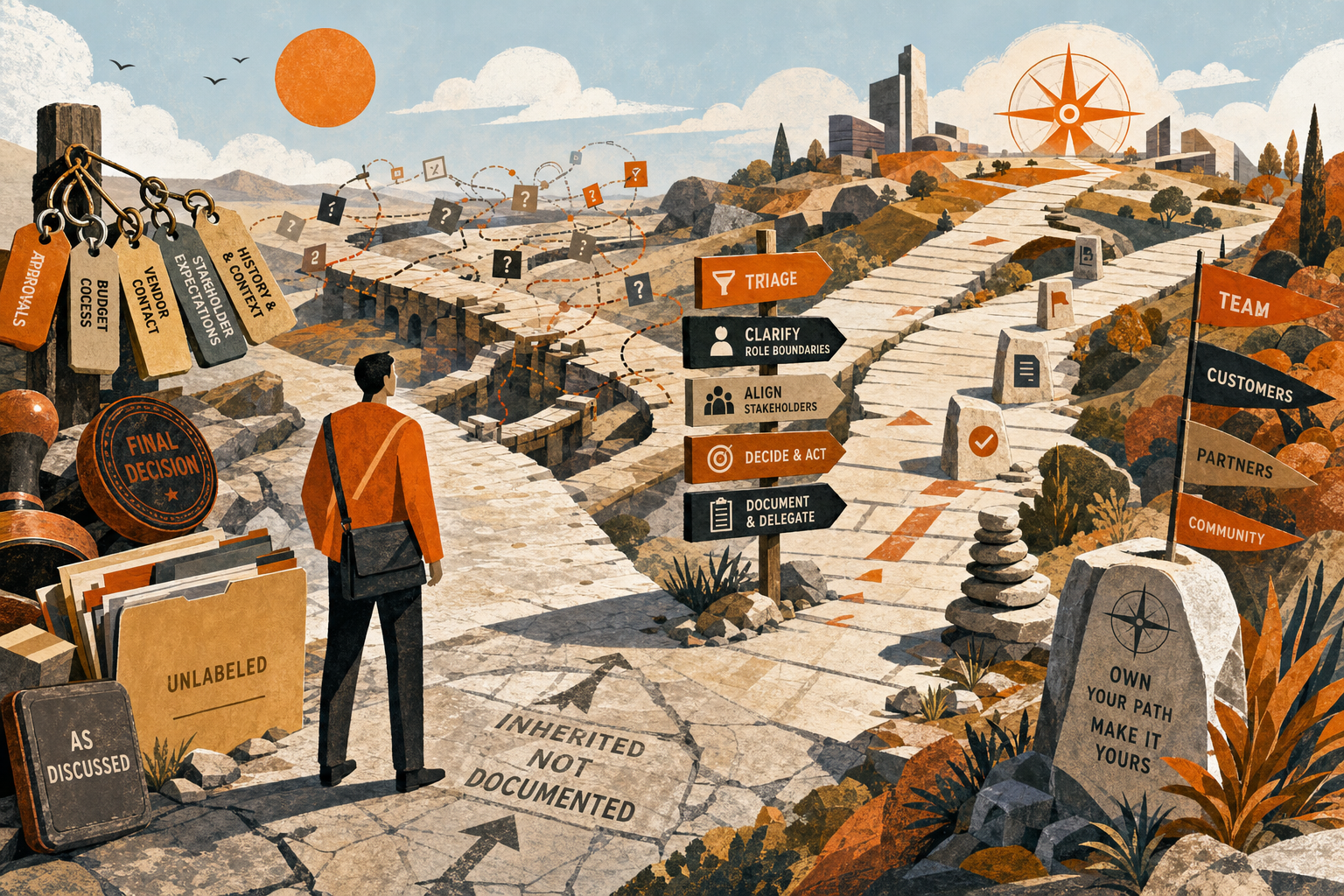
Your Manager Is the Bottleneck. Now What?
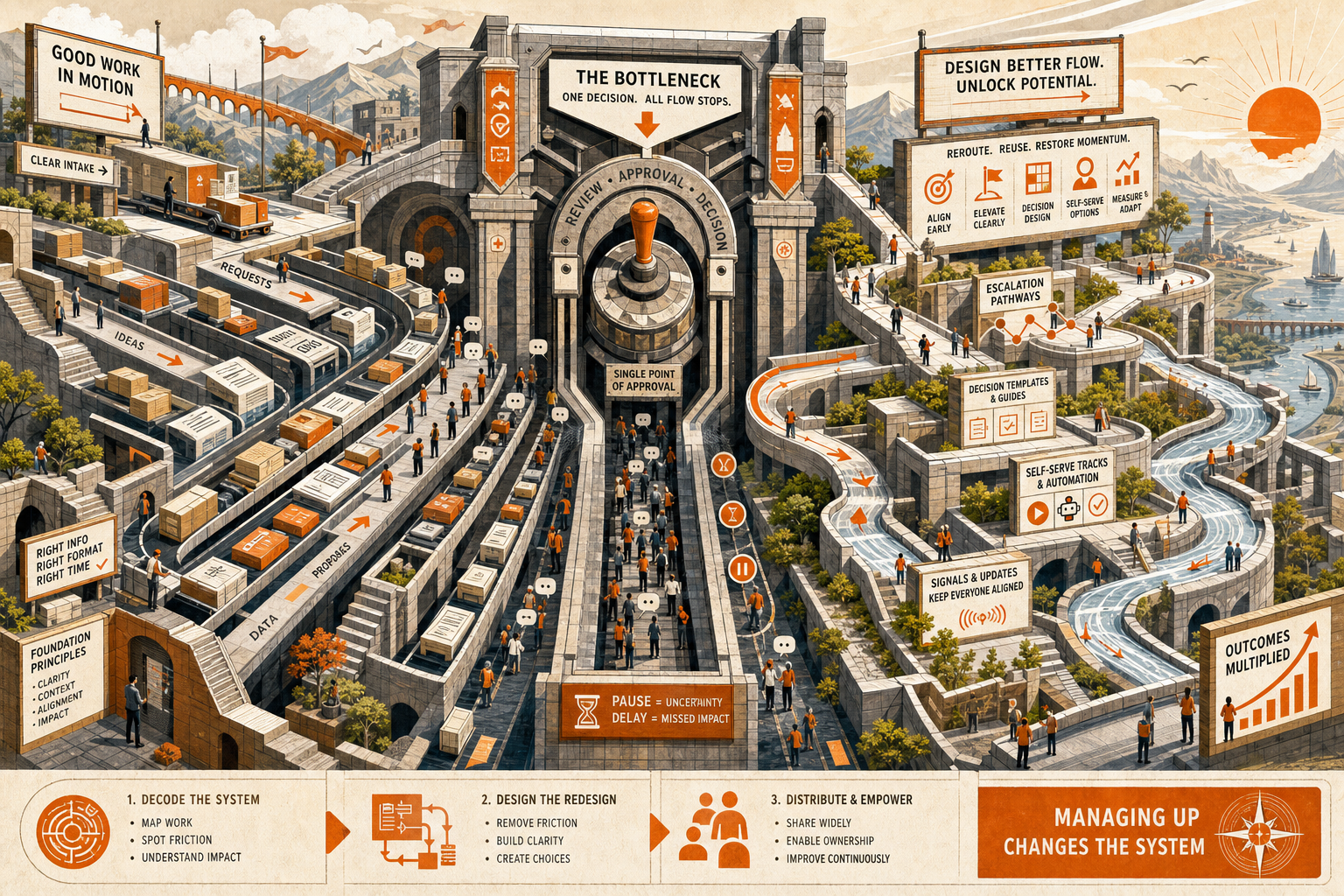
Your Manager Is the Bottleneck. Now What?
A lot of early-career people think they have a discipline problem when they actually have a traffic problem.
You’re working. You’re responsive. You’re staying weirdly late to push something over the line. And still, the line does not move.
A deck sits in draft because your manager hasn’t chosen between two headlines. A vendor is waiting on a yes-or-no answer that should have taken four minutes and one functioning frontal lobe. You already did the hard part, but the project is now parked in someone else’s inbox like a car with the hazards on and nobody in the driver’s seat.
This is the part that scrambles your brain.
Because when work stalls in a place you can’t control, most people do not conclude, ah, yes, a decision system failure. They conclude, I must be doing something wrong. So you replay your note. You rewrite your Slack message in your head while brushing your teeth. You feel guilty for being annoyed and annoyed for feeling guilty. Sunday night starts to feel like pre-disappointment. A good 1:1 feels less like development and more like oxygen.
Sometimes the simplest explanation is the right one: the work is slow because one person is sitting on too many decisions.
And no, the answer is not “just follow up more.” Ten extra pings do not fix a broken approval machine. If your manager is the bottleneck, your job is to do three things: make decisions easier for them to make, make delays visible without sounding theatrical, and protect your reputation while the gears grind.
TL;DR
- A bottleneck is a pattern, not a rough week.
- Most upward communication fails because it hands your manager a pile of context instead of a clean decision.
- Your job is to turn “thoughts?” into “choose A or B by 3 p.m.”
- You are allowed to document dependency risk in plain English.
- If the same traffic jam keeps happening, stop treating it like a personality quirk and redesign the workflow.
First, figure out whether this is actually a bottleneck
Not every slow reply means your boss is the problem. People get buried. Priorities change. Some calls genuinely need a beat.
But a real bottleneck has a particular smell to it: the same person controls too many approvals, too many clarifications, or too many priority calls, so everything stacks up behind them. You keep doing your part and then hitting the same locked door.
Usually it shows up in one of three forms.
1. The approval bottleneck
Nothing ships until your manager blesses it. Every deck, email, copy line, calendar invite, and microscopic judgment call has to pass through their hands.
At that point, you are not doing autonomous work. You are operating a decorative waiting room.
2. The clarity bottleneck
The real goals live in your manager’s head, and the team is expected to retrieve them by séance. You leave meetings with notes, but not with direction. You get feedback after the fact that somehow sounds obvious in retrospect and impossible in advance.
This version is especially corrosive because it makes capable people feel foggy and incompetent.
3. The priority bottleneck
Six stakeholders want six things. Only one person can decide what matters first. That person is hard to pin down, so you end up doing a nervous little bit of everything and finishing the one thing that matters to no one.
Early in your career, it is very easy to misread these patterns. You assume the delay means you need to write a tighter note, volunteer earlier, chase harder, anticipate more, become somehow more “on it.” So you over-function. You become hyper-available. You turn into the human version of a laptop with 38 tabs open and one of them is making noise but you can’t find it.
That misread is expensive. It converts a structural flaw into a personality flaw.
Use this quick diagnostic instead:
| What keeps happening | What’s probably true | What it costs you |
|---|---|---|
| Work is 90% done, then waits days for sign-off | Approval is concentrated in one place | You look slow even when you’re not |
| You leave meetings without a definition of “done” | Direction is trapped in someone’s head | Rework, hesitation, confidence drain |
| Stakeholders pull you in opposite directions | Priority calls aren’t getting made fast enough | You disappoint everyone a little |
| Your manager only weighs in once a deadline is on fire | Decisions happen only after pain forces them | Constant scramble, zero momentum |
| You keep following up, but cycle time never improves | The issue is structural, not reminder-based | You start sounding noisy instead of useful |
Sit with one question before you do anything else: over the last month, where exactly has work been getting stuck? Not what annoyed you. Not who frustrated you. Where was the choke point?
Name that correctly first. Half the mess clears up when you stop diagnosing traffic as laziness.
Stop sending blobs upward
Most communication to a bottlenecked manager fails for one simple reason: it creates fresh work for the exact person who already has too much work.
“What do you think?” “Can you review?” “Any thoughts?” “Just flagging this.”
These messages sound responsible because they are polite and visible. They are also sneakily useless. They require your manager to reload context, identify the real question, compare options, estimate risk, and invent a recommendation from scratch. If they are overloaded, they will delay that cognitive chore like any other unpleasant household task.
If you want faster decisions, do more of the thinking before you send the note.
A good decision message has five parts:
- The decision — what exactly needs to be decided
- The options — ideally two or three, not a tasting menu
- Your recommendation — yes, pick one
- The tradeoff — what you gain and what you give up
- The deadline — when indecision starts costing real time
Here’s the difference.
Weak version:
The landing page copy is drafted, but I’m unsure whether we should position this more for enterprise or SMB. Legal also had a comment on one claim. Can you take a look when you get a chance?
Decision-ready version:
We need a positioning choice today to keep Friday’s launch on track.
Option A: enterprise-led, stronger fit with current sales conversations
Option B: SMB-led, closer match to ad traffic
I recommend Option A because it should improve lead quality even if click-through rate softens a bit. Legal flagged one claim, so unless you disagree by 3 p.m., I’ll finalize A and remove that line.
That second note is easier to answer because it does not ask your manager to build the frame. It gives them a frame and a default path.
Also, let’s kill one miserable piece of office folklore: “Never bring a problem without a solution.” That advice has convinced thousands of junior employees to cosplay certainty. The better rule is: don’t bring an unframed problem when you can bring a bounded decision.
You do not need perfect confidence. You need a clear recommendation and honest tradeoffs.
Pick one stalled thread from this week and rewrite it before lunch. Not tomorrow. Today.
Make the blockage visible without sounding bitter
This is where smart people often go wrong. They either become martyrs — silently carrying schedule risk and hoping someone notices — or they become snitches, narrating every delay with the energy of a minor court filing.
Neither helps.
If a decision is blocking progress, your job is to make the dependency visible in calm, operational language. Not emotional language. Not coded resentment with “gentle nudge!” pasted over clenched teeth. Just a clean record of what is pending, by when, and what happens if it stays open.
Because memory at work is wildly convenient. If there is no record, “we were waiting on a priority call” somehow becomes “the team got behind.” And if you are early-career, “the team” has a funny way of turning into your name.
Compare these:
Bad: - “Waiting on my manager” - “Following up again” - “This has been delayed for days”
Better: - “Pending final audience decision; if confirmed by Wednesday noon, design stays on schedule” - “Keeping this visible because the vendor deadline is tomorrow at 12 p.m.” - “To preserve launch quality, I’ll move delivery to Thursday unless we close the open claim decision today”
Notice the difference. The sentence is about the work, the timing, and the consequence. No villain. No diary entry. Just reality with timestamps.
This matters in stakeholder updates too. You do not need to publicly staple your manager to the bulletin board. You just need to stop absorbing invisible risk in silence.
For example:
Draft is complete. Final send date depends on confirmation of target audience priority. Once that is set, we can release same day.
That one line does two useful things. It protects your credibility, and it creates gentle pressure around the actual decision gate.
There is also a weird emotional relief in writing this way. It calms the 11:47 p.m. spiral of what if everyone thinks I dropped it? A good paper trail replaces panic with something sturdier: the work moved until it hit a decision wall, and the record shows that clearly.
Try This
Open the last email or Slack thread where something stalled. Delete every sentence that sounds apologetic, irritated, or vague. Replace them with three facts: what is done, what decision remains, and what deadline that decision affects.
Build guardrails so every tiny call does not require royal approval
If the same bottleneck keeps happening, the issue is no longer “my manager is busy.” The workflow itself is childish. It treats every decision like a ceremonial blessing.
At that point, your move is not more patience. It is to propose rules.
This can feel scary when you are junior because “managing up” is often sold as a dainty interpersonal art involving gratitude, emojis, and saying “totally makes sense” while your week burns down. In practice, managing up often means saying, calmly, we need a less ridiculous operating system.
Start with guardrail questions like these:
- Which decisions can I make without checking in?
- Up to what level of budget, risk, or visibility should I proceed independently?
- Which choices need your review every time?
- If I do not hear back by X time, should I proceed with the recommended option?
- Would you rather review these live in one weekly block than asynchronously one by one?
These questions are useful because they do two things at once: they reduce future friction, and they reveal the type of manager you are dealing with.
Some managers are overloaded and genuinely relieved when you introduce structure. Others claim to want ownership from you, then punish independent judgment and insist on touching every comma. The first type can be helped. The second type needs careful documentation and hard boundaries, because they are training everyone around them to hesitate.
A practical script:
I’m noticing final decisions on messaging, budget approvals, and stakeholder responses are clustering in our check-ins, which is slowing turnaround. Could we define which calls I should make independently and which ones you want escalated?
That is not an accusation. It is a workflow repair request.
Your move this week is to identify one recurring decision type — customer replies, scheduling changes, minor copy edits, budget approvals, whatever keeps boomeranging back to your manager — and ask for a standing rule instead of another one-off answer.
Know when this stops being “normal job friction”
There is a moment in every broken system when optimism becomes self-gaslighting.
Your manager apologizes. They acknowledge the delay. They thank you for your patience. They promise to get faster.
Then next week the exact same movie plays again, down to the same plot hole.
That is the point where you need to stop treating the issue like weather. A repeated bottleneck is not just annoying. It quietly reshapes your career. It steals reps. It keeps you out of visible wins. It makes you look less decisive because your output is trapped inside someone else’s indecision. And emotionally, it does something nasty: it teaches your nervous system to stay braced.
You can feel it. Sunday night gets heavy. Slack pings feel accusatory before you even open them. You start overexplaining in meetings because you can sense blame floating around the room like carbon monoxide. A good week no longer feels good; it feels like a temporary ceasefire.
So escalate in layers.
First, sharpen the ask.
Then attach a real deadline.
Then propose default rules or delegation.
Then widen the conversation to workflow impact.
Only after you have done those things should you consider broader escalation.
And when you do, escalate around the work, not against the person.
Bad escalation:
My manager is blocking everything.
Useful escalation:
We’re seeing launch delays because final approvals on messaging and creative are concentrated in one review step. I’d like to define what can move without that checkpoint so timelines are more reliable.
One creates a people drama. The other identifies an operating failure.
Here’s the question worth answering honestly: if nothing changed for the next six months, what would this environment do to your confidence, your output, and your learning?
Don’t answer quickly. Write it down. That answer tells you whether you are dealing with a temporary frustration or a job that is slowly teaching you to shrink.
Protect your reputation while you decide whether to stay
Sometimes the system improves. Sometimes a manager gets less chaotic. Sometimes one clean conversation changes the entire pace of a team.
And sometimes it absolutely does not.
If you are in the second situation, your job is not to become heroic. It is to stay legible.
That means keeping your asks sharp. Documenting dependencies. Avoiding emotional language in writing. Saving evidence of what you shipped, improved, rescued, or prevented. Tracking not just your outputs but the conditions around them.
Because bottlenecked teams are experts at distorting self-perception. Good people start wondering whether they are needy, weak, disorganized, “bad at prioritizing,” not leadership material. In reality, they have been trying to perform inside a badly designed decision system and blaming themselves for the fumes.
So keep your own record. Save the draft that was ready on Tuesday and approved on Friday. Note the recommendation you made before the crisis meeting. Track the stakeholder note that clarified the risk before anyone else named it. You are not building a prosecutor’s folder. You are preserving your reality.
And this is where a tool like Career Compass can genuinely help, not as a shiny add-on but as a way to keep your judgment from getting warped. When work is stuck and your confidence starts taking stray bullets, it helps to track your wins, stress patterns, work-life balance, and the relationships shaping your week. Career Compass gives you somewhere to put the facts, not just the feelings, so you can tell whether you are growing, stalling, or slowly getting ground down by a system that keeps mistaking bottlenecks for leadership.
The deeper point is this: your job is not to win a secret trial against your boss. It is not to become the office shock absorber who absorbs every delay with a serene smile and a twitching eye. It is to keep work moving where you can, make reality visible where you cannot, and preserve enough clarity to judge whether this role is building your career or merely consuming your patience.
That is the mindset shift. When work keeps stalling, stop asking only, How can I be more on top of this? Start asking, What operating problem am I standing inside, and what part of it can I redesign, document, or stop internalizing? That question is calmer. Smarter. More honest.
So start small, but start concretely. Look at the last three things that stalled on your plate and label the choke point: approval, clarity, or priority. Rewrite one blob message into a decision note. Name one dependency plainly in writing. Ask for one standing rule that removes a pointless checkpoint. Small moves like that do not just speed up work. They return your sense of agency.
And if you need help keeping that perspective while you do it, Career Compass is a useful place to stand. Not because it can magically fix a slow manager, but because it can help you see yourself clearly while you decide what this job is actually teaching you. That clarity matters. A lot of career damage starts when people confuse someone else’s bottleneck with their own lack of potential. Don’t make that mistake.