Why Your Workload Feels Impossible at Work
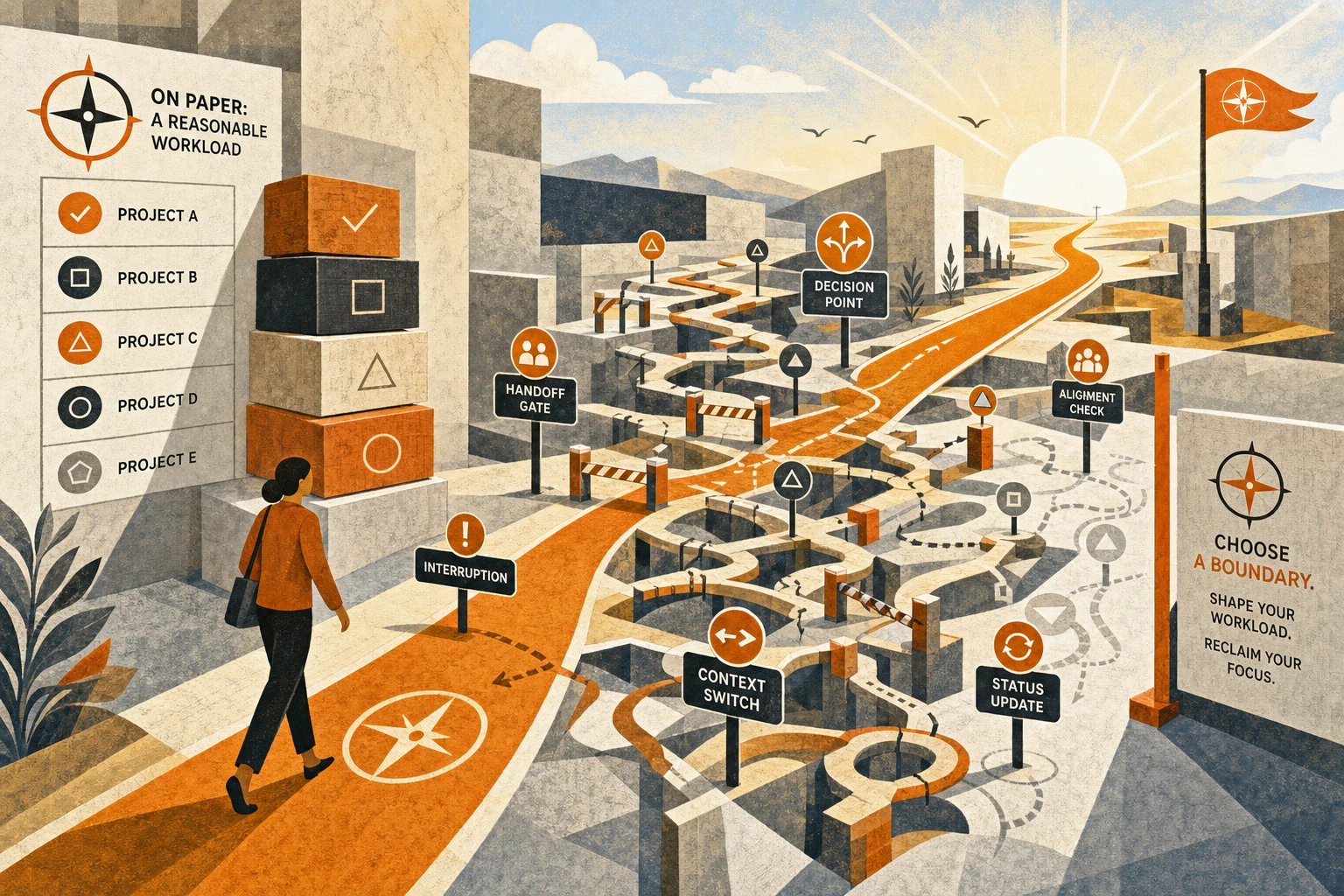
A lot of early-career professionals assume they have a discipline problem when they actually have a badly engineered workday.
That mix-up hurts.
Once you decide you are the issue, you start prescribing yourself little self-improvement punishments: wake up earlier, color-code the calendar harder, answer faster, complain less, become a somehow more purified version of yourself. Meanwhile, the actual problem keeps strolling through the front door all day long as pings, handoffs, follow-ups, “quick questions,” and tasks that are tiny on paper but expensive in attention.
This is how people get cooked by work that does not even look dramatic. Not always sixty-hour weeks and obvious catastrophe. More often it is a tidy-looking list: four projects, seven meetings, one document that needs edits, a Slack channel that never shuts up, and several people who swear each ask will “only take five minutes.” On paper, respectable. In your nervous system, it feels like being pecked to death by ducks with Wi‑Fi.
Then comes the private spiral.
Sunday night dread. Wednesday irritability. That embarrassed little thought when everyone else seems normal and you feel singed by noon: Maybe I’m just worse at this than other adults.
Usually, no.
Usually, the work is arriving in a shape that makes solid performance much harder than it needs to be. The total volume may be reasonable. The shape is what is wrecking you.
TL;DR
- A normal amount of work can still create an unsustainable week.
- The problem is often fragmentation, not raw volume: interruptions, dependencies, conflicting deadlines, and constant mental re-entry.
- “I’m overwhelmed” is true but incomplete. “I’m losing two hours a day to follow-ups and same-day requests” is much more useful.
- Productivity tools can help you navigate a messy week. They cannot fix a work setup that keeps spraying new mess at you.
- Better boundaries are often operational, not dramatic. Change how work enters your day.
The real problem: your workday has no shape
When I say workload shape, I mean the pattern of your work, not just the number of tasks.
How many times do you have to switch gears before lunch? How often do you get interrupted mid-thought? How many assignments are technically “yours” but cannot move until someone else approves, answers, or finally makes a decision they have been circling for three days? How much time are you spending doing the work versus chasing the conditions that allow you to do the work?
That distinction matters more than most workplaces admit.
Companies are decent at counting visible work: the deck, the meeting, the analysis, the client reply, the spreadsheet. They are terrible at counting hidden work: the follow-up email, the “just bumping this,” the ten minutes spent remembering where you left off, the meeting after the meeting, the stray chat messages that turn your concentration into confetti.
Two people can both have six priorities and have completely different weeks. One gets a clean runway and finishes things. The other feels underwater by 10:30 a.m. The difference is not moral strength. It is structure.
If you are early in your career, this gets sharper. Junior employees often have the least control over how work shows up. You are expected to be helpful, responsive, flexible, upbeat, and easy to work with. Fine. Those are good qualities right up until they quietly become an arrangement where everyone else gets to toss unfinished thoughts into your day whenever they feel like it.
That is not “learning to thrive in a fast-paced environment.” That is your attention being treated like public seating.
So the move this week is to stop asking, “Why can’t I handle this better?” and ask a much more useful question instead: How exactly is work landing on me right now? Write down the channels, the people, the timing, and the interruptions. You are looking for the pattern, not trying to win a medal for endurance.
Why a day of small tasks can wreck you faster than one hard project
A hard project can be tiring in a clean, honest way.
You sit down. You think. You get traction. Your brain builds momentum instead of repeatedly slamming into first gear. At the end, you are tired, but it is the satisfying kind of tired that comes from actually moving something forward.
Fragmented work drains you in a pettier, nastier way. It keeps charging an entrance fee.
Open the doc. Reconstruct the context. Notice the Slack ping. Answer the Slack ping. Jump to the spreadsheet. Find the missing number. Reply to the “super quick one.” Reopen the doc. Stare for twelve seconds while your brain tries to remember the sentence it was building. Join a meeting that creates three more tasks and resolves exactly nothing.
That is not a harmless pile of little asks. It is cognitive whiplash with office branding.
Here is a hypothetical day-in-the-life sequence for a recruiting coordinator named Maya:
- 9:05 a.m. She starts revising an interview guide for a role that needs to go out by noon.
- 9:14 a.m. A recruiter Slacks: “Do you have candidate notes from yesterday? Need to send feedback.”
- 9:22 a.m. The hiring manager emails: “Any update on next week’s panel schedule?”
- 9:31 a.m. A coordinator in another office messages in Teams: “Can you grab the Zoom link for Thursday’s debrief?”
- 9:40 a.m. Maya gets pulled into a ten-minute huddle that runs twenty-three minutes and ends with, “Let’s regroup later.”
- 10:07 a.m. She returns to the interview guide, but now she has to reread comments, reopen the rubric, and remember which version was final.
- 10:19 a.m. Sales recruiting pings: “Quick favor—can you move one candidate to tomorrow?”
- 10:46 a.m. She sends the guide, but misses one outdated competency line because she was editing in fragments.
- 11:30 a.m. She feels behind, even though she has been visibly busy for two and a half hours.
Nothing there looks enormous. That is the trick. The damage is in the restart cost, the vigilance, and the fact that every interruption steals not only minutes but continuity. By the end of the day, Maya may have completed twelve small actions and still feel she accomplished nothing that had a beginning, middle, and end.
That feeling is maddening. It also makes people question themselves in ways they do not deserve.
If you want proof, run a boring experiment for three days. Keep a tally on paper every time you are interrupted, switch tools, or have to chase someone for an answer. Not forever. Three days. Most people are shocked less by the number itself than by how normal the number had started to feel.
The hidden career trap: becoming known as the person who replies instantly
One of the fastest ways to destroy your own workday is to teach everyone that you are available at the speed of thought.
At first, this looks like professionalism. You answer fast. You jump in. You rescue little situations before they become annoying. People praise you for being dependable, which feels great when you are new and trying not to seem useless.
Then the reward for being quick becomes more incoming traffic.
People learn that if they want movement, they should put the task near you. Not because they are villains. Because you have trained the system. You have shown, repeatedly, that your attention is open for walk-ins all day long.
Soon you are no longer planning a day. You are hosting an open house for other people’s urgency.
A lot of early-career advice is weirdly careless here. “Be eager” is good. “React instantly to every stimulus” is a rotten rule. It turns helpfulness into permanent interruption.
Try one small experiment with one channel this week. If you currently treat Slack like a heart monitor, stop replying in real time for every non-urgent message. Check it at set intervals. Twice an hour works in many jobs. In some, once an hour is fine. You do not need to make a speech about it. Just change the rhythm and watch what breaks.
In plenty of offices, the answer is: nothing breaks. What changes is that you get enough uninterrupted time to finish a thought.
Stop saying only “I’m overwhelmed.” Show the mechanics.
“I’m overwhelmed” is often true. It is also easy for a manager to hear as weather.
Not because your manager is necessarily heartless. Often they simply cannot see the drag around the work unless you make it visible. They can see the deliverables. They cannot see the hours leaking out through follow-ups, context switching, and waiting on other people.
A stronger sentence names the tradeoff:
- “I can take this on, but it pushes the client deck to Thursday.”
- “I’m spending around two hours a day on status checks and approval follow-ups.”
- “These three priorities are landing as same-day work. If they all stay urgent, quality will slip on one of them.”
- “I’m doing the task, but I’m also coordinating four people around it, and that is what is stretching the timeline.”
- “I’m happy to help, but I need a call on what moves down the list.”
That language works because it turns stress into operational information. It gives your manager something to solve besides your mood.
And yes, there is an unfair workplace truth hiding here: vague distress sometimes gets dismissed as personal fragility, while precise risk gets treated as legitimate business input. That is irritating. It is also useful to understand if you want to be heard.
So before your next 1:1, make a two-column note. In the left column, list the visible assignments. In the right, list the hidden load attached to each one: approvals, revisions, meetings, waiting time, stakeholder chasing, tool switching. Bring the page. Do not walk in with a fog of misery and hope they somehow decode it.
A good 1:1 after a bad week can feel like oxygen. Give the other person enough detail to actually help.
Productivity systems help, but they cannot save a badly designed week
This is usually where people try to rescue themselves with a shinier method.
Time blocking. Pomodoro. Theme days. One big task, three medium tasks, five small tasks. A beautifully organized notebook that briefly convinces you your life is about to become a Scandinavian desk ad.
Some of those tools are genuinely useful. This is not an anti-planner rant.
But a lot of productivity advice quietly assumes your work arrives in stable containers and stays where you put it. Many jobs do not function that way. Many early-career roles are built around interruption, shifting priorities, unclear ownership, and other people remembering you exist the second they need something.
In that environment, a system can help you see the mess sooner. It can help you protect an hour, notice patterns, and avoid forgetting tasks. It cannot stop five humans from dropping six unrelated needs into your afternoon.
That matters, because otherwise you keep blaming yourself for failing a game with crooked rules. You think, If I were more disciplined, this would work. Sometimes the real answer is, No, this setup would chew through almost anyone.
Use systems for what they are good at: seeing priorities, blocking focus time, tracking commitments, and gathering evidence about where your time goes. Do not ask them to perform supernatural acts.
A useful question to sit with this week: Is my current system helping me do meaningful work, or is it mostly helping me look composed while the day falls apart around me?
Boundaries are not just “saying no.” Often they are process changes.
People love handing out boundary advice as if you can simply decline things in a crisp, elegant voice and then float away on a cloud of self-respect.
Sometimes, sure.
But often, especially early in your career, the better move is less glamorous and more effective: change the plumbing.
Maybe requests should not come through five separate DMs. Maybe chat should be for true same-day blockers, while routine asks go to a tracker. Maybe questions get batched before lunch and at 4 p.m. Maybe a recurring meeting needs an agenda and a decision owner so it stops producing vague debris. Maybe “Can you look at this?” needs to become “Do you want feedback, approval, or execution?”
Those are boundaries. Not theatrical boundaries. Functional ones.
Here is a fully grounded hypothetical.
Lena is a junior account coordinator at a marketing agency. On a Tuesday before noon, she gets these messages:
- 9:07 a.m., Slack from her manager: “Can you pull last month’s click-through rates for the Carter account?”
- 9:19 a.m., Slack from a designer: “Client wants new logo files. Do you know where the approved versions live?”
- 9:34 a.m., email from a sales partner: “Need three slides by 2 p.m. for a prospect meeting. Should be quick.”
- 10:02 a.m., Slack from another account manager: “Can you review this caption? Client is waiting.”
- 11:11 a.m., Slack from her manager again: “Also, can you update the project timeline before our 1 p.m.?”
None of these asks are absurd individually. Together, they turn Lena’s morning into chopped salad. She starts the timeline update three separate times and still has not finished it by lunch. She also sends one set of click-through rates with the wrong date range because she pulled the numbers while half-reading a caption request.
By Wednesday, Lena is fried and embarrassed. She does not want to sound dramatic, so instead of saying, “I’m drowning,” she says this in her 1:1:
“I’m noticing most requests are coming through separate Slack messages, and I’m switching tasks constantly. Yesterday I had five same-day asks before noon across three accounts. Could we try routing non-urgent requests into the Asana board, and use Slack only for true same-day blockers? I can check the board at 10:30 and 3:30 so nothing disappears.”
That is a boundary with a mechanism.
Her manager agrees to test it for a week and posts a note in the team channel: “Please add non-urgent account requests to Asana for Lena; use Slack only if something blocks same-day client delivery.”
What changes over the next week? Not magic. But enough.
Lena still has plenty to do. She is not reclining on a chaise lounge eating grapes. But the random interruptions drop. She gets two predictable review windows instead of twelve surprise entrances. She finishes the timeline update in one sitting on Thursday. She makes fewer sloppy errors. Most importantly, she stops carrying that hunted feeling that comes from never knowing what will land next.
That is what a process boundary is for. Not to make work disappear. To stop work from entering your day like raccoons through an open attic.
Try This
Pick the single messiest entry point in your week and redesign only that one.
Maybe the sentence is: - “Please add non-urgent asks to the tracker so I can batch them.” - “If this needs action today, mark it urgent in chat. Otherwise email is easier for me to track.” - “I review requests at 11 and 4, so put it there and I’ll pick it up in the next pass.”
One doorway. Fix one doorway first.
The feelings are data, not proof that you are failing
A badly shaped workload has a recognizable emotional pattern.
Sunday night feels heavy because you already know Monday will begin with ten open loops and no clean starting point. Tuesday afternoon, a perfectly polite Slack message makes you irrationally angry because it is not message number one; it is interruption number seventeen. By Friday, you are tired in a way that sleep barely fixes, because the exhausting part was not effort alone. It was vigilance. Being mentally reachable all day. Holding half-finished things in your head like a waiter carrying too many plates.
A lot of smart people dismiss these reactions because they do not want to sound soft, needy, or “bad under pressure.” That is a mistake.
Your feelings are not the whole analysis. But they are often the first alarm bell. “I worked all day and nothing actually moved.” “I dread opening Slack.” “My real work starts at 4:30 after the parade of requests slows down.” Those are not confessions of weakness. They are clues about how the work is designed.
So for one week, ask yourself a blunt question at the end of each day: What drained me today: difficulty, or fragmentation?
If the answer is fragmentation most days, stop prescribing yourself stricter self-control as if you are the broken part. Start looking for design fixes.
What to say when the workload is the problem
Most people do not need another abstract framework here. They need words that sound normal in a real workplace.
Try one of these:
- “I can do this, but I need help deciding what drops.”
- “I’m getting pulled into too many same-day requests to finish the work already assigned.”
- “This task is small on its own, but the back-and-forth around it is adding more time than it seems.”
- “Happy to help. Where should this sit relative to the other deadlines?”
- “I’m spending a lot of time switching between unrelated tasks. Can we batch these requests?”
- “For this to be solid, I need a protected block to finish it.”
- “I can respond to urgent issues in chat, but routine requests are easier for me to track in the board.”
Here is what that can look like in practice.
Before, in a 1:1:
Employee: “I’m overwhelmed.”
Manager: “Yeah, it’s a busy season. Just do your best.”
That exchange is emotionally real and operationally useless. The employee leaves feeling unseen and faintly foolish for bringing it up.
After, same issue, better framing:
Employee: “I want to flag a pattern. Since Monday, I’ve had nine same-day Slack requests across two projects, and they’re interrupting the reporting work you asked me to finish first. I can keep helping in the moment, but then the report moves to Friday. Which should take priority?”
Manager: “The report should stay first. Put non-urgent requests into the project channel and tag me if people need same-day help.”
Employee: “Got it. I’ll reply that I’m checking the channel at 11 and 3 unless something is blocking today.”
Nothing about that exchange is dramatic. That is why it works. It turns a vague feeling into a tradeoff, and tradeoffs are much easier to manage than vibes.
Pick one stakeholder and send one version of that message today. Do it before you are fully crisped and fantasizing about hurling your laptop into a municipal fountain.
Sustainable work is not a personality trait
This is the part I wish more people learned early.
Sustainable performance is not proof that someone is morally superior, secretly tougher, or blessed by the gods of adulthood. Sometimes they are not “better at work.” They are working inside a cleaner system: fewer interruptions, clearer ownership, steadier timelines, better management, more permission to protect focus.
Of course they look calmer.
Meanwhile, if your setup rewards instant replies, vague responsibility, and endless task-switching, your work life will feel brittle no matter how many productivity podcasts you inhale on your commute.
So stop turning this into a private morality play where every rough week becomes evidence that you are lazy, scattered, or not cut out for professional life.
Ask a sturdier question: What in this setup keeps breaking my attention, and what can I change first?
Then make the answer concrete. Track hidden load for one week. Count interruptions, follow-ups, waiting time, meetings that create work without producing decisions, and the number of times you switch contexts. Bring one pattern to your manager. Change one intake process. Protect one recurring focus block and defend it like it matters, because it does.
If your workload feels heavy before it even looks heavy, do not rush to blame your stamina. A badly designed workday can make competent people feel incompetent with alarming speed. Once you name the design problem, you finally have something real to fix.