Why Work Mistakes Can Shatter Confidence Fast
One mistake at work is annoying.
Three in one week can make you feel like your professional identity has been dragged through a puddle.
Not because each mistake is necessarily dramatic. Often they are painfully normal: the wrong attachment, the old timeline, the follow-up you were sure you sent, the Slack message that somehow landed in the one place it absolutely should not have landed. But when they bunch up, your brain stops treating them like separate events. It starts building a personality profile.
Suddenly the thought is not I had a messy week.
It is Maybe this is who I am at work. Maybe I’m the person people now have to check behind.
That is the real injury.
A mistake is an incident. A confidence crash is the meaning your mind slaps onto that incident at high speed, usually with all the restraint of a courtroom drama. And if you are early in your career, that meaning sticks harder because your professional identity is still new enough to bruise easily. You do not yet have a long private record of rough patches you survived, trust you rebuilt, and weeks that stopped feeling cursed.
So here is the core claim, plainly: a streak of mistakes is often a conditions problem before it is a character problem. When your error rate jumps, the first useful question is rarely, “What is wrong with me?” The better one is, “What changed around the work that made ordinary tasks easier to mess up?”
That question is less glamorous. It is also how people actually get their footing back.
TL;DR
- A cluster of mistakes feels catastrophic because your brain reads timing as evidence of identity.
- Confidence usually collapses because of the story you tell about the mistakes, not just the mistakes themselves.
- Error spikes often come from overload, fractured attention, vague expectations, or low psychological safety.
- A real skill gap has a different pattern from a chaos-driven mistake streak.
- Shame turns performance problems into belonging problems very quickly.
- Confidence usually returns after the work becomes steadier, not before.
The confidence crash is about meaning, not arithmetic
Your nervous system does not count mistakes like an accountant. It counts them like a panicked animal.
Miss one detail in a deck and you feel irritated. Miss one detail, forget one follow-up, and get corrected in a meeting four days later, and now Sunday night feels radioactive. You open your laptop Monday morning with that sour, buzzy dread that makes every notification sound like a legal summons. A perfectly ordinary “quick question” from your manager feels loaded. Your stomach drops before you have even read it.
That jump matters.
I made three mistakes is a description.
I am unreliable is a verdict.
Early-career professionals are especially vulnerable to collapsing those into one thought, because they are still deciding who they are at work. If you have only had a short run in full-time roles, you probably do not have a deep archive of boring evidence that says: I can have an ugly week and still be competent. I can get corrected and still be trusted. I can wobble without becoming a cautionary tale.
So separate the facts from the prosecution.
Take the three mistakes currently taking up rent-free space in your head. Write them in one column. In the next column, write what you think they prove. If the second list starts saying things like careless, behind, not cut out for this, not leadership material, everyone can probably tell, then good — you have found the actual confidence injury. It is not only the work. It is the story.
Why mistake clusters feel bigger than they are
People do not react to a run of mistakes by calmly averaging them out. They react by deciding the pattern means something permanent.
Here is a hypothetical example. Maya is six months into her first full-time marketing role. On Tuesday, she sends a social calendar with one campaign linked to the wrong landing page. On Thursday, she walks into a cross-functional meeting having prepped against the old launch timeline instead of the revised one. On Friday, rushing to wrap before logging off, she forgets to include a senior leader on a thread she had specifically been told to keep updated.
None of those errors is career-ending.
By Friday night, though, Maya is not thinking, I had three fixable misses in a crowded week. She is thinking, I cannot handle a real job. Everyone else probably noticed. I’m becoming the weak link.
That leap is the trap.
Once your brain decides there is a pattern, the emotional weather changes. You stop just doing the work and start watching yourself do the work. You reread messages six times. You hover over send. You feel your shoulders inch up toward your ears by mid-morning. You become so determined not to miss anything that your attention turns brittle, and brittle attention is terrible attention.
If that sounds familiar, do not tell yourself to “just focus harder.” That advice belongs in the bin. Instead, identify when the atmosphere changed. Was it after a public correction? After a deadline pileup? After a manager got sharp with you? After a week of too many meetings and not enough uninterrupted thought? Name the turning point. Shame loves fog. Specificity ruins its day.
Most mistake streaks are built by conditions, not destiny
Before you decide you have become incompetent, check the setup.
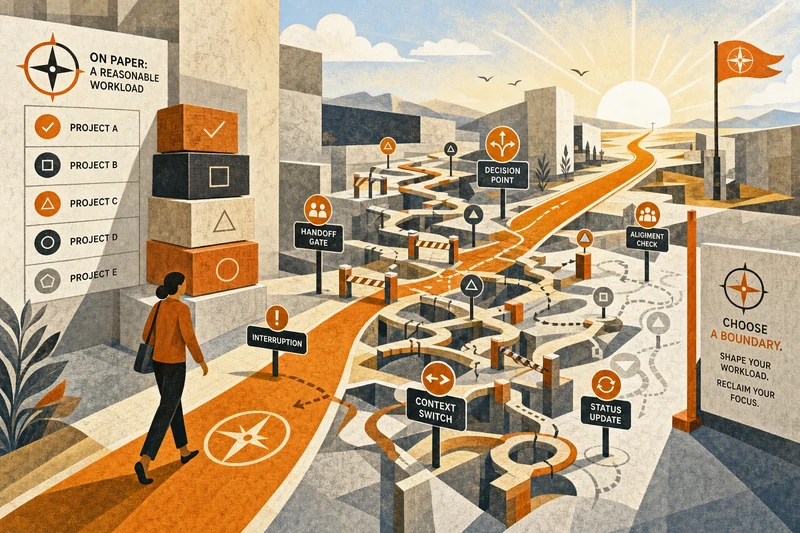
Repeated work mistakes often come from four boring, powerful conditions:
- You are carrying too much.
- Your attention is being sliced into confetti.
- The expectations are vague enough to produce fake failures.
- Work no longer feels settled, so your brain is bracing while trying to do routine tasks.
If you diagnose this as a personality defect, you will prescribe nonsense. So let’s not do that.
Overload makes smart people look sloppy
Too much work does not always make you visibly frantic. Sometimes it makes you eerily robotic.
You answer quickly to look responsive. You keep twelve open loops in your head because writing them down feels slower. You tell yourself you will slow down after this one last thing, then another thing appears, then another. By late afternoon your brain feels like a browser with forty tabs open, two frozen, and music playing from somewhere you cannot find.
Hypothetical example: Jordan, an operations coordinator, is covering his job and part of a colleague’s leave. He sends a board packet and attaches the internal draft budget instead of the approved version. The wrong file still has comments in the margins. The board chair replies. Jordan’s face goes hot. He spends the next hour fixing the packet and quietly imagining his reputation falling down an elevator shaft.
From the outside, that can look like carelessness.
From the inside, it often looks more like capacity failure. Jordan had switched tasks repeatedly, skipped lunch, and tried to finalize a high-detail document while responding to messages. He had simply blown past his attention budget for the day.
Count what you are actually carrying this week — not just projects, but follow-ups, approvals, side asks, scheduling, status updates, emotional smoothing, “quick questions,” and all the invisible glue work that somehow never counts as workload until it starts breaking you. If the list makes you slightly angry, that is useful information.
Fragmented attention turns competence into static
Some mistake streaks are really context-switching injuries with a bad publicist.
You are in email, then Slack, then comments, then a meeting, then back to the spreadsheet, then someone pings “urgent?” about something that is not urgent in any ethical sense of the word. After enough switching, your brain loses continuity. You still know how to do the task. You just cannot hold the whole thing steady long enough to do it cleanly.
A hypothetical example: a client success coordinator is updating a deck for a Monday renewal call. Midway through, her manager asks for churn numbers. Then the client emails with a contract question. Then another message comes in about a reporting discrepancy. She returns to the deck, exports it, sends it, and later learns she attached the previous week’s version — the one that still shows an unresolved issue the team already fixed.
Now she feels sick, because this is the second version-control mistake in ten days, and her brain has already started drafting a memoir called How I Became the Person Nobody Trusts With Files.
But this is often not a trustworthiness problem. It is what happens when work that requires continuity gets smashed into fragments.
Run a small experiment instead of making it moral. Pick one task that has become error-prone. Do it in a 30-minute protected block with notifications off and no inbox open. Then compare the result with what you usually produce while bouncing between channels. You are not testing discipline. You are checking whether the environment is making accurate work unnecessarily hard.
Vague expectations create fake mistakes
A lot of “mistakes” are really ambiguity wearing a fake mustache.
A manager says, “Can you put together a quick update for leadership?” You hear one concise paragraph. They meant a three-slide summary with a recommendation, one explicit risk, and a decision request. You submit what seemed reasonable. It comes back bleeding edits. Now you feel dim, when the real problem is that “quick update” is not a brief. It is a weather pattern.
This is brutal early in your career because you are trying to look competent and low-maintenance. So instead of clarifying, you fill in blanks yourself. Then when those guesses miss, you absorb the mismatch as evidence that you lack instinct.
Sometimes you do miss obvious cues. More often, nobody defined “good” tightly enough for a first draft to land cleanly.
Replace vague agreement with one adult question: “Before I start, can I confirm the format, audience, and decision this needs to support?” It is not needy. It is efficient. If you hate asking follow-up questions because you worry it makes you look inexperienced, ask yourself a better question: does looking self-sufficient for thirty seconds matter more than avoiding two hours of wrong work?
Feeling watched can quietly scramble your brain
This one gets brushed off because it sounds soft. It is not soft. It is cognitive.
If your manager snapped at you in a meeting last week, if a teammate keeps correcting you in that thin, icy tone that makes you feel eleven years old, if you suspect trust is slipping, your brain does not store that stress neatly in a separate folder labeled emotions. It spills straight into attention, memory, timing, and judgment.
You start fumbling simple things. You reread normal emails for hidden criticism. You lose words in conversations you would usually handle fine. Then you make another mistake, and your brain treats that as confirmation that the fear was right all along.
Ask something more precise than “Am I stressed?” Ask: When did work stop feeling settled? Not dangerous in a dramatic movie sense. Just unsettled enough that you are bracing while doing ordinary tasks. That answer may explain more than another week of self-lecture.
Not every pattern means the same thing
This is where lazy career advice becomes completely useless.
“Be more confident” is nonsense if the real problem is chaotic handoffs.
“Tighten up” is lazy if the brief changes halfway through the task.
“Trust yourself” is hollow if you genuinely need to build a skill.
You need pattern recognition, not slogans with good posture.
Same role, two different problems
Elena is a marketing coordinator.
Pattern A: real skill gap
Even on calm weeks, her written project updates confuse people. Teammates keep asking the same questions: What decision is needed? What is delayed? What is the risk? Her manager has given the same feedback across multiple projects, under different conditions. This is not bad luck. Elena has not yet learned how to write an update that gets to the point fast.
Pattern B: context-driven error spike
During launch week, Elena keeps making version mistakes. She links the wrong file, pastes an outdated date into the rollout sheet, and sends a status note before final approval comes through. These misses happen when she is switching constantly between Slack, spreadsheets, review docs, and scattered requests. In calmer weeks, this pattern mostly disappears.
Same person. Same title. Completely different problem.
And the fixes are different too. Pattern A needs examples, coaching, and repeated practice. Pattern B needs workflow changes, clearer sequencing, and less fragmentation.
Here is the sorting question worth using next time you spiral: If this task happened on a calm morning, with clear instructions and enough time, would I still make the same mistake? If the honest answer is yes, train the skill. If the honest answer is no, change the conditions. If the answer is “some of both,” congratulations — you are having a normal human work problem.
The nastiest part is what mistakes do to belonging
After a few mistakes, fear often mutates.
At first you worry about the work. Then you start worrying about what the work says about your place in the room. Maybe I am behind everyone else. Maybe there are rules here I somehow never learned. Maybe they hired the interview version of me and are now meeting the real one. Maybe everyone can tell.
That is when embarrassment hardens into shame.
And shame is heavier because it is no longer asking, Can I fix this? It is asking, Do I deserve to be here at all?
Once belonging gets tangled up with performance, your memory turns crooked. You remember the correction in the meeting, not the three times someone came directly to you because they trusted you. You remember the typo somebody noticed, not the week of solid work nobody commented on because that is what steady work looks like. Shame is a rotten archivist.
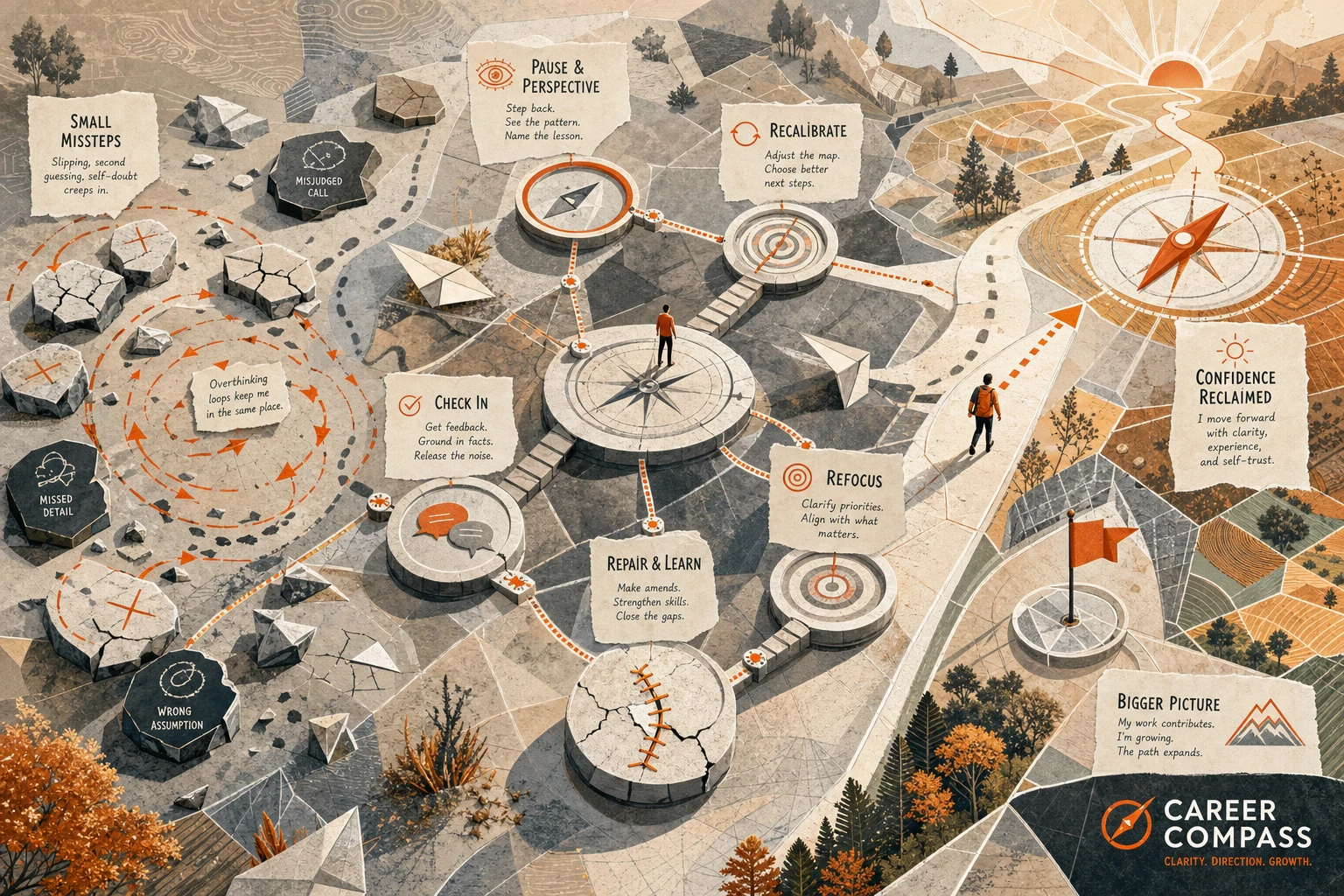
So interrupt it with evidence. Make two columns: Recent mistakes and Recent signs I’m trusted. The second list might include being invited to planning meetings, getting repeat work from the same person, being asked for your view, being looped into decisions that matter, or receiving ordinary corrections instead of formal escalation. This is not a self-esteem exercise. It is record-keeping. You are trying to stop shame from impersonating objectivity.
Accountability helps. Self-contempt does not.
A lot of ambitious people confuse these two so thoroughly they may as well have the same haircut.
Accountability says: “I sent the wrong file because I exported before final approvals came in, and I was using a messy naming convention. Next time I will wait for sign-off and label the final version clearly.”
Self-contempt says: “This is why nobody should rely on me.”
Only one of those makes future work better.
Harshness can feel oddly mature. It has that stern, managerial flavor. But self-attack is usually just vague thinking in a blazer. It creates intensity without insight. It makes you feel busy while teaching you nothing.
After a mistake, do a three-line review while the details are still fresh:
- What happened?
- What made it more likely?
- What will I change next time?
Keep it short enough that you actually do it. You are extracting a lesson, not auditioning for the role of your own least forgiving boss.
Confidence usually comes back after reliability does
This is not especially inspirational, but it is solidly true.
Most people want confidence first. They want to feel calm, capable, and self-trusting again so they can do better work. Usually the sequence is less flattering and more practical. Your work gets steadier. You make fewer preventable mistakes. Your body stops acting like every Monday is a low-budget thriller. Then confidence returns, because now it has evidence.
That is why the fixes are often gloriously unsexy:
- a pre-send check for high-stakes emails
- one naming convention for files
- five minutes before meetings to confirm the audience, decision, and current numbers
- one running doc for open loops instead of storing them in your nervous system
- protected blocks for work that falls apart when interrupted
- a template for weekly updates so you are not reinventing structure every time
Try This: pick the mistake that has repeated most often and build one ugly little system for it. One. Not a new personality. Not a 14-tab productivity overhaul. One system.
If you keep forgetting attachments, your final check becomes: recipients, subject, attachment, date.
If meeting takeaways keep evaporating, end each call by writing: decision, owner, deadline.
If your drafts keep missing the mark, ask for a strong sample before you begin.
Confidence likes proof. Hand it some.
Sometimes the workload really is the problem, and you should say so
There is a point where private self-improvement becomes the wrong tool.
If your mistakes are rising because you are covering two jobs, because priorities change daily, because requests come through six channels, or because key context arrives after the work has already started, then silent suffering is not professionalism. It is unpaid systems absorption.
Hypothetical example: Priya is an analyst supporting two directors during budget season while still carrying her regular reporting. Requests arrive through email, Slack, meetings, and drive-by interruptions. In one week, she uses an outdated assumption in a forecast, misses a risk flag buried in a message thread, and sends an analysis at 7:10 p.m. with one tab still showing draft formulas.
At first, she tries to become “more disciplined,” which is what conscientious people often do when the system is failing them. But discipline is not a magic trick. It cannot create capacity where there is none.
So in her next 1:1, she says:
“I want to flag a quality risk before it gets worse. Right now I’m balancing budget requests from both teams alongside the weekly reporting, and the amount of switching is creating more room for errors than I’m comfortable with. Last week I missed a note in the forecast and sent one file before a final check. Can we clarify priorities or move one deadline so I can protect quality?”
That works because it is concrete. No melodrama. No vague “I’m overwhelmed” speech that can be nodded at and forgotten. She names the pattern, gives examples, and asks for a decision.
If you need that conversation, do not wait until you are crying over leftovers on Thursday night and flinching at every Slack sound. Write down three examples. Book the meeting. Talk about quality risk and prioritization, not your worth.
If it is a skill gap, good. Now it has a name.
A named weakness is less frightening than a foggy sense that you are secretly bad at your job.
If the same issue appears under decent conditions, stop turning it into destiny. Make it trainable.
Not: I’m not good enough.
More like: My written updates bury the main risk.
Or: I gather data well, but my analysis stops at description instead of recommendation.
Or: In stakeholder calls, I leave without clear next steps because I get too hesitant to pin decisions down.
Once the problem has edges, you can work on it without the whole thing becoming a referendum on your future.
Ask one trusted person a sharper question than “Any feedback?” Try: “What is one pattern that, if I improved it over the next month, would make me noticeably more effective?” That question tends to produce a real answer instead of the usual polite mist.
Then practice in public enough that the skill can harden. Collect two strong examples. Build a template. Ask to compare your next draft against a better one. Repeat before your inner critic can turn the whole thing into a personality diagnosis.
The goal is not invincibility. It is accuracy.
A bad week at work can make you feel thin-skinned, fraudulent, and bizarrely alone. It can make Sunday evening feel chemically altered. It can make a normal 1:1 feel almost electric in its relief, because for ten minutes you are no longer guessing whether everyone has quietly decided you are a problem.
All of that is real.
What usually helps, though, is not a pep talk. It is accuracy.
Accurate about what actually happened. Accurate about what conditions were in play. Accurate about whether this is a skill problem, a systems problem, or an ugly little collaboration between the two. Accurate about what your recent work shows, instead of what shame keeps breathlessly insisting it shows.
That is the mindset shift worth keeping: a bad week of mistakes is not a final reveal. It is information. Sometimes the information is “you need a better process.” Sometimes it is “you need clearer instructions.” Sometimes it is “you are overloaded and need to say so.” Sometimes it is “yes, this is a real skill to build” — which is inconvenient, but still much less scary than the amorphous feeling that you are secretly failing at being a professional.
So start with the mistake that still feels hot and embarrassing. Write down what happened, what made it more likely, and what you want to change before the setup repeats. Then do the same for the next one, and the next. Over time, that habit does something important: it stops every rough week from turning into an identity crisis.
And that is how confidence comes back in a form you can actually trust — not as borrowed optimism, but as a quieter, sturdier belief that mistakes are data, not destiny.